Being the change

For her contribution to our series of guest posts, I asked Christine Watson, who owns, directs, and teaches at Be the Change Academy in Round Rock, to share the story behind her school's intriguing name.

Be the change you wish
to see in the world.

 —attributed to Mohandas Gandhi


This quote has always been a favorite of mine because of its inspirational and empowering message. It has fostered my belief that if I want to see something happen in this world, I need to start with myself.

As a public school teacher and administrator, I wanted to do more and make real changes to benefit all students. Unfortunately, the culture and bureaucracy surrounding public education hindered my transformative ambitions. I became frustrated with the limitations of public schools.

While attending a workshop on business and communication, I was assigned the task of creating an advertisement for something. I began writing an ad for my imaginary, ideal school, and the name “Be the Change Academy” echoed in my mind. A young man also attending the workshop loved the name I chose for my school. He informed me that he and his wife homeschooled their children and strongly supported alternative education. This gave me the encouragement and inspiration I needed to begin my journey to open a school that would truly reflect my core beliefs about children and the learning process.
Here at Be the Change Academy we understand that every individual has an inner genius and the potential to fulfill his or her personal mission. By starting to uncover that genius at an early age, students can be inspired to develop their personal talents, increase and deepen their knowledge, and cultivate leadership skills to truly make a difference in their own communities and in the world. We help to bring out that genius and nurture it through play, creativity, movement, and study.

I strive to live my life in accordance with Gandhi’s message. Founding the academy is my effort to “be the change I wish to see” in the way children are educated today and in the future. I am truly full of joy to have this opportunity to forge a new path in education that may enhance the lives of many others.

Christine Watson

What is place-based education?

For the second in our series of guest posts, I asked Caitlin Macklin to explain the concept of place-based education as she and her students practice it at the 9th Street Schoolhouse. Feel free to ask Caitlin questions about this topic by posting a comment below.

 
Place-based education is all about connecting people with the land and each other. At the 9th Street Schoolhouse, I build curriculum around the tangible resources available in our particular place, instead of reading it—abstract—in a textbook. Learning that starts with the offerings of the real world connects students and families to their environment: natural, built, and social. Those connections strengthen ties to community and result in a deep-rooted sense of who you are. That in turn allows for a sense of satisfying purpose and fulfillment in life. Place-based education is about knowing, belonging, and having a positive impact on where you grow up, so that this relationship activates an ethic of care in adulthood.

The way to make learning stick is to bring it in through the body, all five senses alive and humming. The shape of the streets, the contours of the land, the secret spots to find raccoon tracks, the smells of cold winter air tinged with cedar smoke: it all becomes so much a part of you that in adulthood you make choices to preserve community and protect land; you think about your actions rippling out to the people and spaces you love deeply. Your values trump any ambition for profit at the expense of others and limit out-of-control growth. It’s exactly that sense of place that Wendell Berry describes—the place IS you: you eat it and breathe it, and if you pay attention to it you don’t need any experts to tell you what it needs in return.

Place-based education is . . .

. . . reading a geologic map to find out where the igneous rocks are in town, heading out to Pilot’s Knob to look for the old volcano, walking on the limestone at McKinney Falls that’s imprinted with the track of the lava flow, examining granite crystals in the big boulders that fell off the train on the way to build the state capitol.

. . . catching and holding a wiggly lizard, looking at its form and function, filling a dish with water and putting it in a protected spot under a rosemary bush, out of harm’s way.

. . . walking five blocks down to Boggy Creek, playing hide-and-seek and identifying poison ivy, tossing rocks and watching them splash through algae on the surface. Taking water samples and measuring, graphing, and computing the data you collect. Using hand lenses to look at macro-invertebrates and drawing conclusions about water quality. Asking questions about where the bottles and chunks of metal, tattered cloth, and food wrappers come from, and what happens when creeks get polluted; where does the water go, and where does it come from? Organizing a trash cleanup and inviting neighborhood groups and local agencies to help. Writing letters to city officials to ask for changes in laws and calling nearby businesses to encourage them to reduce waste.

. . . getting to know your neighbors, the parents in your school community, the local business owners: Who can help fix a faucet? Who makes the best pot of beans? Who’s been to China? Who served in the Vietnam War? Who can donate scrap paper, fabric, wood?

Place-based education is teaching children to ask meaningful questions—to observe their unique surroundings—to notice the structures that circumscribe their lives. It’s helping them seek answers, creating opportunities for them to present their knowledge to real people, and applying it to community life.

Caitlin Macklin

Invented spelling

This is the first in a series of guest posts by local innovative educators. Thanks to Piaf Azul, director and teacher at Harmony Homeschool, for kicking off the series.


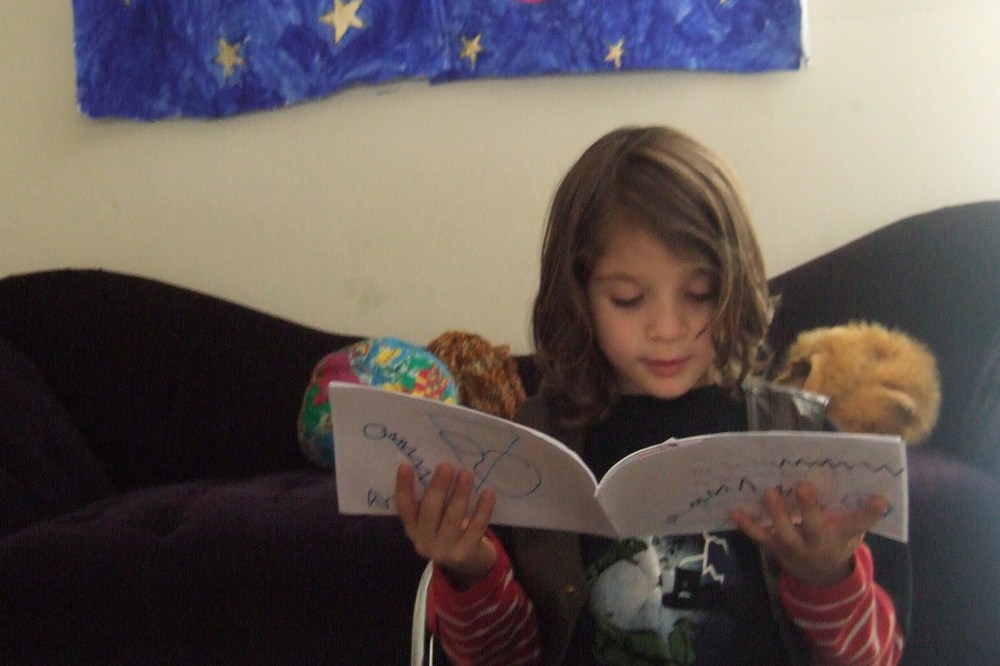
For beginners, writing can seem like just an exercise in hand-eye coordination (penmanship) and memorization (sight words). But that’s not what writing is at all.  It’s art: communication, self-expression, the creative process. At Harmony Homeschool, we change the paradigm with Writer’s Workshop. At first, the kids are often dubious, but soon they are eagerly clamoring for a chance to share their latest writing with the group.

The way we get from Point A (Does my a look round enough? Are there two l’s in hello?) to Point B (And then the dinosaur and the kitten flew away . . . ) is through invented spelling. One of the tenets of Writing Workshop is to just get your ideas on paper, using your best guess.  

It’s hard at first for kids to break their habit of asking, “How do you spell ______?” every couple of words, but eventually they  begin to write on their own. A hushed feeling of concentration descends on the group. Invented spelling gives children the freedom to experience writing as meaningful, the way any author does. Don’t worry; they will learn correct spelling eventually, through editing and through individualized spelling lists pulled from their writing.

At the end of the semester, we invite the parents to join us for an Author Share, where the kids read their stories to the audience. The looks on their faces as they command everyone’s attention make it clear that they understand that writing is power!

Piaf Azul