The chance to feel frustrated

I’m pleased to welcome the illustrious Kami Wilt, of the Austin Tinkering School and Austin Mini Maker Faire, to Alt Ed Austin’s lineup of guest bloggers. Here she discusses the challenges and rewards of frustration. She'd love to hear about your experiences, so I encourage you to leave Kami a comment or question below.

Frustration - TinkeringSchool.jpg

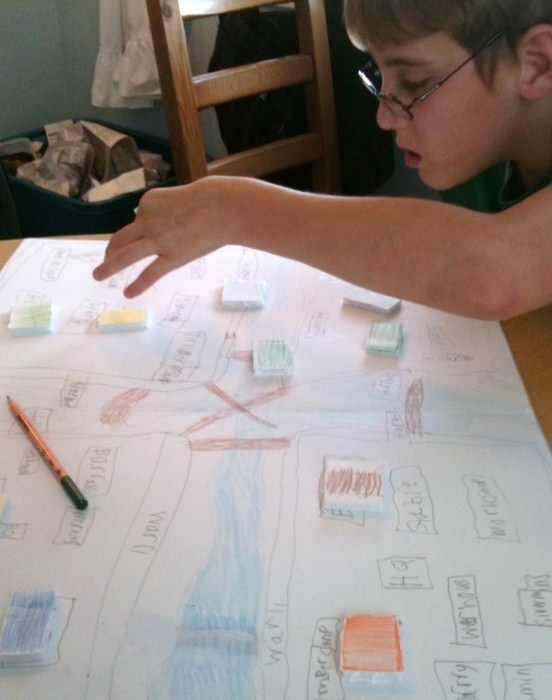
Recently I was leading a class and was, as usual, doing several things at once: plugging in the glue guns, showing someone how to test his battery with the multimeter, getting out the sharpies for the kid who has to decorate every inch of available space—the usual. This is the kind of usual that I totally love.

True to the tinkering ethos, we had an outcome in mind, but we left it open-ended as to how to arrive at that outcome. In tinkering, we try to create projects where kids are encouraged to design and create and problem-solve on their own. We consciously choose not to create too many projects (though sometimes they have their place) that are just follow-along-with-the-teacher activities (“Cut here, fold there, and now we all have a toy car that looks exactly the same! Wheee!”).

Anyway, I had a kid who was stuck. He hadn't been stuck for long. But he was stuck, and the expression on his face read, “Frustrated.” He was SO CLOSE, and I wanted so much to take his project out of his hands and just get it working for him. In fact, the urge to just get it going and spare us both the experience of feeling frustrated and stuck for even one second was almost unbearably uncomfortable. But I decided to ride it out for just a few moments more. Interestingly, he didn't disengage or walk away from the table. I stood next to him and quietly looked at his project with him. I didn't talk a lot or offer suggestions (and he didn't ask for any). I'm sure you can guess the moral of this story: After a few moments of rumination and meditation, the next step revealed itself. His excitement and ownership of the project were not infringed on by me, and now he has a cool experience in his memory bank of working through frustration successfully.

Why is it so hard for us to let our kids feel frustration? It makes me break out in an icy sweat sometimes, and I supposedly have experience in these matters. Luckily, I have my mentor, Gever Tulley, who created Tinkering School and Brightworks in San Francisco, to inspire me and keep me motivated to create experiences where kids have time and space to work on projects (and all the accompanying successes and failures) in their own way, free from an overabundance of adult imposition. An ability to manage and work through frustration is essential to almost anyone in our world who gets anything done. As I overheard one kid say to another recently, “A genius is someone who tries something and if it doesn't work out, he tries something else. And if that doesn't work out, he tries something else. And if that doesn't work out, he tries something else.” Couldn’t have said it better myself!

I think we disrespect children when we assume they can't handle a moment of frustration. It can be really beneficial for a child to have space to think through something on her own, without having an adult jump in and prod her along. We adults can at times be overzealous in our roles as supervisors and facilitators of experiences. As Gever said in one of his great TED talks, “We, the adults, are superheroes, endowed with the power of supervision. Let us use our powers wisely and be amazed at what children can do.”

Kami Wilt

Creating school culture

This guest post by Tom Bohman provides a fascinating case study of the judiciary process in action at the democratically run Clearview Sudbury School, where Tom serves on the staff.


When I read the complaint form to our Judiciary Committee (JC), I knew the day had come when our school would have to decide a thorny issue: How do school rules apply to virtual worlds in multi-player online games? Before telling more about this particular issue, let me explain about our school’s uniquely American way of protecting individual rights while also balancing them with other potentially competing school community concerns.

Students and staff conduct a Judiciary Committee hearing at the Clearview Studbury School

At the Clearview Sudbury School, rules are democratically determined at the School Meeting, in which staff and students have an equal vote. The School Meeting delegates to the JC the responsibility of ensuring that students and staff follow rules and providing a forum to address School Meeting members’ concerns about their rights. Two students and one staff member comprise the JC, and they vote on whether a rule was broken and, if one was, determine a consequence when necessary. A complaint form specifies who is raising the issue, whom the complaint is against, witnesses, and the details of the situation. All School Meeting members can attend JC hearings and ask questions or provide commentary. All students, no matter their age, are expected to serve on the JC, including our youngest students, who may be five years old.

This particular complaint was initiated by an eight-year-old female student (whom we’ll call Amy) against a nine-year-old male student (whom we’ll call Eric) regarding actions that took place in Minecraft, a game that can be played in different ways. Minecraft provides a rich virtual world in which students typically construct amazing structures, especially their houses, in which they invest much creative thought and energy. The game also contains a player versus player (PvP) component in which players compete against each other. Amy's complaint said that Eric had harassed her during the game when, after being invited into Amy’s house, he killed her online character and took resources from the house. I was randomly selected by the JC chair, a nine-year-old student we’ll call Steve, along with a six-year-old student we’ll call Sally, to hear the case.
 
The JC room was full as Amy and Eric in turn described what happened from their perspectives. Amy reported that she had changed the inside of her house on the Minecraft server that many students played on and invited Eric to see those changes. Amy also said that students on the server typically engaged in creative activities in an open-ended and non-competitive fashion. Eric said he was trying to work on his house and needed the resources that Amy had acquired and decided to take them so he could reach his goal. My reaction was that Eric had violated Amy’s rights to be free from interference by others at school as she pursued her self-directed learning. Eric’s defense, which other School Meeting members strongly supported, was that Eric was playing by the rules of the game as allowed on that particular Minecraft server because PvP mode was turned on (not all Minecraft servers allow this). Since Amy chose to play on that server where PvP was allowed, she had the responsibility to accept that other players could play competitively. I argued that our school should be developing a culture in which our interpersonal relationships count the most, and Amy had asked Eric to stop his activity, which Eric ignored. Eric and other school meeting members said that it was unfair for him to be penalized for following the rules of the game that Amy had implicitly agreed to by playing on that server.
 
After a long, emotional debate, the three JC committee members voted that Amy had been harassed. Since this was the first time this issue was raised and it was clear that Eric did not know that the harassment rule would be applied in this case, he was given a warning as a consequence.

However, we weren’t quite done. As part of our school’s commitment to due process, where everyone’s rights are protected to the full extent possible, any School Meeting member can appeal a JC decision to the full School Meeting in which everyone, rather than just the three JC members, has a vote. Even though JC members are selected so that they shouldn’t have any conflict of interest or appearance of partiality (e.g., a JC member cannot have written the complaint), we know that in a smaller school, the person receiving the consequence may feel the process was unfair and in such a case we provide the appeal process. In addition, anyone can appeal the verdict. In this case, a staff member and older student appealed, as they felt this case set an incorrect precedent for the school.
 
The School Meeting was fully attended, and the motion was made (and seconded) to overturn the JC decision that a rule had been broken. The debate was almost as intense as the first one, and additional nuances were brought forward to bolster each side’s position. A majority of the School Meeting participants voted for the motion that overturned the previous JC decision. I felt the sting of defeat for my position and still believe that greater weight should have been given to Amy’s request that Eric stop his actions even when they were permitted by the server. However, the counterargument that Amy needed to take responsibility for playing on that particular server and knowing the rules was persuasive to the majority. Given that students have the freedom to choose what they do during the day at our school, they also have the responsibility to be aware of the consequences of those decisions.

Ultimately, I think Amy felt her concerns were heard and taken very seriously. I think our school’s culture was strengthened by this case in which staff and students were on both sides of the debate. JC is where our culture of freedom and responsibility develops over time as everyone engages in the often difficult decisions of how to balance competing rights and how we define them. At our school, we feel this process is the best way to ensure that everyone is fully respected and heard. I personally hope we revisit this issue in the future since I’m still not convinced we made the best choice. However, I really value that each member of the school has a single vote and that no member of the school community (even staff) can arbitrarily decide that his or her viewpoint outweighs the collective democratic decision making that is an integral part of our school. Democracy is messy, but it still feels like the best way to arrive at decisions.

Tom Bohman

Being the change

For her contribution to our series of guest posts, I asked Christine Watson, who owns, directs, and teaches at Be the Change Academy in Round Rock, to share the story behind her school's intriguing name.

Be the change you wish
to see in the world.

 —attributed to Mohandas Gandhi


This quote has always been a favorite of mine because of its inspirational and empowering message. It has fostered my belief that if I want to see something happen in this world, I need to start with myself.

As a public school teacher and administrator, I wanted to do more and make real changes to benefit all students. Unfortunately, the culture and bureaucracy surrounding public education hindered my transformative ambitions. I became frustrated with the limitations of public schools.

While attending a workshop on business and communication, I was assigned the task of creating an advertisement for something. I began writing an ad for my imaginary, ideal school, and the name “Be the Change Academy” echoed in my mind. A young man also attending the workshop loved the name I chose for my school. He informed me that he and his wife homeschooled their children and strongly supported alternative education. This gave me the encouragement and inspiration I needed to begin my journey to open a school that would truly reflect my core beliefs about children and the learning process.

Here at Be the Change Academy we understand that every individual has an inner genius and the potential to fulfill his or her personal mission. By starting to uncover that genius at an early age, students can be inspired to develop their personal talents, increase and deepen their knowledge, and cultivate leadership skills to truly make a difference in their own communities and in the world. We help to bring out that genius and nurture it through play, creativity, movement, and study.

I strive to live my life in accordance with Gandhi’s message. Founding the academy is my effort to “be the change I wish to see” in the way children are educated today and in the future. I am truly full of joy to have this opportunity to forge a new path in education that may enhance the lives of many others.

Christine Watson

What is place-based education?

For the second in our series of guest posts, I asked Caitlin Macklin to explain the concept of place-based education as she and her students practice it at the 9th Street Schoolhouse. Feel free to ask Caitlin questions about this topic by posting a comment below.

 
Place-based education is all about connecting people with the land and each other. At the 9th Street Schoolhouse, I build curriculum around the tangible resources available in our particular place, instead of reading it—abstract—in a textbook. Learning that starts with the offerings of the real world connects students and families to their environment: natural, built, and social. Those connections strengthen ties to community and result in a deep-rooted sense of who you are. That in turn allows for a sense of satisfying purpose and fulfillment in life. Place-based education is about knowing, belonging, and having a positive impact on where you grow up, so that this relationship activates an ethic of care in adulthood.

The way to make learning stick is to bring it in through the body, all five senses alive and humming. The shape of the streets, the contours of the land, the secret spots to find raccoon tracks, the smells of cold winter air tinged with cedar smoke: it all becomes so much a part of you that in adulthood you make choices to preserve community and protect land; you think about your actions rippling out to the people and spaces you love deeply. Your values trump any ambition for profit at the expense of others and limit out-of-control growth. It’s exactly that sense of place that Wendell Berry describes—the place IS you: you eat it and breathe it, and if you pay attention to it you don’t need any experts to tell you what it needs in return.

Place-based education is . . .

. . . reading a geologic map to find out where the igneous rocks are in town, heading out to Pilot’s Knob to look for the old volcano, walking on the limestone at McKinney Falls that’s imprinted with the track of the lava flow, examining granite crystals in the big boulders that fell off the train on the way to build the state capitol.

. . . catching and holding a wiggly lizard, looking at its form and function, filling a dish with water and putting it in a protected spot under a rosemary bush, out of harm’s way.

. . . walking five blocks down to Boggy Creek, playing hide-and-seek and identifying poison ivy, tossing rocks and watching them splash through algae on the surface. Taking water samples and measuring, graphing, and computing the data you collect. Using hand lenses to look at macro-invertebrates and drawing conclusions about water quality. Asking questions about where the bottles and chunks of metal, tattered cloth, and food wrappers come from, and what happens when creeks get polluted; where does the water go, and where does it come from? Organizing a trash cleanup and inviting neighborhood groups and local agencies to help. Writing letters to city officials to ask for changes in laws and calling nearby businesses to encourage them to reduce waste.

. . . getting to know your neighbors, the parents in your school community, the local business owners: Who can help fix a faucet? Who makes the best pot of beans? Who’s been to China? Who served in the Vietnam War? Who can donate scrap paper, fabric, wood?

Place-based education is teaching children to ask meaningful questions—to observe their unique surroundings—to notice the structures that circumscribe their lives. It’s helping them seek answers, creating opportunities for them to present their knowledge to real people, and applying it to community life.

Caitlin Macklin

Invented spelling

This is the first in a series of guest posts by local innovative educators. Thanks to Piaf Azul, director and teacher at Harmony Homeschool, for kicking off the series.


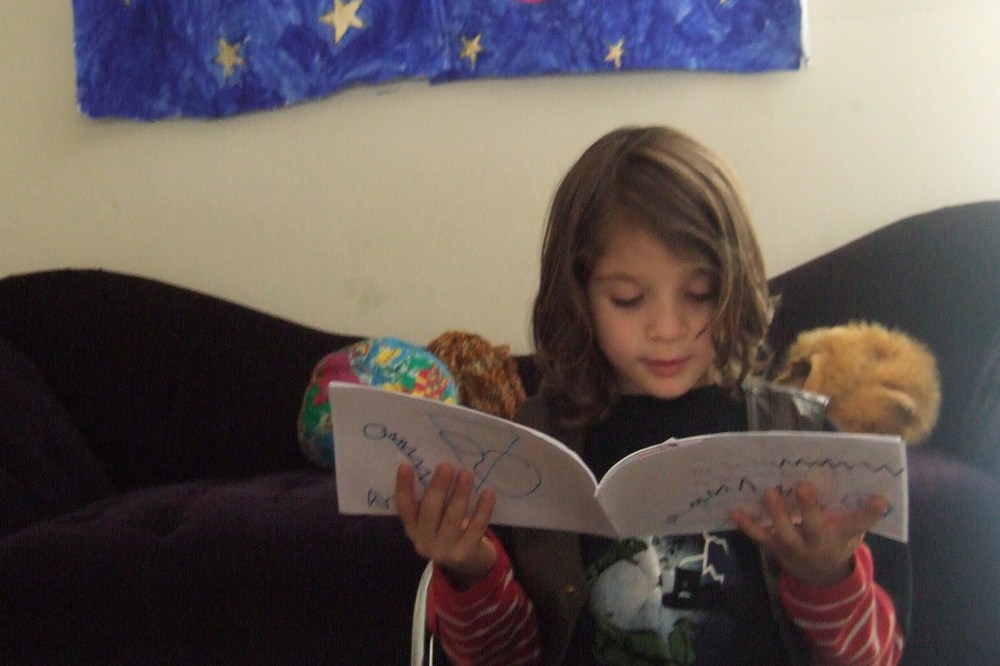
For beginners, writing can seem like just an exercise in hand-eye coordination (penmanship) and memorization (sight words). But that’s not what writing is at all.  It’s art: communication, self-expression, the creative process. At Harmony Homeschool, we change the paradigm with Writer’s Workshop. At first, the kids are often dubious, but soon they are eagerly clamoring for a chance to share their latest writing with the group.

The way we get from Point A (Does my a look round enough? Are there two l’s in hello?) to Point B (And then the dinosaur and the kitten flew away . . . ) is through invented spelling. One of the tenets of Writing Workshop is to just get your ideas on paper, using your best guess.  

It’s hard at first for kids to break their habit of asking, “How do you spell ______?” every couple of words, but eventually they  begin to write on their own. A hushed feeling of concentration descends on the group. Invented spelling gives children the freedom to experience writing as meaningful, the way any author does. Don’t worry; they will learn correct spelling eventually, through editing and through individualized spelling lists pulled from their writing.

At the end of the semester, we invite the parents to join us for an Author Share, where the kids read their stories to the audience. The looks on their faces as they command everyone’s attention make it clear that they understand that writing is power!

Piaf Azul