Building meaningful education

Not many schools have wood shops these days, and it’s even rarer to find one populated by elementary school chldren. When I asked Jennifer Hobbs, who directs the Progress School in Central Austin, to explain why the wood shop is an important part of the learning environment there, she responded with this lovely guest post.

This crutch is an example of the Progress School students’ handiwork.

I love our whole school, but one of our most magical spaces is the wood shop. An open-air building, workbenches, shelves, cabinets. Hammers, saws, drills. Sandpaper, nails, glue. Brushes, canvases, paint. Books, paper, wood. The possibilities are as endless as the imagination of a child.  

We’ve made tables, chairs, cars, planes, castles, crutches, boxes, shields, birdhouses, bathouses, dollhouses, sculptures, board games—the list could take up the rest of this post.

Why build? Many skills are developed in wood shop projects: planning, problem solving, measuring, geometry, fine motor, hand-eye coordination, and so on. But one of the most important reasons to build is that the experience of building is so empowering. An idea, just a seed in your mind, taking root in schematics, then blossoming into form—you can touch it and use it and it works! It is more than an idea now, it is something solid and real, and you made it! The satisfaction from such an experience is worth more than gold stars and good grades.

This is meaningful education.

It starts with the student. She is playing a game, pretending her leg is broken, and she needs crutches! Another student learned about gladiators, and he must make a shield! And another loves the birds, so we make birdhouses!

It is nurtured by experiences. We found some pieces of pecan wood while taking a walk—what can we make with it? We visited an art exhibit—what kinds of sculptures can we make?

It inspires new growth. The skills from the last project will most certainly be useful in future projects. Whenever we finish a project, there’s a sense that we are really just beginning, always with the thought, “What’s next?”

So what do you want to build?

Jennifer L. Hobbs

Fall down seven times, get up eight

Deborah Hale, executive director and cofounder of The Inside Outside School, submitted this thoughtful guest post about how her school deals with “the daily drama.”

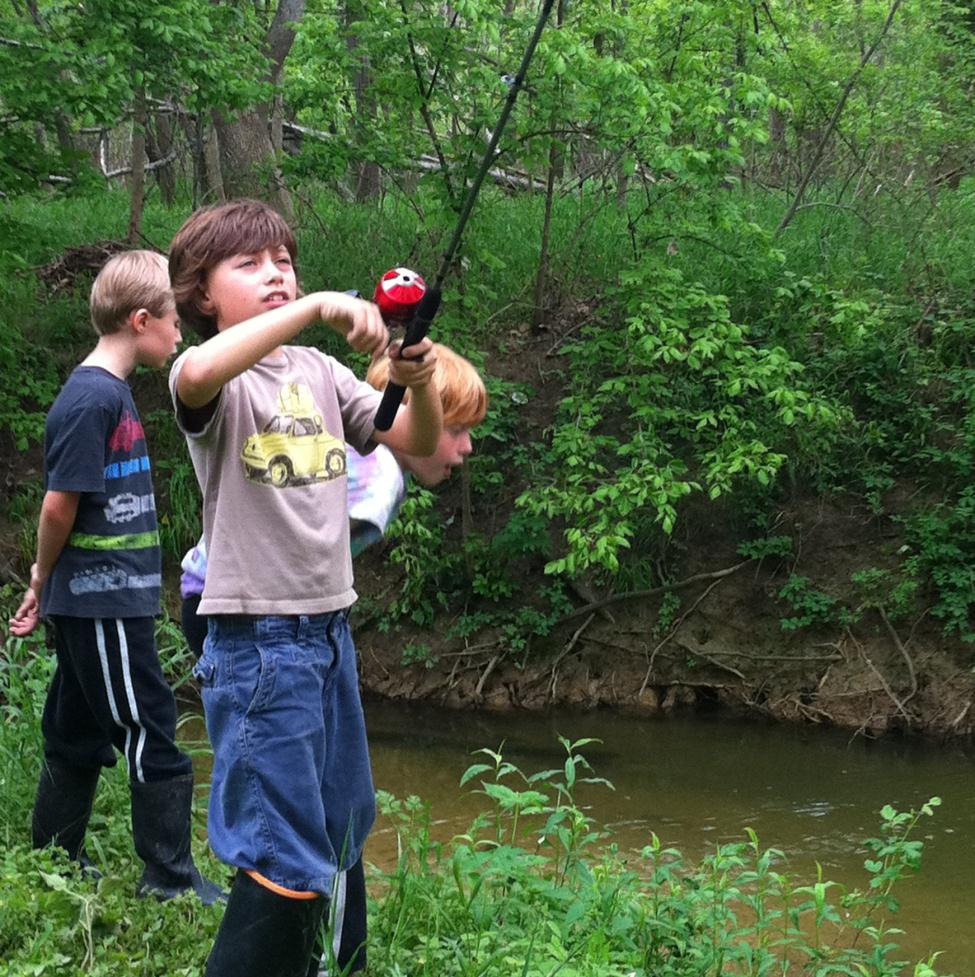
Fishing and observing wildlife in the creek are some of the calming and centering activities available to children at the Inside Outside School.

At the Inside Outside School we help our students become positive contributors to the world by supporting their growth in seven dimensions of human greatness. We introduce one dimension every week for a special focus when we have our Monday democratic meeting, which we call “The Hive.” For the past two weeks we have been working with the dimension of interaction, which Lynn Stoddard, author of Educating for Human Greatness, defines as “Promoting courtesy, caring, communication, and cooperation. Fostering a sense of community.”

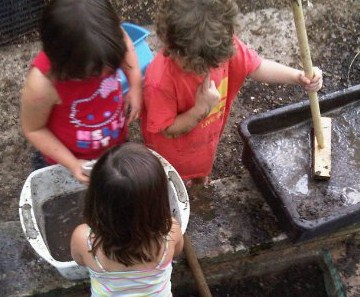
With our younger elementary students, learning to regain composure is an ongoing big issue. We have many things in place to help them with this, like safe places where students can go when they are angry, sad, or overly frustrated. We have a zen garden box where students can rake sand and arrange stones. We have a great big dirt pile with shovels. We teach breathing exercises, calming activities such as squeezing a pillow and tapping shoulders with crossed arms, and conflict resolution scripting for being at “the equator” (an imaginary line either side of which children in conflict can stand to work toward a resolution without having an adult swoop in to fix it for them). We have mediation-trained older students who help out when the equator is not enough. We have acres of calm green woods, a bubbling creek, gardens, chickens, and hands-on classes where kids get to make things like herbal salve to put on fire ant bites, quilts, slit drums, boats, and apple pies. Above all, we have no tests and no homework.

And we still have the daily drama. It's a mystery.

There are myriad circumstances that activate the fight-or-flight response, which seems to fuel the drama. Norepinephrine, a neurotransmitter, is released when the inner alarm system is triggered. Sometimes a child will feel a threat to his or her safety, esteem, or position of power, or maybe perceive a threat where there is none. Once activated, the response can seem violent or inappropriate. Things that seem minor to adults take on major proportions in the life of a child. So working on interaction as a dimension of human greatness requires looking at the children with loving eyes, knowing that each one is complicated and that even when they act out, do hurtful things to their friends, and push every one of our buttons, they are simply trying to get their needs for power, approval, and security met—needs we all have.

A Japanese proverb says, “Fall down seven times, get up eight.” This speaks to resilience. Our effort at the Inside Outside School is to help children learn strategies for getting back up again, learn how to help those who have fallen, learn when it is best to give others space to feel what they are feeling about having fallen down, and, ultimately, to care deeply about the well-being of each member of our community.

Deborah Hale

A space for true collaboration

Emily Hurd teaches for the Austin Tinkering School and also runs Creatures Habitat. Adapted from a photo essay she recently published on her own blog, this guest post takes a close look at a pivotal moment of collaborative decision making during a Spring Break camp for three- to seven-year-olds that Emily codirected.


Today the kids destroyed half of Cardboard City

. . . and relocated the other half to the top of the hillside overlooking the house.

The kids were not unified in their desire to destroy the town. They came to this decision during a town hall meeting in which they reached consensus about which direction to go with the project on the second day of its existence.

This is what Cardboard City looked like when we assembled and painted it yesterday morning:

This morning, a couple of kids began to destroy the city—excitedly so, with “evil” voices and heh-heh-heh laughter. They wanted to see how quickly the cardboard would biodegrade. Needless to say, those who were not ready to be finished with the project were fuming.

I called a town meeting to try to reach resolution before people got really angry. I pointed out that some people wanted to destroy the town and others did not think that was OK. They were then free to discuss. I moderated the discussion, made sure every voice was heard, and kept us moving along in a timely manner. My partner, James, and I wanted to honor the authenticity of this learning experience that had bubbled up naturally.

The kids really seemed to enjoy it. Almost everyone spoke up about how he or she felt about the issue. After a long, long while, we urged the group to come to an agreement. We asked them how long they needed to reach a decision. Three minutes. James and I left them to discuss and argue, and shortly returned to inquire about their decision. They would count the number of houses and divide that in half. One half would be relocated to the hillside as the remaining town; the other half would be destroyed. The group had reached consensus. They were thrilled! It was one of those electric moments when you can hear the energy buzzing about.

The destroyers even helped the preservationists relocate their homes.

The new town was relocated to the top of the hillside by the chicken coop.

The old town was destroyed with water and might.

A rebel in the group started salvaging houses that weren’t yet destroyed and moving them up to the new town.

A preservationist returned to the destroyed town to mark its existence with a green plant.

The beauty of this process for me was that the kids were able to work through so many issues together, and with a minimal amount of interference from adults. It was a collaborative project. The kids created the town, and then, when they began to disagree about what direction to go with the project, we worked together in a playful way to come up with a resolution—on their terms.

The project grew into something that clearly illuminated that we can have different feelings and desires, we can express them to one another, and we can reach agreement on how to move forward together. It was true collaboration!!!! So beautiful!

Emily Hurd

The art and science of giving

One of the many practical skills students learn at The Living School is the art and science of giving. Director and teacher Paula Estes guest blogs about how and why service projects form a core part of the curriculum at this unique microschool.

Life's most persistent and urgent
question is: What are you doing
for others?

                —Martin Luther King Jr.

When Teri asked me if I was interested in writing a guest blog post for her fabulous new website, I knew immediately what I wanted to write about. Service projects are a vital and regular part of our school community, but like many of the things we do at the Living School, they grew out of our everyday experiences.
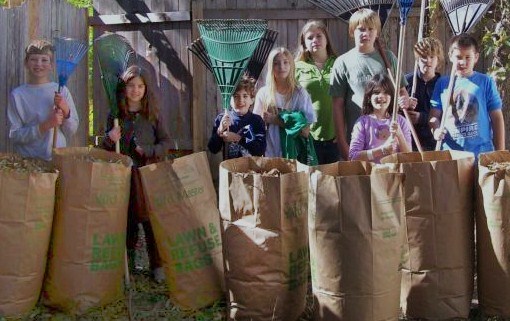
Raking leaves for neighbors is just one of The Living School’s frequent and varied service projects.

Years ago when the kids were younger, we had conversations on our walks to the neighborhood park about litter and why people throw trash on the ground. This led to regular trash walks in our neighborhood to clean it up. We often plugged into seasonal opportunities to donate or volunteer. Each fall we gathered our too-small coats and donated them to Coats For Kids; each spring we gathered school supplies to donate to Manos de Cristo's Back-to-School program.

It wasn’t until about three years ago that I realized the potential for service projects as a regular part of our learning experience. In the month before winter break we were discussing our tradition of making gifts for each other, and one of the kids said, “Maybe we should just give the money we would spend on making gifts to people who need it.” That year at our winter family potluck we had our first Giving Tree. Kids individually researched and chose nonprofit organizations to which they would give small financial donations or volunteer their time. They shared with the group at a ceremony what they had learned about their chosen organizations and how they were working to solve particular problems in the world. I was amazed at the diversity of the kids’ chosen organizations and at the thought they had put into their selections. As a result of this positive experience, we began to weave regular service projects into our learning.

We often combine our projects with field trips to see how our work relates to the bigger picture. For instance, after gathering food for the Capital Area Food Bank, we took a tour and learned about the millions of pounds of food that are distributed each year, the thousands of volunteers who work to sort the food, the companies that lend trucks to transport it to smaller food pantries, and the local businesses that give food that would otherwise spoil and end up in a landfill. Trips like these give us a sense of what one person—connected with a larger organization—can do. Suddenly we no longer feel powerless.

Service projects also create great opportunities to build on kids’ interests, which can lead us down diverse and unexpected paths. For example, many of my students feel a strong connection to animals, so we have been drawn to making treats for chimps at a primate sanctuary and helping Austin Pets Alive! in various ways.

Other projects arise as a result of a current event or natural disaster. Building toiletry kits for earthquake victims in another country or collecting books and toys for a child who has lost it all in a local fire can help kids feel empowered in a situation they may find scary or overwhelming.

In preparation for writing this post, I asked the kids what their favorite service projects were. They almost unanimously chose the big Heifer International family fundraising effort we conducted over the recent winter holidays. These are a few of the reasons they gave:

  • “It helps you learn about people in another region of the world.”
  • “It helps people, it’s not just charity . . . it helps them to help themselves.”
  • “It has that ripple effect of the gift.”
  • “Writing the letters helped us with our writing skills.”
  • “You let us choose how to raise the money.”

This last comment came from a kid who took a unique approach to earning the money. Adam asked the owner of his neighborhood corner store if he could set up a lemonade stand on a Saturday in front of the store. Not only did the owner allow it, but he also donated the cups and ingredients to make the lemonade. With each customer, Adam was able to share his project, his goal, and information about Heifer International. He had a vision, and he made it happen!

When Teri asked me to relate why I felt it was important to include service projects in the curriculum, I was reminded of a conversation I had with a youth from a local high school one Saturday while working in a community garden. When I asked him how he chose this project, he simply said, “I have to complete a certain number of hours to graduate, and this looked like the least boring of the choices.” My reaction was: how sad. I don’t want our children to do service projects simply because they will look good on their college applications.

These are some of the reasons we do service projects at our school:

  • They help connect us to our local community and to see ourselves as part of the larger world community.
  • They build empathy and compassion by introducing us to the challenges and concerns of others.
  • They encourage goal setting, problem solving, independence, and creativity while drawing on students’ interests.

Making this list made me wonder what the kids thought—so I asked them. Here are a few of their answers:

  • “With friends, the work of service projects feels more fun and less like a chore. Once you do it with school friends you might be more likely to do it with your family another time.”
  • “It gives you a challenge—how am I going to work toward this?”
  • (and my all-time favorite) “When you do it and you are being educated about it, you will grow up to do it and teach that to your kids!”

I couldn’t have said it better myself.

Paula Estes
My search for alternative high schools

Elliot Hallmark, a staff member at the Clearview Sudbury School, contributed this guest post on the scarcity of and need for alternative schools that serve teenagers. Welcome, Elliot!

Two years after graduating from university, I was considering my options. I had been accepted into the University of California at Merced to study nonimaging optics. It seemed like a great opportunity, but I felt a strong concern that the engineering companies I would inevitably end up working for were not worth my life energy. The revolutionaries I admired all spoke of an attitude toward science that would bring freedom to humanity. Unsure of my final path, I decided teaching high school science would allow me to explore this possibility. I went looking around for alternative high schools in Austin.

I had heard of Sudbury schools and free schools. Democracy and freedom, both core principles in these types of schools, stand out to me as values necessary for the dignity of humans, including high school students. The teenage years are a period when freedom of thought and action is of great importance. High school was the time in my life when my mind was reaching out most for ideals, trying to figure myself into the creation of a better world.

Over months of research it seemed that I must be searching poorly. I found numerous alternative schools for students under 13. I found college prep private schools. I found the public "alternative high school" attempts at places for kids who could not or would not fit into the standard model. I found that the more established alternative models sometimes, sometimes, sometimes find their way to the high school level. But I did not find the high school community of freedom, equality, and respect I was looking for.

It was nearly two years later that I did finally find a fledgling democratic school, for ages 5–19. It is just what I had hoped to find. At Clearview Sudbury School, where I now work, as students and staff we cultivate freedom through democracy and respect.

I have heard high school aged students at our school say that the younger students sometimes look up to them. They are a model that matters to more than themselves. These teenagers have skills that are useful and interests that are interesting. I have seen them take an equal part in some managerial aspects of the school. I have seen them use their time and energy to pursue online classes, college classes, and performance arts, as they felt suited them. They correct me sometimes, and they tell me about interesting things I didn’t know. I see that the freedom to learn that is the foundation of being an adult also prepares the young to be adults, and I wonder why institutions like this are so incredibly few.

The standard model has produced hundreds of millions of adults who are intelligent and reasonably successful. I myself survived to become a person I am quite happy to be. Yet most thoughtful people I know consider high school to have been largely a waste of their days, sprinkled only sparsely with deeply enriching encounters. (Not to mention, the standard model has churned out countless incompetent and dull examples as well.)

One tough issue that families interested in alternative education face is concern over the objective value of an alternative high school education. Students need to be accepted by colleges and offered jobs based on how they look on paper. But standard accreditation and state test scores interest neither employers nor most university admissions officers. It is the combination of emotional maturity, curiosity, life experience, and intelligence of the student that carries the day (and also SAT/ACT results, essays, interviews, portfolios, etc.).

Studies in this regard have been conducted on generations of students and graduates of the Sudbury Valley School. Sudbury Valley departs from the traditional high school model to the most extreme degree. Institutions requesting a transcript receive, instead, a letter saying, essentially, “It is not the place of our school or its staff to evaluate students.” Now, applying to a university without submitting SAT or ACT scores or without the required essays most likely would result in rejection. But generations of Sudbury Valley graduates have shown that the complete lack of any evaluation by this high school does not hurt. Something like 80 percent have gone on to higher education.

Alternative high schools of the type I envision are small and few in Austin, but they are growing and maturing. Though teenagers are still largely underrepresented in the struggle for a sane childhood, there are—and there deserve to be— real alternative high school options.

Elliot Hallmark

The playground as classroom

Michelle Mattalino, who contributed this guest post, is the owner and executive director of The Olive Tree Learning Center, an innovative Austin preschool that emphasizes outdoor learning and follows the Reggio Emilia approach to early childhood education.

On our playground, under the skyward reaching branches of the oak trees that span hundreds of years, I can hear the lilting laughter of children approaching. As the chatter and energy begin to increase, I know the students are about to flood out onto the playground in a wave of pure motion and purpose. Every student has a mission, it seems. Some flock to the trucks, some to the shovels, others to the playscape and swings, and often a small group will huddle in the playhouse. Each student chooses a mode of play, and then, as in a dance, switches partners, materials, and activity levels. It is perhaps the most fascinating part of my day and the main reason I have based my teachings on the child development work ongoing in Reggio Emilia, Italy.

One of the questions I receive most frequently is “What is Reggio?” The succinct answer is that Reggio is your child. Each child is different, reacting and responding uniquely to the environment and community. The Reggio Emilia model provides children with individualized platforms on which to explore and collaborate, along with guides who can hear and receive their experiences and provide reflection and more research to add to their learning; an environment that is carefully crafted with materials, sensory items, and tools to further their discovery; and a community that lifts them up with respect, understanding, and freedom.

Here at The Olive Tree, I have a deep love and admiration for the team of educators (we call guides) whom I am blessed to work with in applying the Reggio philosophy. The guides and I meet extensively to reflect and research on the words and actions of our students. We present and re-present materials, subjects, and topics that the students have found fascinating, either individually or as a group, and provide the children with the tools and structure necessary to further develop these burgeoning interests.

The guides document learning and exploration for the students and parents to see in pictures and written dialogue. This documentation becomes our pathway for further investigation into a topic, choice, or experience. We walk with them along this discovery path, hand in hand, asking questions and documenting the answers for further thought and focus.

At the end of the day, our children always say that their favorite part was playing. Yes, learning is playing, and the playground is where children assimilate all the information of the day through application and practice, whether they choose the trucks or the playhouse or something else.

With graduation around the corner, I reflect on what I would like my students to take with them from their time on our playground. My wish is for all my students to be able to hear their own voices, through a crowd or while alone; to remember that learning is about how you approach and think about a situation or problem, not necessarily how well you perform, and that mistakes are essential to the growth process and should be viewed as opportunities; to understand how to be safe and healthy; and most importantly, to know that they are capable, competent, and powerful in their own right.

Michelle Mattalino