Austin Mini Maker Faire 2013!

Today’s guest post comes from one of Austin’s most beloved educators: Kami Wilt, director of the Austin Tinkering School. She is currently reprising her role as producer of the Austin Mini Maker Faire, and here she shares the latest news about my favorite event of the year. Read to the end to find out how you can enter to win a family pack of tickets!


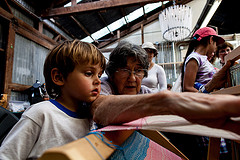
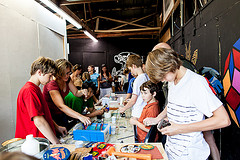
We’re super excited to be putting on our second annual Austin Mini Maker Faire on May 5, from 10 a.m. to 6 p.m., at the Palmer Events Center. 

Last year our first Austin Mini Maker Faire had over 2,000 attendees, more than twice as many as expected. It was a DIY extravaganza of hands-on projects, robots, electric vehicles, glassblowing, and so much more. This year we have over 100 Makers signed up, and we expect 5,000 attendees. (Not so mini, you might say!)

The Faire will feature:

  • A Robot Petting Zoo
  • Steampunk Village
  • Mega Swap-o-rama of clothes-hacking and fabric arts
  • FIRST robotics stage with robot battles and more
  • Tinkering: Open Shop
  • Eco makers of all sorts in our Sustainable Village
  • Young Makers and Education area
  • 2 stages, each with a full schedule of performers and speakers with a Maker element
  • A 30' x 30' inflatable Planetarium
  • Austin Bike Zoo, premiering their Interactive Carnival and Bike Wonderland
  • 3-D printers, weaving, soldering workshops, homemade telescopes, and much much more!


In the years to come, we look forward to the cross-pollination and inspiration that will happen as our Faire grows and as schools and the community learn to utilize the event as a learning tool. Already, educators have begun to gear projects of all kinds toward the opportunities our Faire provides to “show and tell” in extraordinary ways. 

Can’t wait to see you all at the Faire!

Kami Wilt

Enter our drawing to win a family pack of tickets to the Austin Mini Maker Faire! Just leave a comment below telling us which area of the Faire most interests you or another member of your family. For another chance to win, share this post on your Facebook timeline before noon on Thursday, April 18, 2013. The winner will be randomly selected and will receive 2 adult and 2 child passes, a $34 value.

Amy Jackson reaches for the stars

Starry Sky Austin’s Amy Jackson always has a lot to say about space and astronomy. What she shares in this guest post (adapted from a recent one on her own blog), however, is more personal—and highly adventurous! Read on and watch Amy’s short, sweet video to learn how you can help one of our favorite alternative educators launch her latest mission.

Why does space exploration matter? Why should we put our hard-earned money into something that seems so intangible when there are so many other issues that need our attention here on Earth?

I get this question a lot as I work at educating the public about space. To answer, it helps to remember what got me excited about space and astronomy and why I eventually decided to study physics in college. It all points back to an experience I had on a field trip to NASA when I was in the third grade. As I followed my fellow classmates around rooms filled with mock-ups of Apollo mission spacecrafts, old astronaut suits kept behind glass, and small artifacts from past missions, I stumbled across a book filled with signatures of people who wanted to be astronauts. I will never forget adding my own signature to that book.

In eighth grade I went to Space Camp. I chose to study physics and astronomy in college. Two years ago I applied to the educator astronaut program at NASA, and now I teach children and the public about space and astronomy. Today I am working hard to get as many votes as possible so I can win a trip to space and fulfill my lifelong dream.

Space is the final frontier. It holds the biggest questions that have yet to be answered. How did the universe begin? How will it end? What makes up the majority of the mass of the universe? Space represents hope and inspires us to dream. It prompts us to ask questions and inspires us to want to find the answers. What do we have left if we don’t allow ourselves to dream?

Last September, on the official first day of fall, I walked my first grader to school. As she was putting away her bicycle, I heard kids shouting. I thought someone had fallen off a bicycle or there was a car accident. Lo and behold, everyone was pointing up to the sky in excitement. It was the space shuttle on top of a NASA airplane flying over the school! Parents and kids stopped and watched in awe. The fact that the adventure of going to space inspires young and old alike is proof enough for me that looking up to the sky—and dreaming of what can be—allows for great things to take place down here on Earth.

Amy Jackson

If you’d like to help inspire future generations of space explorers, scientists, and educators, click here to vote for Austin’s own Amy Jackson to win a chance to travel into space in the AXE Apollo Space Academy Competition.

Get out of the way!

Our latest guest post, which describes an “aha moment” that took place at Terra Luz Co-op, is a collaborative effort by Michelle Foreman, the parent-assistant on rotation during that time, and Andrea Gaudin Triche, the program’s cofounder and teaching guide. An earlier version of this article first appeared on the Terra Luz blog.


Michelle begins:

My time at the schoolhouse has always been inspiring. Who wouldn’t be inspired in that creative environment, immersed in love? However, today things happened on a whole new level, and I caught a glimpse of how wonderfully amazing learning can be.

After spending too much time last night researching uninspired, tired old Thanksgiving crafts, I narrowed it down to a couple of options. I presented my “exciting” idea to the first group, who were apathetic at best but compliant nonetheless. And I am pretty certain that a few “important” things were learned as we talked about the cornucopia and made collages of the different foods served at Thanksgiving meals past and present. The next go-around, I offered this project and was met with the same unenthusiastic response from the second group of kids. I said “OK, then what do you want to do?” Almost immediately, the kids started throwing out ideas. Here is my perspective on what transpired.

Alaira invented a new crocheting technique using toothpicks and yarn, which she taught to Sophia and Lola, who then used it to make clothes like the pilgrims wore. I took that opportunity to introduce the book A Day in the Life of a Pilgrim Girl, showing and reading to them a few pages about the work the pilgrims had to do, clothes they wore, etc. We chatted about how many clothes were in our girls’ closets at home today and the quantity of clothes they thought the Pilgrim girls had. We talked about having to make each piece of clothing by hand with limited materials vs. going to the store to choose from among hundreds of options.

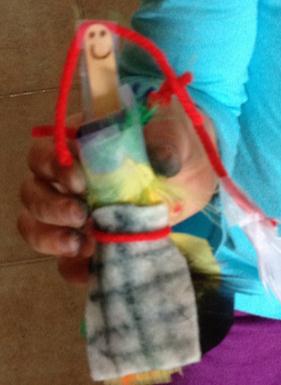
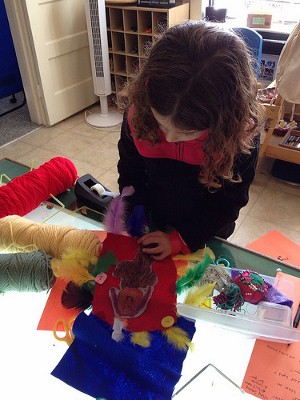
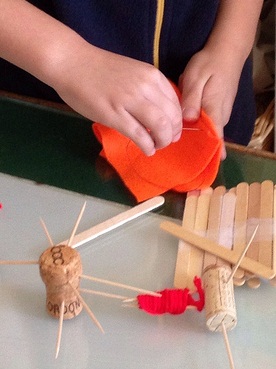
Lola, who had discovered the sewing boxes the day before, quickly chose to work with those materials again. She threaded the needles, and I showed her how to double the thread and tie a knot. Then we pulled out the buttons and she began to sew them on. She kept building on her idea with more excitement as each new thought popped up in her head: making a gingerbread girl out of felt, then sewing it onto another felt piece that she decorated with buttons. She could not find the brown felt she wanted, so she decided to color the gray piece brown (very resourceful).

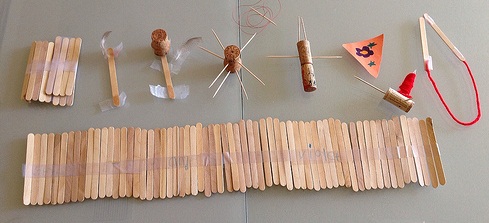
Sophia was soon engaged in the minute details of making a ballerina doll with felt and markers, feathers and pipe cleaners. Liam, pretty much uninterested in the clothes and doll making, was watching Alaira with the toothpicks and started tinkering with them. I offered a few suggestions of items he could make that related to the Thanksgiving story, and his eyes showed a glint of interest when I suggested a boat. So a boat it was; the Mayflower was what I called it, after the one on which the first pilgrims came over from England. He then got out the corks and I watched him become completely engaged in building, using toothpicks, corks, and tape—and more tape.

Then everyone thought tape was a good tool for all of the various projects. So I bit my tongue and let the roll dwindle down, though I did try to suggest glue a couple of times. Gavin saw Liam’s design and decided to begin building his own creation with corks and toothpicks.

Damon came over and watched for a couple of minutes; then he turned around and pulled out the popsicle sticks and started toying with them. “Hey!” I said, “That reminds me of the houses the Pilgrims had to build.” “Yeah, that’s what I was thinking!” he said excitedly, with a big smile and bright eyes— nothing at all like the glazed-over look in the eyes of the kids (my own included) who were following my chosen project of the Thanksgiving collage a little while earlier. So I got out a few other books, including A Day in the Life of a Pilgrim Boy, and turned to pages that showed the houses that were built out of planks they brought from England and rough wood from chopped trees and topped with thatched roofs.

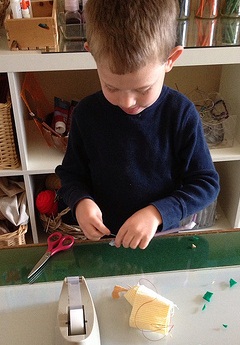
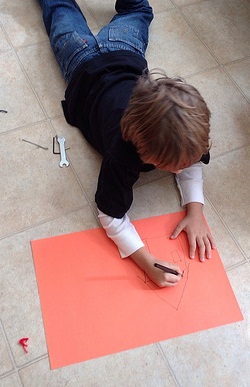
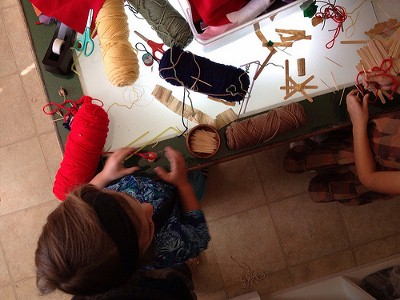
All of this took place in the Atelier, around the light table. While I sat on a stool casually mentioning things about the first Thanksgiving and how it related to what they were each working on, five girls and three boys stood around the table—completely, effortlessly, and passionately engaged in their chosen work. The table was stocked full of felt, pipe cleaners, markers, feathers, corks, toothpicks, construction paper, sewing kits, glue, scissors, yarn, popsicle sticks, and tape. The Zen of learning unfolded before my eyes.

Creative thinking, problem solving, geometry, measurement, math, art, cooperation, sharing, turn taking, community, support, fine motor coordination, history, listening, pride, and accomplishment were all at that table. There was no fighting or resistance, even with only one roll of tape! They were working individually and simultaneously—yet together on a higher level of creative energy flowing easily around the room. One idea would pop up and inspire another, then another. The children took short breaks to look up from their work, just long enough to see a friend’s project, make a contribution to the Thanksgiving conversation, or show me or their friends how awesome what they were doing was.

And it was.


Andrea adds:

Yes. Give them what they need to thrive, and then get out of their way. Our role as parents and educators is to be there to offer support, but not to do it for them.

Whether your children are learning in a traditional school setting, at home, or in a co-op or hybrid program, I strongly encourage you to get your hands on the book Project-Based Homeschooling: Mentoring Self-Directed Learners by Lori Pickert, read it, and try implementing some of these things at home. Project-based learning doesnt have to be all or nothing. It doesn’t have to be your entire curriculum (although it could be), so if you’re a structured Latin-loving Classicist or a relaxed unschooler, project-based learning can still be brought in. It should be. Carve out time for your children to do self-chosen project time. Your children will thank you!

Michelle Foreman and Andrea Gaudin Triche

Farming with young children

It is a pleasure to welcome Katherine Patton as Alt Ed Austin’s newest guest writer. Katherine not only directs and teaches at The Joyful Garden preschool but also is an accomplished urban farmer who conducts Urban Farm Camps for both kids and adults. Here she shares the rationale behind her agricultural work with the very young as well as some tried-and-true tips for parents and others who want to grow things with kids.


The Why

I’ll be honest: I started integrating farming activities into my preschool program because of my own passion for being outdoors and growing things. To me, it has always made sense to structure my work with young children (aged eighteen months to three years) around what interests me most. Being outside, growing and tending plants and animals, and turning the end results (fruits, vegetables, honey, eggs) into delicious food on the table are hobbies that have become integral to my life and livelihood. Sharing them with the children I teach and care for was just a natural for me, in terms of interest (mine and theirs), setting (outdoors), and results (beautiful feasts for the senses; the hands, eyes, ears, nose, and taste buds can all enjoy the process of raising our plants & animals).

It’s only recently, about a year after actively integrating farming activities into our daily routines, that I have researched and weighed all the benefits of doing so. It turns out that farming (or growing and caring, as I think of it) is beneficial for children from the youngest ages, for so many reasons! Gardening and caring for our chickens support early childhood development by:

  • providing a setting for active/experiential learning—sensorial work, in the Montessori lexicon
  • giving children opportunities to practice social skills, such as verbal communication and cooperation—social/emotional work
  • supporting healthy eating and food choices—self-care
  • introducing principles of science, such as botany and biology
  • reinforcing preliteracy and prenumeracy by providing endless opportunities for naming and counting

All that is wonderful, but to me, it’s all about the daily experiences with the children. No moment is more positive, more filled with potential, than the moment each morning when I push open the farm gate and walk through it with my young charges. Pip the dog runs ahead to check around the chicken pens. The children and I straggle behind, taking in the berry and herb beds, sometimes finding flowers, leaves, and fruit to pick, smell, and taste. A rooster’s crow or the approach of one of the cats, purring and begging to be petted, might stop us in our tracks. One is an occasion to clap our hands over our ears, the other to stop and gently touch soft feline fur.

We eventually reach the shed, from which I can extract the huge chicken feed container and several small sand pails. Children grab scoops and fill the pails with chicken feed. They practice their social skills and conflict resolution, working out who should use which scoop. Fine and gross motor skills are strengthened. Resilience gets a workout when someone is disappointed by the scoop that he or she ends up with. I might count the number of scoops going into the pail. Soon pails are full and scoops go back into the container. Children observe while I dump the feed into the feeders and the chickens chow down.
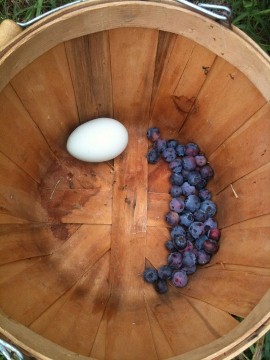
When we tire of observing—sometimes quite a while later—we check for eggs. Many times there are some that we can count and carry, sometimes none are waiting for us. Our next stop is the garden, where we check for ripe vegetables for our brunch table. Very often, undersized/underripe fruits and vegetables are picked prematurely. It’s all a part of learning in the garden. Over time, the children learn that tomatoes and berries are not ready until they are richly, darkly colored. The proof is in the tasting! Cucumbers and summer squash can be either too small and hard or too large and seedy. They experience the range over time during our indoor work time, when we wash and slice the garden’s bounty for brunch-time consumption. Sometimes the garden’s offerings make it onto the table; sometimes not.

When we sit to eat our mid-morning meal, not every child likes, or will even taste, our harvest. But I know that each exposure to a new food increases the chance that a child will try and enjoy it at some point. If it takes, as some experts say, ten exposures to a new food before a young child will actually taste it (some say fifteen exposures), I know that each child with me that day has seen that food twice—once in the garden, and once at the table. They see me tasting and enjoying it, and with any luck, at least one of their peers will be enjoying it also. In this simple way, we are laying the foundation for healthy eating habits.

The How

Here are a few of my tips for growing and caring with the very young:

Focus on the process, rather than the product. A toddler might focus on scooping soil, to the exclusion of getting to the next steps of planting seeds to sprout, and then watering, and so on. Provide the materials and tools that are capturing the child’s focus right now. You can always seed separate starting trays while he or she is occupied with all that scooping.

Start small. One to three pots filled with dirt alone might be enough for a young child to experience (touch, smell, even taste) as a start. Start some seeds in other pots, set up and out of the way; your kiddo will likely be delighted to help you harvest when they bear fruit.

Keep it safe. Examine the environment for sharp edges, biting insects and spiders, and other hazards before offering it to a young child. Practice organic cultivation rather than using chemical pest deterrents and fertilizers. Research livestock-borne disease risk before allowing your child to interact with animals, and keep a close eye on all child-animal interactions. Chickens and other farmyard animals can frighten or injure a young child through just their natural behaviors (pecking, quickly taking flight, crowing). Teach your child to eat only those plants and fruits that you have approved for consumption. A good mechanism for enforcing this, which has nothing to do with asking permission, is to make a habit of washing everything before tasting. This gives the grownup a chance to review what will be consumed in advance of dining.

Grow plants that are easy and that you like. If you hate tomatoes, don’t grow them! Grow food that you will enjoy sharing with your child. If there is a vegetable that you know she or he loves, plant some seeds. Once your kid enjoys picking that favorite from the garden and eating it, it’s a short stroll to the next pot, where a soon-to-be-favorite is growing.

Katherine Patton

Becoming established

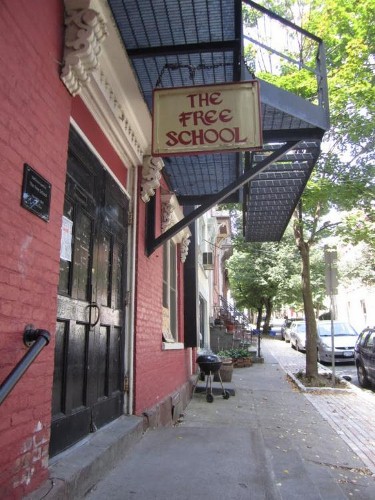
Caitlin Macklin, 9th Street Schoolhouse mentor and founder, recently visited the famed Free School in Albany, New York. In this guest post she shares some images and insights she gained there about building a democratic school community and culture over time.

“Wow. I’m really here. The place of my inspiration.”

This summer I made a pilgrimage to Albany, New York, to visit the Free School. This decades-old institution has long been a guiding light for me. It was my first introduction to the concepts of non-mandatory classes, democratic participation by students in conflict resolution and school governance, and putting children truly at the center of education.

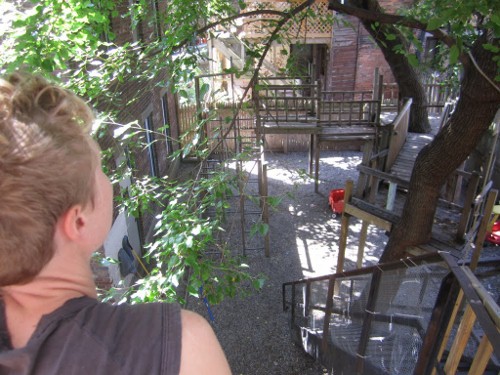
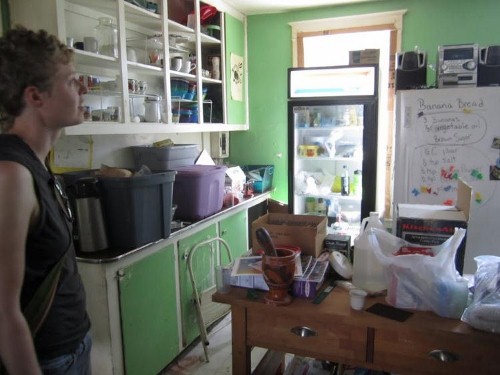
As a new teacher (of four years) and a new school (into our third here at 9th Street), the thing that sank in most for me is the sense of being established that the Free School exudes. The feeling of rootedness settled in as I climbed up narrow stairways and stood on wood floors with lived-in scuff marks—I mean, even the disaster area of the summertime kitchen made my heart ache to have a SPACE to CREATE.

I currently teach out of my home on East 9th Street. This year, Laura Ruiz joined the Schoolhouse, and collaborating feels great! We intend to grow slowly but surely into a larger community of families more the size of the Free School, about sixty kids with a staff of five or six. During the visit to Albany, I was just soaking it in—in awe of what people have built together, just “making it up as [they] go along,” doing what makes sense, not what a bureaucrat tells them to do. Working with families, giving kids opportunities and mentoring, so they may discover and grow while staying whole, messy, in touch with their inner selves.

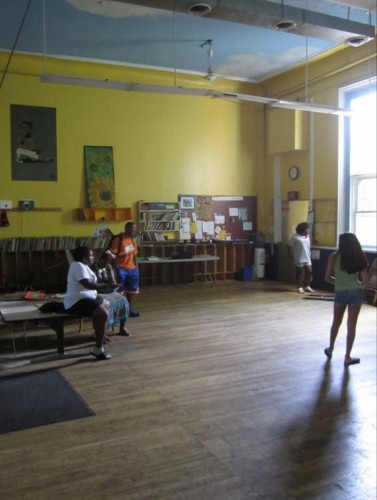
YouthFX program participants rehearse scenes for their summer narrative film project in the great room at the Albany Free School.

I have put so much thought into how to implement in my teaching and in the Schoolhouse structure the lessons AFS has learned that to see it and know it as a place with a particular community and history helped me understand their context and refocus my efforts in recognizing and building on what our community’s strengths are. Getting to ask Bhawin, a longtime teacher, some of my burning questions about the how of their lives together, talking with him about their process of becoming the school they are now, gave me an infusion of patience with our process.

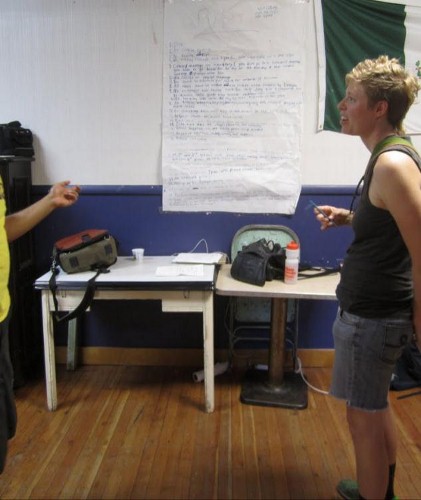
Bhawin stepped out of the frame as we discussed the community-created Rules on the wall behind us.

I left feeling encouraged to give time to developing the particularities of our program, staying true to who we are as teachers, youth, parents—as people—and to respond from those real relationships to create better and better opportunities for living and learning together. Part of that is my commitment to making democratic, learner-centered education accessible to people in Austin who might not be able to afford it. In addition to an affordable tuition and part-trade options, I’ve also been working with the Education Transformation Alliance to collaborate on creating a scholarship fund.

Making meaningful education available to more folks in Austin is what our work with the ETA is guided by. And I think finding meaning is what this shift in education in Austin is all about: this is a growing movement of people who want more than cookie-cutter experiences for their kids and their lives. People in Austin are more than ever feeling acutely that the current system is just not fulfilling their dreams for their kids. We all want our youth to live lives that are prosperous and flourishing, and I want the young people in my program to identify and define that success for themselves within a strong web of community, where they are known and where they know what resources are available to them.

We are seeking meaning in our learning and in our relationships, and we are creating institutions that respond, that put down roots, that take time to get established, that work together. I invite you to find out more about the many alternatives available across the city on the ETA School Tour this Saturday, Oct. 20!

For further reading on the Albany Free School, pick up any of Chris Mercogliano’s works, watch Free to Learn by Bhawin Suchak and Jeff Root, and check out the school’s website or this blog post from an intern.


Caitlin Macklin

Celebrating failure!

In this very personal guest post, Ariel Dochstader Miller argues for embracing failure as a positive and necessary experience in school and beyond. Ariel is cofounder and chief motivator at Austin’s Bronze Doors Academy.


My birthday was a few days ago, and my husband fulfilled my lifelong dream of having a party for me at Peter Pan Mini Golf. One of the partygoers was my eight-year-old birth daughter, whom I carried for my dear friend, who is infertile.

At one point during the party, her mom told me that she was very upset and crying because she was not doing well at mini golf. I went to her and discussed how she was feeling. This child was crying and wanted to leave because she was not performing up to her expectations.

One of my concerns for this child of my heart is that she is becoming a perfectionist because she is attending a school where the factors that determine success are all external. She is living in a world that values a memorize-for-the-test-then-forget mentality versus learning how to fail fabulously and celebrate learning because it is fun. The other young party attendees were students who attend the progressive school I own. None of them were keeping score, and I could tell the amount of fun they were having by the peals of laughter issuing forth from the golf course.

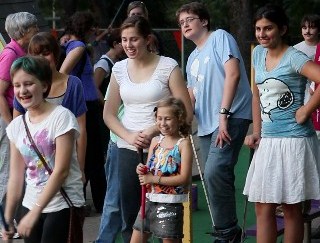
Bronze Doors Academy kids celebrate the prospect of failure at the mini golf course on this special occasion—and at school every day.

One of the things I fear most for public school youth (and those at many traditional private schools as well) is that too often they are taught that failure is the worst thing that can happen. I could not disagree more. I believe failure should be celebrated. Milton Hershey started seven businesses that failed before he found his recipe for success in his hometown of what is now called Hershey, Pennsylvania. Walt Disney went to more than three hundred banks before he found one that would fund his dream of Disney Studios. How many people would have stopped at one or two failed attempts?

The determining factor for today’s students’ future will not be how many degrees they have, their test scores, or grades but rather their entrepreneurial skills and ability to think critically. Microsoft specifically says it hires people who fail often because that means they are innovators who are not afraid to push the boundaries of whatever they are working on.

Both of my parents died young, and thus I am a huge joy advocate. None of us knows how much time we have, so why waste it not experiencing joy because we are not performing to some external measure? At Bronze Doors Academy, the adults model the attitude that failing can be spectacularly fun and is actually quite important, because it means you are stretching yourself and trying something new and different. We also model that perseverance is much more desirable than striving for perfection. In my study of business and owners of successful companies, I have found that their unwillingness to give up was much more important to their success than their grades. A study I read a few years back found that most successful business owners were C students.

Solving the problems we are facing as a society will require serious out-of-the-box thinking. Why not enjoy ourselves while pushing the boundaries of what we know is possible, even if it means the ball never goes in the hole?

Ariel Dochstader Miller