Something beautiful: A solstice story

To celebrate the winter solstice, Marie Catrett has generously shared with Alt Ed Austin’s readers the gift of this moving story, adapted from a letter she sent yesterday to the parents of her students at Tigerlily Preschool. (It turns out to be a story within a story within a letter within a blog post!) Enjoy—and may your long winter nights be filled with light.


December 20, 2013

I’m still moving through all the layers of the story I’m sharing here today. It touches many different parts of me and my work here. You might already know that Reggio thinking, which I admire so much, began with a school started in Italy built literally from the rubble of World War II. Such a respectful, empowered view of learning arose from terrible circumstances. Of the many stories I'm learning in my own teaching journey, you could say Reggio thinking hooked me from the start as I'm a sucker for a good phoenix tale. . . .

Word had it that at Villa Cella, the people had gotten together to put up a school for the young children; they had pulled out the bricks from the bombed-out houses and had used them to build the walls of the school. Only a few days has passed since the Liberation and everything was still violently topsy-turvy . . .
     I felt hesitant, frightened. My logical capabilities, those of a young elementary school teacher overwhelmed by the events, led me to conclude that, if it were true (and how I hoped it were!), more than anomalous or improbable, it was out of this world . . . maybe someone from Cella would show up. No one did.
     That is why I got on my bicycle and rode out to Villa Cella. I got confirmation from a farmer just outside the village; he pointed out the place, a long way ahead. There were two piles of sand and bricks, a wheelbarrow full of hammers, shovels and hoes. Behind a curtain made of rugs to shield them from the sun, two women were hammering the old mortar off the bricks.
     The news was true, and the truth was there, for all to see on this sunny spring day, in the uneven but stubborn hammering of these two women. One of them looked up at me and waited; I was a stranger, someone from the city, maybe they could tell from the part in my hair or my low-cut brown shoes. “We’re not crazy! If you really want to see, come on Saturday or Sunday, when we’re all here. Al fom da boun l’asilo (we’re really going to make this school)!” . . .
     I had the honor of experiencing the rest of the story . . . and it remained an uninterrupted lesson given by men and women whose ideas were still intact, who had understood long before I had that history can be changed, and is changed by taking possession if it, starting with the destiny of the children.

. . . a new educational experience can emerge from the least expected circumstances . . .

—excerpts from “History, Ideas, and Basic Principles:
An Interview with Loris Malaguzzi,” in
The Hundred Languages of Children: The Reggio Emilia Experience in Transformation


Willa: (Upon arriving, handing me a small gift to unwrap; she and I are holding something wrapped in tissue) Look, can you see a little bit of golden peeking out?

Marie: I can, I can. (We unwrap further.)

Willa: It makes me think of a bird. (Gesturing to the folded paper that is with it) Read the words that tell you about it!

I read the paper to myself.  Here is some of what the paper says: “This candleholder spreads peaceful light from the remains of a brass bomb shell. Handcrafted by artisans of Cambodia’s Rajana Association. . . . ‘When we make jewelry [like this] then we know our country has peace,’ said one young silversmith.”

Willa gives me a hug and skips off to play. I watch the children, holding the candlestick for a while, until I call the children in for circle.
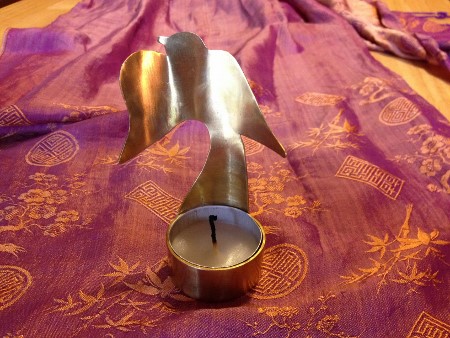


Marie: I want to tell a story that takes place in a far-away place called Cambodia. The people there were a having a big terrible problem where some people thought one thing and some people thought something else. And the people didn’t do talking about it. They got mad, mad, mad, mad and had a war.

Daphne: What’s a war?

Willa: It’s when you get so angry you’re like (waving arms like sword play) and set off bombs.

Marie: Big big fighting, mmmhmm.

Emerson: Yeah, and sometimes wars have those truck things that shoot out bullets. And bombs, they explode.

Willa: [In Cambodia] there were some bombs that didn’t explode, right?

Nayan: And there’s some places far away that didn’t have problems.

Kids name some far-away places.


Marie: This story is about the place called Cambodia.

Nayan: And there was bullet world.

Marie: The people there were having the terrible problems with each other. But then the people thought it was too much fighting and wanted it to stop. The people that thought one thing and the people that thought a different thing started talking to each other. And about how to fix the problems. Like how kids say, “I’ll be nice to you if you’ll be nice to me.” Finally the people did that. They said, “I’ll be nice to you if you’ll be nice to me,” and it stopped the fighting. But, because of all the fighting they’d had, there were still some bombs where they lived. So some people had the job to go find the bombs and put them away so they couldn’t hurt anybody.

Emerson: Spray them with water to try to kill the fire in them!

Marie: Yeah, they have ways to make them not dangerous anymore and had workers to do it. And, the people also wanted to make stuff. So when they had made the pieces of the bomb not dangerous anymore people thought and they thought and they thought. And they thought: hmmm, we had these big problems . . . and now things are better . . .

Emerson: (Really excited) And! And I know! How ’bout they make something out of those bombs?! And fill them up with water so it’s safe!

Willa: Yeah! And the water can just squirt out if there is a fire, (with a button like) push push push!

Marie: They did just exactly that, they did decide to make something good out of the stuff that had been the bombs.

Willa: They made a candle holder! They made something beautiful. This is something that my mother got for Marie that’s really really delicate.

Daphne: Is it her Christmas present?

Willa: It is her Christmas present! I wrapped it.

Emerson: It was in a box, right?

Willa: Yeah, and I wrapped it with blue paper, and I used a yellow ribbon for her.

Marie: We can pass the candle holder around before we light it ’cause I would like to share it with everybody.

Kids pass the candle holder around the circle, quiet and focused.


Marie: Everyone take one little scoouch back so we can light it, all see it, and be safe about the candle flame. (Getting ready to light the candle) Oh, I’m feeling so many feelings! That this candle used to be a bomb for hurting. And then people started talking, and made things better. And then people decided to make something beautiful out of it.

Nayan: Should you light it now?

Willa: It might do burning?

Marie: Well, it can’t do any more hurting now, it’s a candle holder, now that the people have made it into something wonderful.

Willa: It might burn up the metal?

Daphne: Or it might go all over the house?

Marie: Now it can’t be anything but a beautiful candle for looking at. I’m sure it’s completely safe. (Being careful like we are about candles when we light one together, I would add, though in the conversation I am certain the kids are needing to know that the candle can’t be a bomb anymore). This candle has been on a very big journey. It was a bomb, it used to be able to do hurting, but then the hurting stopped and people made it into a new thing, a wonderful thing. And then a mama saw it and thought it would be a good present. To be a beautiful candle to be special at our school. And a kid put it in a pretty striped box and wrapped it up in blue paper and tied it with a yellow string and gave it to me. And I opened it up and learned the candle’s story, and now I’m telling the story of the candle to you children.

Emerson: I wish I had it.

Marie: We’ll enjoy it, all of us together, and that’s the best part now of this candle story. It’s a pretty wonderful thing.

I light the candle and we’re singing together:

This little light of mine, I’m gonna let it shine
I’m gonna let it shine
This little light of mine, I’m gonna let it shine
Let it shine, let it shine, let it shine

Won’t let anyone (whsssh!) it out, I’m gonna let it shine . . .
Hide it under a bushel? No! I’m gonna let it shine . . .
Take this light around the world, I’m gonna let it shine . . .


We sing “This Little Light of Mine” with one finger for a candle, the other hand spread behind it, “to shine the light.”

The Something Beautiful candle
Marie Catrett
 

Staying close to the fire

It’s cold this week here in Central Texas, but the folks at 9th Street Schoolhouse are keeping the fires lit. Founder Caitlin Macklin, our guest today, writes about her students’ latest unit of study and how you might try this kind of collaborative, interest-driven inquiry with your kids at home.


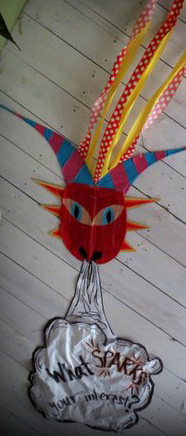
This encouraging dragon kite soars above our classroom.Over here at the 9th Street Schoolhouse, we are engaged in a continual effort to close in on meaningful learning. We also seek to develop 21st-century skills and a lifelong love of learning in our students. To this purpose, the older class has started working based on a more open-ended learning model for our unit study. Unit study is a 45-minute chunk of time during our morning class lessons. For the next couple of weeks until the winter holiday, our unit will focus on student-driven, curiosity-based questioning. Students will become seekers, hot on the trail of inquiry, researching the answers to these questions via internet searches, supplementing with written reference material, and contacting knowledgeable people as well.


This is how it will work:

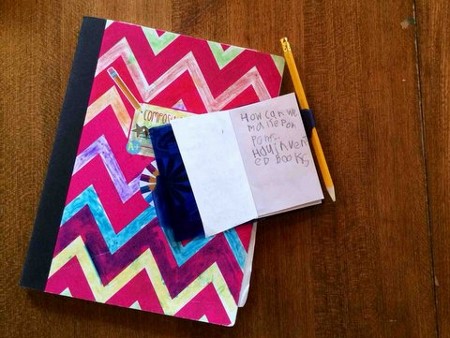
Students will be generating questions in a small notebook. The notebook—dubbed our Book of Wonderings—will be carried back and forth between home and the schoolhouse. In fact, we recommend that they keep it in a pocket at all times, because you never know when curiosity will strike! It is their responsibility to generate at least one question per day on their own time. Questions should be about things students want to know, are curious about, and have a genuine interest in finding out. They may be broad or narrow, easy or difficult. At the heart of it, their questions should spark the fire of their interest and be Important To Their Lives.

“How can we make pom poms? Who invented books?”

During the unit study portion of our class lesson time each day, students will share their questions. We will alternate turns of whose question we will answer each day. Students will mainly use the internet to find out answers to their questions, also seeking out good books and people who know. They will keep a record of their findings on notepads and posters. Students will help each other answer these questions. Discussing what they find, how to search, and what does it all mean will create more lasting learning.

As their mentor, I will guide them to evaluate the validity of the sources they use and will encourage them to go deeper into their findings. If a question can't be answered in one session, we will keep with it until we are satisfied. Perhaps a question will spark a longer project for a student or the whole class.

We will share the findings and process of this unit with our community at our end-of-semester Showcase. Please follow our blog if you are interested in the conclusion of the unit.

The goals of this unit are to:

  • Develop critical thinking, reading comprehension, collaborative work habits, and interpersonal skills.
  • Refine the ability to question effectively.
  • Build technological proficiency.
  • Generate inner motivation through understanding that learning is an essential part of everyday life.
  • Connect students’ lives and what they care about to what is being learned.

This collaborative, open-ended research method is inspired by:

  • An amazing article from Wired magazine.
  • Sugata Mitra's research in child-driven Self Organized Learning Environments (SOLEs).
  • Most of all, it is based on the experiences Laura and I have had teaching in the classroom, and our desire to move toward the fiery source of interest that is at the heart of kids' passion to know. We continue to strive toward a Free to Learn approach, while maintaining a strong mentoring relationship and offering our own experiences and ideas to expand the kids’ growing edges. As educators, we have many questions and will continue to refine and research as we go.

Interested in trying this at home?

You can download the SOLE Toolkit from TED. Once you get started with your youth, here are some suggestions for what you can do to support your students’ process:

  • Begin noticing when your children have questions.
  • Help them develop deeper questions that they can bring to their explorations.
  • Encourage them to write these questions down in their Book of Wonderings (or whatever they choose to call their special book!).
  • Read about the inspiration for this project. It will give you good background info and insight into guiding the children to follow their own purposes for learning.
  • Observe your children, notice any changes in their enthusiasm for learning, or school, or life!

We would love to hear from you if you are engaged in this learning design. Keep in touch by commenting on our Facebook page. You can also post on the SOLE Tumblr to connect with the larger movement.

In closing, here’s a great truth from author Sir Arthur C. Clarke that Mitra references:

“If children have interest, education happens.”

For us, finding that coal of red-hot interest in each child is what it is all about.

Caitlin Macklin

The future is STEAMy

Maggie Duval wears many hats comfortably: event producer, web developer, futurist, alt educator, mom. In her guest post for Alt Ed Austin she shares the news about her latest project, STEAM3, the conference and “Interactive Playground” that is shaping up to be one of the most interesting events of 2014.

GIVEAWAY: As part of Alt Ed Austin’s 2nd anniversary celebration, we have two pairs of Interactive Playground passes to give away—each good for one adult and one student. There are lots of ways to enter the drawing; you’ll find the entry form at the end of the post, along with a special discount code for all Alt Ed Austin readers who want to attend the whole shebang. Thanks, Maggie!


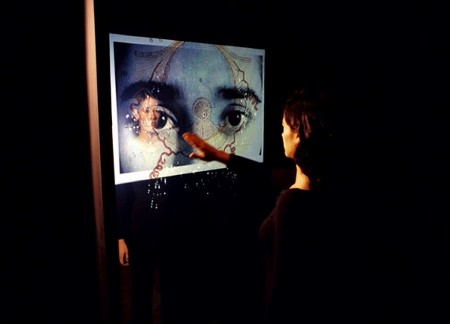
I’m very excited about a new project I’m working on that weaves together my four great loves:  alternative approaches to education (including STEM/STEAM), mining the brilliance that lives at the intersection of art and technology, futures studies, and emerging technology. Called STEAM3 (Science + Tech + Engineering + Arts + Math “cubed”), it will take place in early March and is the first public event of its kind to present a comprehensive look into the future of experiential learning. It will provide an interactive stage for the exploration and demonstration of the emerging approaches, formats, technologies, and learning models that will redefine education over the next decade.

The buzz is huge around STEM in education, which focuses on bringing kids up to speed on science, technology, engineering, and math skills by masterfully blending holistic and cross-disciplinary approaches to teaching and engagement. However, many are finally acknowledging the importance of the arts in that equation, hence the “A” in STEAM. The “cubed” part comes from our desire to address the whole child, explore alternative approaches to education (which as a mom I’ve been passionate about since my own childhood), as well as engendering a positive, empowered approach to what’s coming toward us in the future.

I have developed the event with professional futurist Derek Woodgate of The Futures Lab, who is also Consultant in Residence at the Digital Arts and Entertainment Lab (DAEL) at Georgia State University. I serve as CEO for two divisions of The Futures Lab, Inc., Learning Innovations in Future Education (LIFE) and the Future Entertainment and Events Lab (FEEL). The latter was formerly known as Plutopia Productions, Inc., which I also headed up, and we produced numerous “sense events” at SXSW Interactive and beyond.

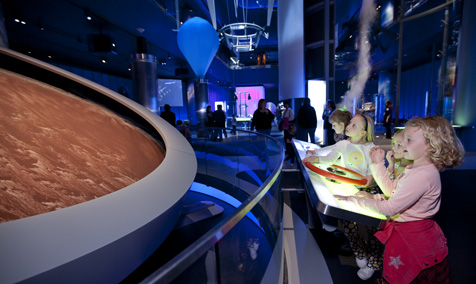
For this unique two-day event held in Austin, Texas, we’ve assembled some of the world’s foremost experts in the field of future education as well as the most innovative and immersive demonstrations and exhibits of emerging educational technologies in what we’re terming our “Interactive Playground,” featuring such areas as the Living Classroom, Make Magic, Interactive Storytelling, and the Game of Learning. Special panels and demos will address topics such as alternative approaches to education, avatars for learning, “education is art, art is education,” girls in engineering, and more.

The family-friendly event is for parents, kids, and educators certainly, but also for artists, instructional designers, “makers,” instructors/trainers, content creators, mobile development designers, researchers, and more! And this is only the beginning of our journey. It will continue through a number of similar events that we are planning for Atlanta, Georgia; Belo Horizonte, Brazil; and Manchester, UK, as well as through an online post-event portal and virtual and in-person salons.

Our Keynote Speakers include:

There will also be talks and demos from MIT Media Lab’s Lifelong Kindergarten group, Nano Art by Cris Orfescu, Experimental Geography by Nato Thompson, and Algorithmic Art from Joel Kahn. And don’t miss Art, Technology, and Augmented Reality from Marvin Neibuhr and Dr. Bruce Niebuhr, Gamification for Learning by Billy Joe Cain, and Makerspace, a space for young children to learn about STEAM-oriented topics with Joseph Lopez, Head of Faculty of Convergent Media at the University of Incarnate Word in San Antonio.

STEAM3
Conference and Interactive Playground
March 1 & 2, 2014
UT Commons Learning Center
JJ Pickle Research Campus, University of Texas
10100 Burnet Road, Austin, TX 78758

VIP Party for conference ticket holders
and special guests only

Saturday, March 1, at ATX Hackerspace
9701 Dessau Road, Suite 304, Austin, TX 78754

More information and tickets are available at steam3.com. Full Conference + Interactive Playground + VIP party tickets are priced at $99.95 until December 31—and Alt Ed Austin readers get an extra $10 off this special rate! Just use the coupon code ALTEDATX at checkout. Feel free to share with your friends. On January 1, the price goes up to $124.95. Interactive Playground–only tickets range from $7.50 to $25.

This event is sponsored in part by The Futures Lab, Inc., Learning Innovations in Future Education (LIFE), Skybridge Academy, and ATX Hackerspace.

See you there!

Maggie Duval


Enter below to win one of two pairs of adult + student passes to the STEAM3 Interactive Playground on either day!

a Rafflecopter giveaway

When what you’re doing isn’t really working

Joey Hajda holds a doctorate in veterinary science and a master’s degree in secondary and higher education curriculum and instruction. He has taught science courses at the middle and high school levels for more than 20 years as well as at the community college level. He and his wife, Lisa Hajda, MEd, are homeschooling parents and coauthors of the innovative and popular Friendly Chemistry curriculum. In this refreshingly honest guest post, Joey shares his bumpy journey to becoming a creative, highly effective educator.

GIVEAWAY: Joey and Lisa have kindly offered a complete set of Friendly Chemistry (a $120 value) to one lucky reader in honor of Alt Ed Austin’s 2nd anniversary. Read on to find out all the ways you can enter to win!


My first teaching job was in a rural public school in Northeast Texas. I was assigned the whole science department (grades 7–12), which was great for developing continuity between subject areas but rather exhausting when it came to lesson preparation. But I managed, and I grew to enjoy it.

Teaching the life sciences came easily due to my veterinary training, but for chemistry I had to rely more heavily upon the text. My chemistry course was good, though—or so I thought. After about two years, I began to receive feedback that the students to whom I had taught chemistry were failing their freshman chemistry course at the nearby junior college. Yikes! Could that be true? What was going on?

I went to the junior college to find out what was being expected of freshman chemistry students and to determine what was wrong with what I was doing. Something needed to change because not only were these kids failing this course, but they were also getting the idea that pursuing a college degree was now unattainable. Things were going sour for these kids, and I needed to do some serious thinking about what we were doing in my classroom.

After looking closely at the college’s freshman chemistry course syllabus, I readily saw that the course was really just a repeat of the concepts I had been presenting to students in my course, but it all came at a much faster pace in a single semester rather than a year-long course. I dissected the syllabus in greater detail to determine exactly what concepts my students needed to fully understand in order to be successful in this course. I made the decision to focus only upon these basic chemistry concepts and forget about the rest. While we had been “covering” most of the text, my students had really not had the time to fully understand these basic concepts. In my class, they were scoring well on tests and final grades were stellar, but in reality they were only excelling at memorizing a multitude of tiny facts and not understanding the “big picture” of chemistry whatsoever. Things had to change.

I went to my chemistry text, all 15 pounds of it, and set about locating those basic concepts that I felt matched those required in the college course. When I compared them to what the district (and state) required, we were well within the prescribed scope of the course. Next, I thought long and hard about the sequence in which these concepts were being presented within my text. The sequence that the text followed wasn’t making the best sense, so I experimented with rearranging them and came up with a plan that I hoped would be a more logical approach for my students.

This was all good, but then the thought came to me: if I pared away 70 percent of the text material, would I have enough for a year of teaching? And then a second thought came to me: maybe part of my earlier problem, in addition to covering way too many concepts, was the fact that maybe I wasn’t giving my students enough practice at the concepts I was presenting to them. Maybe we were moving along too fast. And again, maybe it was just good memorization on the part of the kids that was allowing them to keep afloat. Maybe, we just needed to slow down and spend more time with each concept and then practice more of what we learned.

But more practice only meant more worksheets. Or did it? As a church youth group leader and middle school camp counselor, I’d always loved group games. I enjoyed the combination of physical play with intense application of some sort of concept. I began developing classroom games—both running-around-the-room-type games and board games—that could allow for practice of the chemistry concepts we were learning. We were now enjoying ourselves with the fun and challenge and “physicalness” of the game.

Together, my students and I modified the games, which gave them ownership of the process and resulted in greater effectiveness. They always wanted to make the rules more challenging. What was once drudgery turned into my having to limit “practice” time in order to move on to new concepts. I think one of the best things to come from this experience was the fact that the students could see that I, too, really enjoyed play. We had fun—lots of good fun.

Smores and Stoichiometry: One of many fun and effective activities in Friendly Chemistry

And the learning came. My students were no longer experiencing failure as they entered their freshman chemistry courses, whether at the local junior college or at universities others were attending. Things were better, they really were. In this case, some of my classroom teaching had not been as effective as I had hoped. It took some time to evaluate the whole situation and more time to remedy it, as well as taking risks to get things fixed. But, in the end, those efforts paid off.

Joey Hajda


And here’s your payoff: Enter here for your chance (or several chances) to get a complete set of Friendly Chemistry. This includes:

1 Student Textbook
1 Volume 1 Teacher’s Edition
1 Volume 2 Teacher’s Edition
1 Manipulative Set
1 Annotated Solutions Manual

Total Retail Value: $120.00. Bonus: Everyone who enters the giveaway will receive a discount coupon on one purchase at friendlychemistry.com.

a Rafflecopter giveaway
Thanks to Joey and Lisa for helping mark Alt Ed Austin’s two-year milestone. Stay tuned all week for more great giveaways!

What she wishes you knew

Barb Steinberg is a teen life coach and workshop facilitator who transforms the lives of adolescent girls and the adults who care about them. I’m excited to welcome Barb as a guest contributor with a preview of her workshop at the upcoming We Are Girls Conference. To learn more about Barb and her work, please visit barbsteinberg.com.

Watching our girls grow up can be bittersweet. We pour our hearts and souls into these little beings and rearrange our worlds for them. We cheer them on when they take their first steps, we dole out hugs and band-aids for skinned knees, and we relish the moments when they hold our hands, even when they don’t have to.

When our daughters hit adolescence, things start to change. Voices may be raised. Eyes may be rolled (although, admittedly, this can happen much earlier). Sighs can become louder and longer. Tensions can run higher.

In my twenty years of working with adolescent girls and the adults in their lives, I often hear parents lament, “Where did my sweet little girl go?”

As challenging a time as it can be for us parents, during adolescence our daughter’s primary developmental task is to separate from us. The brain goes into overdrive, rewiring in a way she has not experienced since she was a toddler. She tries on different identities to see which is right for her. She may experiment, and sometimes makes mistakes. You may feel a widening gulf between the two of you.

If given the chance to be totally honest, what would our daughters tell us about how to better parent them during adolescence? What do they wish we knew? Here are a few things our daughters would share with us:

  • We wish our parents didn’t expect us to be perfect. We want you to trust us to make the right choices and learn from our mistakes. We need time and space to do so. We feel disempowered when our parents take over for us.
  • We wish our parents would respect our need for privacy. One of the ways we are transitioning into being adults is by asking for more privacy. Our rooms are sacred spaces, and so we’d like to ask that you knock before you enter.
  • We wish our parents realized how much we want to fit in. Social media can make it so much easier to feel left out, when friends are posting photos having fun somewhere we weren’t invited.
  • We wish our parents understood that comparing us hurts more than you think. Whenever a parent starts a sentence with “Why can’t you be more like _______ (insert name of perfect best friend or older sibling here)?” teens automatically cringe. Comparing us to others makes us feel bad about ourselves.

These are just a few of the insights I will be sharing during my upcoming What She Wishes You Knew workshop at the We Are Girls Conference hosted by GENaustin. I will be drawing from my experience working with girls and their families as well as the latest research. I hope you can join me! If not, I invite you to join me on the evening of November 7 for a similar workshop in the Barton Hills neighborhood.

Parents, was this list of girls’s wishes surprising? Girls, is there anything you would like to add?

Barb Steinberg, LMSW

Growin’ Together and playin’ rough

Can rough play be good for children? A growing body of evidence says it can. The Growin’ Together Hands-On Afterschool Program makes a point of encouraging it, as staff members Joe Carr and Heather Aguilar explain in today’s guest post.


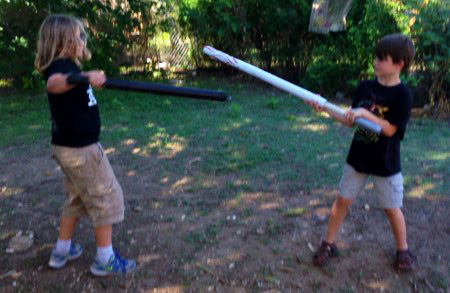
As any parent knows, kids love to play with their entire bodies. Running, jumping, climbing, and wrestling are the norm on most playgrounds. Many kids even enjoy play fighting, using swords or other pretend weapons. This is scary for educators at a lot of schools and youth programs, as well as for some parents, so they don’t allow this kind of play. They may worry that it is unsafe or that it encourages violence. At Growin’ Together, however, we encourage kids to play this way and to develop agreed-upon boundaries that keep all willing participants safe. We also have conflict resolution structures in place to resolve issues when boundaries are crossed.

This topic recently came up when students expressed a desire for swordplay. They started using sticks and other objects, making some adults (and some kids) worry about safety. So we had a meeting. “How can we engage in this type of play and keep everyone safe?” we asked them. As a group, they talked and listened and agreed by consensus on a specific set of guidelines. In the process, they learned important skills in teamwork, compromise, and boundary setting. Here’s what they came up with:

  • You may play rough only with someone who agrees to play that way.
  • Stop means stop!
  • We only play rough in a certain area of the yard (this includes solo practicing with a weapon).
  • Anything used like a weapon must be foam-covered.
  • Contact should be made between objects, such as foam swords, not people.
  • Objects may touch another person’s body only if each player agrees, and then only with a light touch that is not intended to hurt.

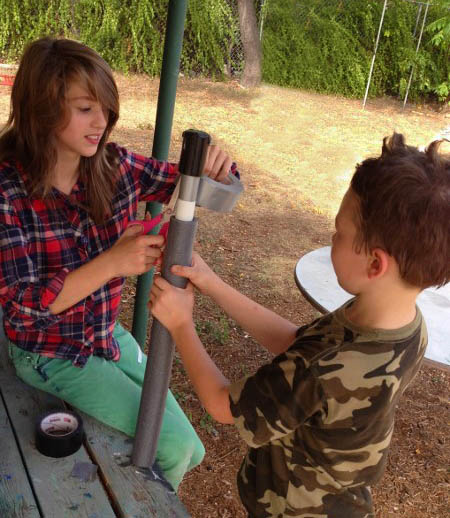
We used our next Carpentry Wednesday to make and decorate foam-covered swords, and it was one of the most engaging activities we’ve done. Some made staffs, one kid made a club, another a sai (a traditional weapon used in Okinawan martial arts), another a magic wand. It brought out their full creativity and ingenious designs and made for endless hours of imaginative play.

Do the kids violate their agreements? Of course! Which is then an opportunity for them to assert boundaries, hear the pain or anger their action caused, and make a different choice.

Is it dangerous? No. There is the risk of some pain, but no risk of injury. At Growin’ Together, we make a strong distinction between danger and risk, and we believe that taking risks is essential to learning what our limits are and how to stay safely within them—or to deliberately move beyond them.

For more insight into children’s need for rough play, why we support it, and how we supervise it, check out this enlightening article by educator and author Frances M. Carlson: “Rough Play: One of the Most Challenging Behaviors.” And for a more in-depth discussion of rough play and its benefits, we recommend The Art of Roughhousing: Good Old-Fashioned Horseplay and Why Every Kid Needs It, by Anthony T. DeBenedet and Lawrence J. Cohen (2010). In this well-researched and persuasive book, the authors make this “Bold Claim”: “Play—especially active physical play, like roughhousing—makes kids smart, emotionally intelligent, lovable and likable, ethical, physically fit, and joyful.”

We think so, too.

Joe Carr and Heather Aguilar