Reversing dyslexia? A response from Dr. Books

In guest contributor Shari Holland’s review of the recent book Reversing Dyslexia, she voices several common concerns about author Phyllis Books’s unusual claims. Upon Alt Ed Austin’s invitation, Dr. Books has responded to Ms. Holland’s critique. We encourage you to join the conversation by leaving a comment below.


Dr. Phyllis BooksThank you so much for the opportunity to address the comments from Shari Holland regarding my first book. There are points on which Shari and I agree. For example, I think it is fair to say we both agree that dyslexia, as well as many other learning challenges, and indeed our overall health and well-being, respond well to good lifestyle habits, which include adequate sleep, healthy eating, and a good balance of work and play. It is easy to take these natural methods for granted or even dismiss their importance.

The Hawthorne Effect, which she discusses, is another area of agreement. Positive psychology, placebo studies, even studies on plants, all point out the importance of a positive framework to seed a positive outcome. Before I work with children, I have parents agree with me about who is responsible for what during our time together. One tenet is for the parent to keep an open mind and to hold the space for the child to change. There are many factors (such as getting decent nutrition, sufficient exercise, and enough sleep) that I have no control over but ultimately affect the long-term success of Books Neural TherapyTM (BNT).

Shari writes, “Dr. Books seems to contradict herself about whether dyslexia is reversible. At one point, she writes that dyslexia may not be permanent.” The very fact that I have no control over variables mentioned above is reason for me to not make 100 percent guarantees. I willingly affirm that I have an 85 percent success rate, which, as my brochures and other literature say, is based on questionnaires gathered from clients six to ten years after treatment.

There are, however, several points I would like to correct or on which I would like to offer another view:

Shari states that she “found the organization of the book confusing and the logic muddled.” And “[I use] ‘dyslexia’ interchangeably with so many words describing learning challenges it’s hard to understand why [I] used dyslexia in the title.”

I have a degree in English and a master’s degree in communication, and my first thought was to find her comment disconcerting were it not for the fact that my publisher, who has been very successful over the past thirty years in publishing books written by professionals, chose to develop the chapters in a formula that works for most readers.

Upon further reflection, I wonder if some of the uncertainty she experienced about the title might not be caused by what the publisher left out of the contents of my book as originally submitted. My original book, before the publisher put the editing crew on it, was more of a “how to” guide for parents. The subtitle “Improving Learning and Behavior without Drugs” still reflects my original intention with the book; however, much of the content morphed into a different kind of book.  The publisher thought it best that my first book help establish me as a neutral expert in the field of dyslexia by explaining the whole playing field of dyslexia—describing the larger context of dyslexia, its many facets, and ways dyslexia can affect someone’s life—and offering insight and suggestions for addressing the various forms of dyslexia and issues the family member might be dealing with at any particular age. In the published content, I can see how she might mix up the definition of dyslexia, the definition of the various other diagnoses that may or may not accompany dyslexia, and the various ways children handle the emotional issues that so often accompany dyslexia.

Dyslexia is not a one-dimensional issue, which is one of the main points of the book. As Dr. Fred Pescatore, a New York–based integrative physician and author of several books on children’s health, states in the foreword to my book, “Dyslexia is not simply having difficulty with reading and writing. It is a disorder that permeates a person’s entire life, promoting all sorts of unwanted symptoms, from poor organizational skills to behavior and attitude problems.”

Shari writes, “If dyslexia is reversible, why talk to parents about choosing a tutor or a college that caters to dyslexic students?”

Actually, that was also my first response when my publisher insisted on adding a chapter on schooling, tutoring, and extracurricular activities. His response was wise: “You don’t know when people are going to pick up your book. Their child may be about to enter college when they first see your book. You need to meet people where they are. And since you aren’t there in person, you have to consider all possible situations, not just if their children have access to you at an early age.”

Shari wonders why I wrote the book if it wasn’t to promote my own therapy.

The preface says: “I wrote this book to dispel the myth that dyslexia is permanent. The idea that learning disorders are unchangeable is simply untrue, and it harms children. . . . I also wrote this book to open minds to a new way of looking at dyslexia, to create empowered advocates for dyslexic kids, and to make sure individuals get the help they need to dismantle the problem of dyslexia for good. Most of all, I wrote this book to help free the human spirit—the spirit that still lies inside every dyslexic person and begs to be unchained.”

Final thoughts: I’m passionate about my work with children, and I love my life. My life is geared around helping children become healthy, happy, and self-reliant—and to be free enough to usher their dreams into reality.

It takes a new mindset to believe there is hope for your dyslexic child, especially when “the experts” have ingrained the idea that it is permanent. My book may not be accepted well by people who want to hold onto their old beliefs. Even Einstein said, “I have all the new facts about quantum mechanics. I just don’t want to believe it.”

“Whether you think you can or you can’t, you’re right” is a statement very apropos with regard to dyslexia. If you believe and choose to hold onto your belief that dyslexia isn’t reversible, it won’t be. Not because that belief is true, but because your child will pick up on your belief—the belief of traditional education and the medical model which are embedded with the concept that dyslexia is permanent.

“We should never wait for science to give us permission to do the uncommon; if we do, then we are turning science into another religion. We should be brave enough to contemplate our lives and move ‘outside the box’ and do it repeatedly” (Dr. Joe Dispenza in Evolve Your Brain). I encourage all parents to be brave enough to follow their own internal compass. You know your child better than any expert. Scientific studies don’t trump your own truth, and no two dyslexics are alike. Seek help wherever you can. Believe in your own ability to choose wisely. Keep looking for ways to bring out your child’s highest potential. Believe in your child. The world needs you both.

Dr. Phyllis Books

Reversing dyslexia?

Alt Ed Austin is pleased to present two differing perspectives on the recent book Reversing Dyslexia by Phyllis Books, a chiropractor, nutritionist, and author based in Austin. The first is in the form of a thoughtful review (below) by Shari Holland, an Austin consultant and parent of a child diagnosed with dyslexia. The second (posted here) is Dr. Books’s response to Ms. Holland’s specific criticisms of the book. What do you think? We encourage you to make respectful use of the comments section below to continue the discussion.


Guest contributor Shari HollandHaving watched my ten-year-old son struggle with dyslexia, I visualize his challenge as a very tall wall, like the kind in a military obstacle course, one that you have to haul yourself up and over, maybe with the aid of ropes, maybe with help from others. This wall of words is very tall for some kids yet hardly present for those of us who easily and eagerly learned to read. Information—science, geography, fiction, even jokes and comics—is on the other side of the wall. The effort it takes to get to the information he craves is significant for my son.

When a friend passed along Phyllis Books’s recent book Reversing Dyslexia, I was intrigued. I had previously visited her website because I had heard about a technique she uses with dyslexic kids. This book only mentions her technique by name once in a brief paragraph among a list of alternative methods that presumably may prove useful in reversing dyslexia. If her book were simply a tool for marketing her technique, I could understand her purpose in writing it. But since it doesn’t do that, the book is all the more puzzling.

The flaws are numerous and significant. Reversing Dyslexia is long on opinion and anecdotes (most have nothing to do with dyslexia) and short on research. While Dr. Books has footnotes unevenly scattered throughout the book, many of the sources she cites are dated. She acknowledges that there is little research to support her claim that dyslexia is reversible, saying that case studies have to be sufficient proof until funds are available to study alternative therapies, including her own. She uses “dyslexia” interchangeably with so many words describing learning challenges (such as ADHD) that it’s hard to understand why she used “dyslexia” in the title. In the chapter titled “Determining Dyslexia” she bizarrely claims that self-mutilation (“cutting”) and drug and alcohol abuse may be clues that your child has dyslexia (or another learning disorder). And although I am not aware that there are currently any pharmaceuticals on the market for dyslexia, the subtitle of her book is “Improving Learning and Behavior without Drugs.” In the chapter called “Rewiring the Brain,” she writes that “dyslexics may be able to adjust their learning processes without using . . . pharmaceuticals.” I found the organization of the book confusing, and the research and logic muddled.  

Dr. Books’s website is as perplexing as her book. The details about her technique, called Books Neural Therapy, are vague, presumably because it is proprietary. The price of her services is also not disclosed. In an email exchange with her a year ago, she quoted her online course at around $1,000, with an unspecified higher cost if you work directly with her in her office. Her website claims that she has an 85 percent success rate in reversing dyslexia, but she provides no information about how this percentage is calculated and over what period.

Another organization, the Brain Balance Achievement Centers (BBAC), makes claims very similar to Dr. Books’s about the ability to ameliorate a whole host of learning and social disorders. The BBAC (there is one in Austin) offers a similar package of proprietary techniques that are designed to create new neural pathways based on the concept of brain plasticity. BBAC also does not disclose its pricing, but a number of blogs and message boards suggest that the cost is upwards of $5,000 for a three-month round of therapy – and since more time might be needed to see improvements in your child, the payout could be significant. Criticisms of the BBAC are easy to find on the internet (search:  “brain balance criticism”).

None of the educators, researchers, neurologists, psychologists, and chiropractors that I have consulted in the last few years has ever suggested that dyslexia can be eliminated. Moreover, even Dr. Books seems to contradict herself about whether dyslexia is reversible. At one point, she writes that dyslexia “may not . . . be permanent.” The chapter on “Schooling, Tutoring, and Extracurricular Activities” inexplicably discusses the academic supports that will be helpful to dyslexics. But if dyslexia is reversible, why talk to parents about choosing a tutor or a college that caters to dyslexic students?

While her argument is just not convincing, I do not think that it is necessary to “prove” that dyslexia is reversible. The point is that children with dyslexia will be profoundly affected by it—academically, socially, and emotionally—and it is our responsibility as parents to mitigate the effects as best we can.

I agree with Dr. Books that stress can impact learning, nutrition and creative play are very important to a child’s brain development, and dyslexia is multifaceted and varied; for those reasons, an integrated approach to addressing a dyslexic child’s needs makes sense. But before spending thousands of dollars on a vaguely defined program, I’d suggest starting with getting your family’s emotional house in order, making improvements in your family’s healthy food intake, and reading up on what you can do at home or within your child’s school to address your child’s needs.

I have no doubt that Dr. Books has helped many of her clients overcome obstacles and make improvements in their lives. I’m no stranger to alternative therapies, and over the years my son and I have seen acupuncturists, chiropractors, a cranial-sacral therapist, counselors, and tutors and tried herbal, homeopathic, and other types of home remedies, with many positive outcomes. While he still struggles with dyslexia, he has experienced great improvements.

The Hawthorne Effect cannot be overlooked when it comes to alternative therapies or any intervention. To paraphrase: a child to whom positive intention is directed will improve. This may explain positive results as much as anything in some situations. As parents, we are called to summon our best efforts to address the needs of our children. Our job is to help our children understand how their dyslexic brains make them special and how to make the wall separating them from knowledge and information less daunting to scale. You may choose to engage a village of mainstream and alternative teachers, therapists, and practitioners to work with you and your child, which may involve parting with some hard-earned cash; some will be beneficial and some will not be. The only certainty is that there is no silver bullet (yet), and all we can do is search for what works for our own families, within our means.

Shari Holland

Texas should tell parents about course choice.

Guest contributor Heather Staker, a senior research fellow at the Clayton Christensen Institute, a nonprofit, nonpartisan think tank that works to transform education through disruptive innovation, writes frequently on blended learning and other education topics. This post is adapted from one that previously appeared on the institute’s blog. Three of Heather’s children attend Acton Academy, an independent school in Austin that regularly makes use of online learning resources.

The author with students at Acton Academy

The author with students at Acton Academy

Do you know what the TxVSN is? If not, you’re not alone. I asked 25 neighbors in Austin with children in grades K–12 what the acronym stands for, and not even one person knew. That’s unfortunate because last year the Texas legislature passed HB1926, which requires districts to pay for high school students to take up to three year-long online courses per school year through the TxVSN—the Texas Virtual School Network.

Despite that opportunity, 24 out of the 25 parents in my informal survey said they were not aware that tax dollars will pay for students to take online courses. When I asked how well schools communicate online course options to parents, 88 percent of the parents said “not at all” or “poorly.”

This suggests that thousands of students who need an alternative to a face-to-face course are likely to miss out simply because of lack of communication. Do students in Amarillo know that they can take online Chinese? Do busy athletes in Dallas and San Antonio know that they can take online world history, sociology, and psychology if those courses don’t fit in their normal schedules? What about students who want a course about information technology—do they know that the TxVSN offers an option for those whose districts have none?

The fine print of HB1926 says that school districts must provide parents with a written notification of TxVSN policies every year. But districts are likely to downplay that requirement; after all, they have little incentive to pay for students to pursue anything outside their geographic boundaries. Although I am sympathetic to the challenge of breaking down time-honored boundaries and staffing structures, limiting Texas students to the learning opportunities within their local vicinities no longer makes sense when countless lessons and resources are now available online and worldwide. Districts will need some pressure from parents and the state to do a really good job of publicizing options to students, but with some respectful encouragement, I’m confident they will choose to give their students every possible opportunity rather than keep them in the dark.

The legislature has acted to extend course choice to students. Let’s leverage that opportunity.

That’s my cheerleading for HB1926. Now for my criticism. Although HB1926 broadens course choice, Texas is nowhere near where it should be in terms of bringing digital opportunities to our children. For one thing, the TxVSN is pretty weak. Check out the site—it ought to look like the Amazon.com of learning opportunities, all listed in one clean, simple, user interface. Instead it’s a clutter of bureaucratic paragraphs and government FAQs. Dig a little deeper, and the range of courses is limited and uninspiring. I hope that the Texas Education Agency (TEA) will take a clue from Silicon Valley about how to build a consumer-facing portal. As Steve Jobs said, “Simple can be harder than complex: You have to work hard to get your thinking clean and make it simple.”

One essential feature of the site should be information about which courses are any good. Do students find them engaging? Do they learn anything? Was it even worth it? Let’s have some transparency, openness, and student input about what this site is peddling.

Furthermore, I don’t see why state portals such as the TxVSN are even limited by state. Shouldn’t a Texas student be able to take a great Florida Virtual School or Michigan Virtual School course? In fact, Texas should grant credit to students who can ace the state’s end-of-course exams even if they learned the content from an outside site such as Khan Academy or the edX platform created by Harvard and MIT. Our interest is in helping Texas students reach mastery, not in overly controlling or limiting the pathway to get there.

These are primarily TEA issues. But the legislature has some work to do, too, to fix HB1926 next session. The law has all kinds of loopholes to limit course choice. Districts can deny choice, for example, if they think they offer a “substantially similar course.” The state won’t pay for more than three a year. And the maximum price for a TxVSN course is capped at $400, which means that the state bars students from certain premium courses purely because it set an arbitrary fixed price. Better to let the state commissioner of education negotiate prices.

Online learning is a classic disruptive innovation that’s changing the way the world learns. It’s shocking to me that so many shun the one innovation that arguably has more potential to broaden education access than any other since the dawn of the printing press. Texas should stop trying to limit and duck, but instead lead the way nationally in channeling online learning to its highest quality and broadest potential.

Let’s make learning options for our children as big and bold as Texas is. Our state has always been a leader, and it’s a shame to be laggards in bringing next-generation learning formats to our youth.

Heather Staker

Something beautiful: A solstice story

To celebrate the winter solstice, Marie Catrett has generously shared with Alt Ed Austin’s readers the gift of this moving story, adapted from a letter she sent yesterday to the parents of her students at Tigerlily Preschool. (It turns out to be a story within a story within a letter within a blog post!) Enjoy—and may your long winter nights be filled with light.


December 20, 2013

I’m still moving through all the layers of the story I’m sharing here today. It touches many different parts of me and my work here. You might already know that Reggio thinking, which I admire so much, began with a school started in Italy built literally from the rubble of World War II. Such a respectful, empowered view of learning arose from terrible circumstances. Of the many stories I'm learning in my own teaching journey, you could say Reggio thinking hooked me from the start as I'm a sucker for a good phoenix tale. . . .

Word had it that at Villa Cella, the people had gotten together to put up a school for the young children; they had pulled out the bricks from the bombed-out houses and had used them to build the walls of the school. Only a few days has passed since the Liberation and everything was still violently topsy-turvy . . .
     I felt hesitant, frightened. My logical capabilities, those of a young elementary school teacher overwhelmed by the events, led me to conclude that, if it were true (and how I hoped it were!), more than anomalous or improbable, it was out of this world . . . maybe someone from Cella would show up. No one did.
     That is why I got on my bicycle and rode out to Villa Cella. I got confirmation from a farmer just outside the village; he pointed out the place, a long way ahead. There were two piles of sand and bricks, a wheelbarrow full of hammers, shovels and hoes. Behind a curtain made of rugs to shield them from the sun, two women were hammering the old mortar off the bricks.
     The news was true, and the truth was there, for all to see on this sunny spring day, in the uneven but stubborn hammering of these two women. One of them looked up at me and waited; I was a stranger, someone from the city, maybe they could tell from the part in my hair or my low-cut brown shoes. “We’re not crazy! If you really want to see, come on Saturday or Sunday, when we’re all here. Al fom da boun l’asilo (we’re really going to make this school)!” . . .
     I had the honor of experiencing the rest of the story . . . and it remained an uninterrupted lesson given by men and women whose ideas were still intact, who had understood long before I had that history can be changed, and is changed by taking possession if it, starting with the destiny of the children.

. . . a new educational experience can emerge from the least expected circumstances . . .

—excerpts from “History, Ideas, and Basic Principles:
An Interview with Loris Malaguzzi,” in
The Hundred Languages of Children: The Reggio Emilia Experience in Transformation


Willa: (Upon arriving, handing me a small gift to unwrap; she and I are holding something wrapped in tissue) Look, can you see a little bit of golden peeking out?

Marie: I can, I can. (We unwrap further.)

Willa: It makes me think of a bird. (Gesturing to the folded paper that is with it) Read the words that tell you about it!

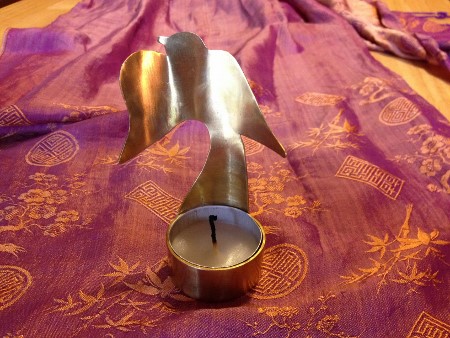
I read the paper to myself.  Here is some of what the paper says: “This candleholder spreads peaceful light from the remains of a brass bomb shell. Handcrafted by artisans of Cambodia’s Rajana Association. . . . ‘When we make jewelry [like this] then we know our country has peace,’ said one young silversmith.”

Willa gives me a hug and skips off to play. I watch the children, holding the candlestick for a while, until I call the children in for circle.


Marie: I want to tell a story that takes place in a far-away place called Cambodia. The people there were a having a big terrible problem where some people thought one thing and some people thought something else. And the people didn’t do talking about it. They got mad, mad, mad, mad and had a war.

Daphne: What’s a war?

Willa: It’s when you get so angry you’re like (waving arms like sword play) and set off bombs.

Marie: Big big fighting, mmmhmm.

Emerson: Yeah, and sometimes wars have those truck things that shoot out bullets. And bombs, they explode.

Willa: [In Cambodia] there were some bombs that didn’t explode, right?

Nayan: And there’s some places far away that didn’t have problems.

Kids name some far-away places.


Marie: This story is about the place called Cambodia.

Nayan: And there was bullet world.

Marie: The people there were having the terrible problems with each other. But then the people thought it was too much fighting and wanted it to stop. The people that thought one thing and the people that thought a different thing started talking to each other. And about how to fix the problems. Like how kids say, “I’ll be nice to you if you’ll be nice to me.” Finally the people did that. They said, “I’ll be nice to you if you’ll be nice to me,” and it stopped the fighting. But, because of all the fighting they’d had, there were still some bombs where they lived. So some people had the job to go find the bombs and put them away so they couldn’t hurt anybody.

Emerson: Spray them with water to try to kill the fire in them!

Marie: Yeah, they have ways to make them not dangerous anymore and had workers to do it. And, the people also wanted to make stuff. So when they had made the pieces of the bomb not dangerous anymore people thought and they thought and they thought. And they thought: hmmm, we had these big problems . . . and now things are better . . .

Emerson: (Really excited) And! And I know! How ’bout they make something out of those bombs?! And fill them up with water so it’s safe!

Willa: Yeah! And the water can just squirt out if there is a fire, (with a button like) push push push!

Marie: They did just exactly that, they did decide to make something good out of the stuff that had been the bombs.

Willa: They made a candle holder! They made something beautiful. This is something that my mother got for Marie that’s really really delicate.

Daphne: Is it her Christmas present?

Willa: It is her Christmas present! I wrapped it.

Emerson: It was in a box, right?

Willa: Yeah, and I wrapped it with blue paper, and I used a yellow ribbon for her.

Marie: We can pass the candle holder around before we light it ’cause I would like to share it with everybody.

Kids pass the candle holder around the circle, quiet and focused.


Marie: Everyone take one little scoouch back so we can light it, all see it, and be safe about the candle flame. (Getting ready to light the candle) Oh, I’m feeling so many feelings! That this candle used to be a bomb for hurting. And then people started talking, and made things better. And then people decided to make something beautiful out of it.

Nayan: Should you light it now?

Willa: It might do burning?

Marie: Well, it can’t do any more hurting now, it’s a candle holder, now that the people have made it into something wonderful.

Willa: It might burn up the metal?

Daphne: Or it might go all over the house?

Marie: Now it can’t be anything but a beautiful candle for looking at. I’m sure it’s completely safe. (Being careful like we are about candles when we light one together, I would add, though in the conversation I am certain the kids are needing to know that the candle can’t be a bomb anymore). This candle has been on a very big journey. It was a bomb, it used to be able to do hurting, but then the hurting stopped and people made it into a new thing, a wonderful thing. And then a mama saw it and thought it would be a good present. To be a beautiful candle to be special at our school. And a kid put it in a pretty striped box and wrapped it up in blue paper and tied it with a yellow string and gave it to me. And I opened it up and learned the candle’s story, and now I’m telling the story of the candle to you children.

Emerson: I wish I had it.

Marie: We’ll enjoy it, all of us together, and that’s the best part now of this candle story. It’s a pretty wonderful thing.

I light the candle and we’re singing together:

This little light of mine, I’m gonna let it shine
I’m gonna let it shine
This little light of mine, I’m gonna let it shine
Let it shine, let it shine, let it shine

Won’t let anyone (whsssh!) it out, I’m gonna let it shine . . .
Hide it under a bushel? No! I’m gonna let it shine . . .
Take this light around the world, I’m gonna let it shine . . .


We sing “This Little Light of Mine” with one finger for a candle, the other hand spread behind it, “to shine the light.”

The Something Beautiful candle
Marie Catrett
 

Staying close to the fire

It’s cold this week here in Central Texas, but the folks at 9th Street Schoolhouse are keeping the fires lit. Founder Caitlin Macklin, our guest today, writes about her students’ latest unit of study and how you might try this kind of collaborative, interest-driven inquiry with your kids at home.


This encouraging dragon kite soars above our classroom.Over here at the 9th Street Schoolhouse, we are engaged in a continual effort to close in on meaningful learning. We also seek to develop 21st-century skills and a lifelong love of learning in our students. To this purpose, the older class has started working based on a more open-ended learning model for our unit study. Unit study is a 45-minute chunk of time during our morning class lessons. For the next couple of weeks until the winter holiday, our unit will focus on student-driven, curiosity-based questioning. Students will become seekers, hot on the trail of inquiry, researching the answers to these questions via internet searches, supplementing with written reference material, and contacting knowledgeable people as well.


This is how it will work:

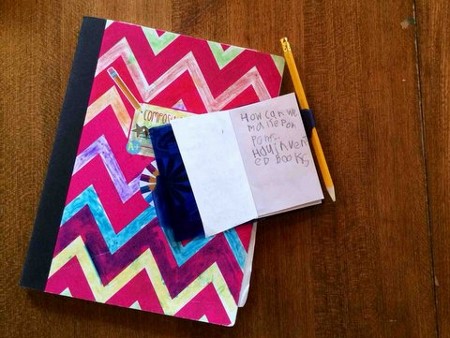
Students will be generating questions in a small notebook. The notebook—dubbed our Book of Wonderings—will be carried back and forth between home and the schoolhouse. In fact, we recommend that they keep it in a pocket at all times, because you never know when curiosity will strike! It is their responsibility to generate at least one question per day on their own time. Questions should be about things students want to know, are curious about, and have a genuine interest in finding out. They may be broad or narrow, easy or difficult. At the heart of it, their questions should spark the fire of their interest and be Important To Their Lives.

“How can we make pom poms? Who invented books?”

During the unit study portion of our class lesson time each day, students will share their questions. We will alternate turns of whose question we will answer each day. Students will mainly use the internet to find out answers to their questions, also seeking out good books and people who know. They will keep a record of their findings on notepads and posters. Students will help each other answer these questions. Discussing what they find, how to search, and what does it all mean will create more lasting learning.

As their mentor, I will guide them to evaluate the validity of the sources they use and will encourage them to go deeper into their findings. If a question can't be answered in one session, we will keep with it until we are satisfied. Perhaps a question will spark a longer project for a student or the whole class.

We will share the findings and process of this unit with our community at our end-of-semester Showcase. Please follow our blog if you are interested in the conclusion of the unit.

The goals of this unit are to:

  • Develop critical thinking, reading comprehension, collaborative work habits, and interpersonal skills.
  • Refine the ability to question effectively.
  • Build technological proficiency.
  • Generate inner motivation through understanding that learning is an essential part of everyday life.
  • Connect students’ lives and what they care about to what is being learned.

This collaborative, open-ended research method is inspired by:

  • An amazing article from Wired magazine.
  • Sugata Mitra's research in child-driven Self Organized Learning Environments (SOLEs).
  • Most of all, it is based on the experiences Laura and I have had teaching in the classroom, and our desire to move toward the fiery source of interest that is at the heart of kids' passion to know. We continue to strive toward a Free to Learn approach, while maintaining a strong mentoring relationship and offering our own experiences and ideas to expand the kids’ growing edges. As educators, we have many questions and will continue to refine and research as we go.

Interested in trying this at home?

You can download the SOLE Toolkit from TED. Once you get started with your youth, here are some suggestions for what you can do to support your students’ process:

  • Begin noticing when your children have questions.
  • Help them develop deeper questions that they can bring to their explorations.
  • Encourage them to write these questions down in their Book of Wonderings (or whatever they choose to call their special book!).
  • Read about the inspiration for this project. It will give you good background info and insight into guiding the children to follow their own purposes for learning.
  • Observe your children, notice any changes in their enthusiasm for learning, or school, or life!

We would love to hear from you if you are engaged in this learning design. Keep in touch by commenting on our Facebook page. You can also post on the SOLE Tumblr to connect with the larger movement.

In closing, here’s a great truth from author Sir Arthur C. Clarke that Mitra references:

“If children have interest, education happens.”

For us, finding that coal of red-hot interest in each child is what it is all about.

Caitlin Macklin

The future is STEAMy

Maggie Duval wears many hats comfortably: event producer, web developer, futurist, alt educator, mom. In her guest post for Alt Ed Austin she shares the news about her latest project, STEAM3, the conference and “Interactive Playground” that is shaping up to be one of the most interesting events of 2014.

GIVEAWAY: As part of Alt Ed Austin’s 2nd anniversary celebration, we have two pairs of Interactive Playground passes to give away—each good for one adult and one student. There are lots of ways to enter the drawing; you’ll find the entry form at the end of the post, along with a special discount code for all Alt Ed Austin readers who want to attend the whole shebang. Thanks, Maggie!


I’m very excited about a new project I’m working on that weaves together my four great loves:  alternative approaches to education (including STEM/STEAM), mining the brilliance that lives at the intersection of art and technology, futures studies, and emerging technology. Called STEAM3 (Science + Tech + Engineering + Arts + Math “cubed”), it will take place in early March and is the first public event of its kind to present a comprehensive look into the future of experiential learning. It will provide an interactive stage for the exploration and demonstration of the emerging approaches, formats, technologies, and learning models that will redefine education over the next decade.

The buzz is huge around STEM in education, which focuses on bringing kids up to speed on science, technology, engineering, and math skills by masterfully blending holistic and cross-disciplinary approaches to teaching and engagement. However, many are finally acknowledging the importance of the arts in that equation, hence the “A” in STEAM. The “cubed” part comes from our desire to address the whole child, explore alternative approaches to education (which as a mom I’ve been passionate about since my own childhood), as well as engendering a positive, empowered approach to what’s coming toward us in the future.

I have developed the event with professional futurist Derek Woodgate of The Futures Lab, who is also Consultant in Residence at the Digital Arts and Entertainment Lab (DAEL) at Georgia State University. I serve as CEO for two divisions of The Futures Lab, Inc., Learning Innovations in Future Education (LIFE) and the Future Entertainment and Events Lab (FEEL). The latter was formerly known as Plutopia Productions, Inc., which I also headed up, and we produced numerous “sense events” at SXSW Interactive and beyond.

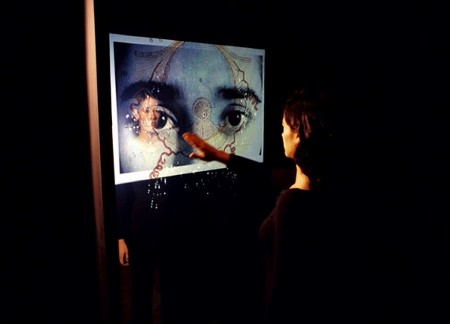
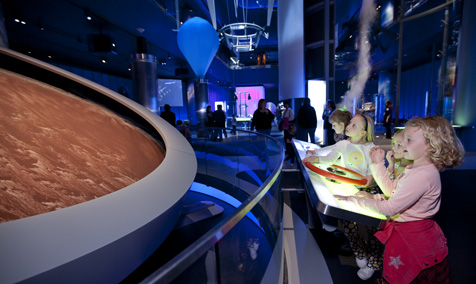
For this unique two-day event held in Austin, Texas, we’ve assembled some of the world’s foremost experts in the field of future education as well as the most innovative and immersive demonstrations and exhibits of emerging educational technologies in what we’re terming our “Interactive Playground,” featuring such areas as the Living Classroom, Make Magic, Interactive Storytelling, and the Game of Learning. Special panels and demos will address topics such as alternative approaches to education, avatars for learning, “education is art, art is education,” girls in engineering, and more.

The family-friendly event is for parents, kids, and educators certainly, but also for artists, instructional designers, “makers,” instructors/trainers, content creators, mobile development designers, researchers, and more! And this is only the beginning of our journey. It will continue through a number of similar events that we are planning for Atlanta, Georgia; Belo Horizonte, Brazil; and Manchester, UK, as well as through an online post-event portal and virtual and in-person salons.

Our Keynote Speakers include:

There will also be talks and demos from MIT Media Lab’s Lifelong Kindergarten group, Nano Art by Cris Orfescu, Experimental Geography by Nato Thompson, and Algorithmic Art from Joel Kahn. And don’t miss Art, Technology, and Augmented Reality from Marvin Neibuhr and Dr. Bruce Niebuhr, Gamification for Learning by Billy Joe Cain, and Makerspace, a space for young children to learn about STEAM-oriented topics with Joseph Lopez, Head of Faculty of Convergent Media at the University of Incarnate Word in San Antonio.

STEAM3
Conference and Interactive Playground
March 1 & 2, 2014
UT Commons Learning Center
JJ Pickle Research Campus, University of Texas
10100 Burnet Road, Austin, TX 78758

VIP Party for conference ticket holders
and special guests only

Saturday, March 1, at ATX Hackerspace
9701 Dessau Road, Suite 304, Austin, TX 78754

More information and tickets are available at steam3.com. Full Conference + Interactive Playground + VIP party tickets are priced at $99.95 until December 31—and Alt Ed Austin readers get an extra $10 off this special rate! Just use the coupon code ALTEDATX at checkout. Feel free to share with your friends. On January 1, the price goes up to $124.95. Interactive Playground–only tickets range from $7.50 to $25.

This event is sponsored in part by The Futures Lab, Inc., Learning Innovations in Future Education (LIFE), Skybridge Academy, and ATX Hackerspace.

See you there!

Maggie Duval


Enter below to win one of two pairs of adult + student passes to the STEAM3 Interactive Playground on either day!

a Rafflecopter giveaway