Preparing for the SAT by means of alternative education

Michael Strong is co-founder of the Khabele Strong Incubator, a new Austin school serving students of middle and high school age. He is also author of the book The Habit of Thought: From Socratic Seminars to Socratic Practice, a frequent speaker on TEDx stages, founder or co-founder of several successful schools, and an advocate for nurturing the entrepreneurial spirit as a force for social good. In this guest post, Michael addresses an issue I hear often in my consultation work with parents considering alt schooling for their kids: What about the SAT?

Many of those exploring alternative education models do so in part because they are repelled by the lockstep curriculum and testing regimen associated with traditional schooling. They are committed to a “follow the child” philosophy, according to which educators support student interests rather than test prep.

While I am committed to personalized education that nurtures a child’s interests, I am not hostile to the SAT. In fact, I find that, under some circumstances, an alternative education can result in superior SAT scores.

This perspective is based on my own experience. I was raised on a farm with a 1.5-hour bus ride each direction. Our small black-and-white television received two channels occasionally; my siblings and I had to be pretty desperate to try to watch TV. Within this context, I became a reader—a voracious reader. In sixth grade, a friend and I recorded the books we were reading. I was already reading a 200-page book every night.

At the same time, he and I would play chess on the long bus rides to and from school. Because the chess pieces would often fall off the board as we went over bumps, we became good at remembering where they were on the board from memory. Eventually we quit using the board entirely and played chess games with each other in our heads as we endured the long rides to and from school.

My real learning took place during reading and chess. I also did well on “memorize-and-forget” tests at school, doing almost no homework. I was admitted to Harvard without ever studying for the SAT (really without knowing what the SAT was). My parents, good working-class people, had no idea that Harvard was hard to get into; all they knew was that I was going to college back East somewhere.

Thus my own experience was dramatically different from that associated with children of angst-ridden “helicopter parents” today. All I did to get into Harvard was have fun reading and playing chess. What’s the big deal?

As an educator, I’ve focused on creating schools at which kids mostly have fun. But because of my natural intellectual bent, the form in which the “fun” tends to manifest itself is largely intellectual: we read and discuss intellectually serious articles, we play around with mathematical and scientific ideas, etc. And it is all a natural, spontaneous process based on engaging students’ authentic interests.

Not all students will necessarily obtain high SAT scores. But high-level academic performance does not require tedious studying. If one can create an environment in which students have fun engaging in intellectual activity, then high-level performance on the SAT is often a natural, spontaneous outcome.

There are a couple of reasons why the SAT is associated with stressful studying rather than spontaneous joy:

  1. Conventional schooling provides little intellectual development. The majority of class time is devoted either to classroom management or to “memorize-and-forget” activities. If we were able to monitor blood flow to the prefrontal cortex of most students during most school days, we would find little activity going on there. Most students most of the time are bored, flirting, joking, or goofing off in school. Insofar as much school activity is nonlearning, of course students are stressed out by a measure of cognitive functioning—their brains have been turned off for years, and now we ask them to turn it back on?
  2. Some parents place their own anxieties related to social status onto their children. In some cases they force children into competitive college admissions when such a direction is entirely inappropriate for that particular child. The result is anxiety and resentment toward the competitive process itself.

Young people are sponges who absorb their environment. If they are placed in an environment in which others are trying to avoid learning as much as possible, most will also work to avoid learning. If they are placed in an environment in which the play is primarily physical, or social, then most will become excellent at physical or social forms of play. If they are placed in an environment in which the play is primarily intellectual, then most will become excellent at intellectual forms of play.

It is a bizarre artifact of coercive schooling that intellectual activity is the one domain in which people are least likely to understand the playfulness of it. For many people, the term “intellectual” has heavy, unpleasant connotations. Just as alternative educators would rejoice in supporting their theatrically gifted students to star on Broadway, or their musically gifted students to win on American Idol, we should rejoice in supporting those with intellectual appetites in achieving in the manner that gives them the most joy.

For me, play and excellence are intimately related no matter what a child’s gifts. When I work with young people who are brilliant theatrically or musically, I want to help them develop their gifts in a playful, yet serious, manner. When I work with young people who thrive on social engagement, I love showing them ways in which the world richly rewards their gifts when properly directed (such as sales), and encourage them to interweave play and the development of extraordinary skill.

My mission as an educator is to identify the genius within every child, and then coach him or her to a joyful expression of that genius. From such a perspective, taking the SAT for some is really no different from an audition for others—simply a natural part of their particular journey. Sometimes “follow the child” implies creating an intellectually rich, yet playful, environment that happens to lead to great SAT scores. Sometimes it means creating a dramatically rich, yet playful, environment that happens to lead to an extraordinary range of acting skills.

Someday all students will attend “school” where most of the time they are engaged in joyful, yet serious and demanding, activities. And we’ll all wonder about that peculiar institution of the twentieth century that resulted in teen rebellion and the mass drugging of an entire generation of young people.

Michael Strong
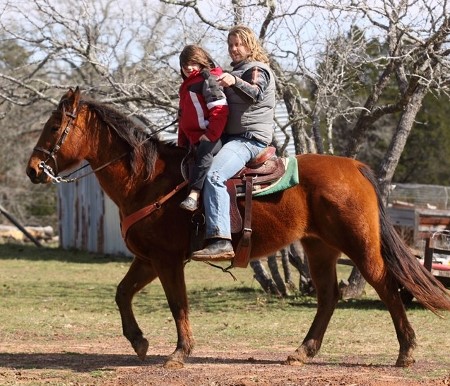
Kinetic learning with the Horse Boy

Alt Ed Austin is honored to share this moving story from guest contributor Jenny Lockwood. Jenny is an educational psychologist and alternative educator who works with a child known worldwide as The Horse Boy and with other remarkable children and their families at Horse Boy World in Elgin, Texas.

In April 2004 Rowan Isaacson was diagnosed with autism. At the age of two and a half he suffered from neurological tantrums that could last for hours and that his parents were powerless to stop. He could repeat long passages of text from his favorite books and movies but was unable to tell his parents he was hungry, thirsty, or tired. He was incontinent and unable to make friends. At age three his speech therapist “gave up” on him and told his parents that he would never use expressive language.

That was almost ten years ago. Rowan is 12 now, and earlier today he told me that he wanted to open his own zoo to provide “a forever home for animals that are abused and neglected.” He is ahead academically, has friends of all ages, and wants to help other special (his word) kids like himself learn to talk, read, and write. So what changed?

When he was almost four years old, Rowan ran away from his father, Rupert, into their neighbor’s horse pasture and threw himself down on the ground in front of a horse called Betsy. His Dad, a lifelong horse person, was terrified that his precious son was about to be trodden on and certainly did not expect Betsy to lower her head and begin to sniff and breathe on Rowan whilst he giggled in delight.

Up until this moment Rupert had been keeping Rowan away from horses, afraid that he would get hurt. But now both his son and the horse had given him a clear sign. He approached his neighbor, Stafford. Instead of worrying about liability, Stafford, a true southern gentleman, gave Rupert the key to his barn and said, “Have at it.”

From that moment onward, Rowan and Rupert lived in the saddle together. And the more they rode, the more Rowan began to talk. You can learn more about this story and the family’s subsequent trip to Mongolia in the book and film The Horse Boy.

Around the same time that Rowan met Betsy, his parents made the difficult decision to pull him out of school. He had been stuck all day in a windowless classroom with unmotivated teachers who kept the television turned up loud to drawn out the noise of the kids. Rupert began to homeschool Rowan, and Betsy was a huge part of that. They did a lot of learning, from letters and numbers to reading and writing to basic arithmetic and fractions, up there in the saddle together. When Rowan was on the horse, he seemed to be in an ideal position to soak up new information and make it his own.

Over the years we have discovered that the reason this works is the movement that the horse provides. Children with autism are often kinetic learners, meaning that they need to move in order to be able to learn. Force them to sit at a desk, and all they will learn is how to sit at a desk. Allow their bodies to move, and their brains will be free to receive and retain information.

I have been Rowan’s main teacher for about five years now. We discovered how important movement was to his learning after I had been working with him for about a year. Back then, we still did all his academics inside at a desk but allowed him frequent breaks to go outside and bounce on the trampoline or ride. We always supplemented what he was doing on the horse, of course, but when it came down to “serious” academics, we went inside.

Then one day I decided it was time to start his multiplication tables. He flew through his 0 and 1 times table, but when we got to the 2 times table he began to struggle. The more he struggled, the more he rocked in his chair, so that he eventually fell off and the chair fell on top of him. That seemed a good time to take a break!

So outside we went to the trampoline to blow off some steam. Then I had a brainwave: Why not learn the multiplication tables outside whilst bouncing and having fun? He loved the trampoline, so he was motivated to be on it . . . maybe the movement would help him pay attention?

Little did I know how true that would turn out to be.

By the end of a 30-minute bounce session, he had already mastered the 2 and 3 times tables. By the end of the week, we had done all 12 and were moving on to division (and I had lost more than a few pounds to boot). It was so successful, in fact, that from that day onward we abandoned any thought of trying to teach Rowan at a desk and instead created a whole curriculum for him based around movement. He learned angles through chase games and equations through treasure hunts. We discovered how to calculate the relationships among speed, distance, and time on bike rides and did force, mass, and acceleration through wheelbarrow rides.

What’s more, we began to try the same techniques with other children—some on the autism spectrum, some not—and it worked just as well, as long as the games and activities were adapted to those kids’ interests and passions and we incorporated movement, movement, and yet more movement.

We now work directly with hundreds of children on the autism spectrum each year and indirectly with thousands through the trainings we provide for equine professionals, teachers, and parents. To find out more about our work, please visit our website or contact me at jenny@horseboyworld.com.

Jenny Lockwood

Making mayhem: The perils of project-based learning

Wes Terrell directs the science department at Skybridge Academy. You can see and play with some of the cool projects his students have made—despite all of the obstacles Wes discusses below—at the Austin Mini Maker Faire on May 3, 2014.
 

Flynn and Jacquelyn, who will be our first two Skybridge graduates, building a 3D printer. We could have simply bought a printer, but they wanted to build one. And I love the idea that our students are leaving a maker legacy for future Skybridge kid…

Flynn and Jacquelyn, who will be our first two Skybridge graduates, building a 3D printer. We could have simply bought a printer, but they wanted to build one. And I love the idea that our students are leaving a maker legacy for future Skybridge kids to use for creating.

Making stuff is central to who I am as a person. I’m happiest when I’m in the midst of a project. So when I became a public school teacher, I set out to bring making to the masses of bored kids in the hopes that they would all be transformed and realize their inner maker.

In my mind, the opportunity for making was the only thing they were missing. We held a schoolwide junk drive and collected tons of awesome junk. I brought in every tool I owned, since the science department at my school had a $15,000 ventilator hood but didn’t have any $30 cordless drills. Then I told the kids to make something amazing. I showed them a bunch of pictures and videos of cool stuff that other people had made.

What followed was not the maker fantasyland that I had envisioned. Kids destroyed lots of things. They broke my tools. They even stole stuff. And worst of all, no one made anything spectacular. It dawned on me that I had grossly underestimated the energy that was required to maker-ize the public school system.
 

Cainan working on a solar-powered phone charger from a hacked phone charger that plugs into a cigarette lighter and a solar panel from a garage sale.

Cainan working on a solar-powered phone charger from a hacked phone charger that plugs into a cigarette lighter and a solar panel from a garage sale.

As time went on, I got better at developing systems that were more conducive to the outcomes I wanted. In some cases, I simply stopped expecting certain results. Eventually I took a job at Skybridge Academy, where many of the barriers to this kind of work were removed and the administration was in full support of this approach to learning. I thought that I could finally have the maker space of my dreams, but it turned out that there were still some pretty big obstacles to overcome.

I’ve read a lot lately about the value of getting kids to make things. If you’re someone who has been thinking about embarking on such a mission and you’ve read up on the subject, you might have the impression that these maker spaces are whimsical wonderlands of innovation. You hear less about the messy part. What follows is a brief survey of some of the hardest parts of doing this kind of work with kids. I wish I could follow this with a list of solutions. I can’t. But I do think these points are useful to keep in mind for anyone considering how to implement project-based learning activities with kids:
 

James converting a broken-down gasoline-powered go-kart into a three-wheeled electric vehicle. 

James converting a broken-down gasoline-powered go-kart into a three-wheeled electric vehicle.


Kids don’t know how to use tools. This sounds obvious, but I didn’t fully realize it when I started working with kids. Of course not many kids have used a chop saw before, but surely they know how to use a hammer. It turns out most of them don’t. I’ve seen kids use a drill as a hammer, a saw as a drill, and vice versa. If you’re going to use real tools—and most experienced project-based educators agree that you should—then you have to teach these things explicitly. It takes time, and tools will be destroyed in the process.

Beth and Sami getting some Arduino practice. They will build a gumball machine that releases candy only when you give the machine the correct secret knock. 

Beth and Sami getting some Arduino practice. They will build a gumball machine that releases candy only when you give the machine the correct secret knock.


Kids suck at putting things back where they belong. So you built shelves and got separate bins and even labeled each one. Kids will not put anything back where it belongs. I covered our hammers in plastic wrap, hung them from nails, and painted them with bright red paint to make bright red silhouettes of hammers that would compel a hammer user to put it back where it belongs. If you want to find one of these hammers, you’d be better off looking in the “Screwdrivers” bin. No matter how good your system is, kids will ignore it.

Teenagers are never going to act as excited as you want them to. You’ll think you’ve come up with the most exciting project these kids have ever been exposed to, when, without fail, someone will say, “This is lame.” It can be demoralizing, but you just have to remember that the most vocal opinions usually don’t represent the most popular.

Wyeth and art teacher Johnny Villarreal working on a drawing machine. 

Wyeth and art teacher Johnny Villarreal working on a drawing machine.


Lots of parents aren’t convinced that making is for their kids. Some people think that “hands-on” learning is synonymous with vocational learning, which is synonymous with my-kid-isn’t-going-to-college. Lots of parents think that their kids will be better prepared for university by memorizing electron configurations and that making stuff is for the less ambitious.

Kids hate failure. Celebrating failure has become a popular mantra lately. At least a dozen presenters at SXSWedu last month mentioned it [and multiple guest contributors to this blog have discussed it.]. The idea is that kids learn to embrace the struggle and find little nuggets of wisdom in each failed attempt at creating something. The truth is that this is way easier said than done. Kids want to celebrate their failure about as much as they want to celebrate their acne. I’ve done prototyping activities with my daughter’s kindergarten class where literally half of the kids are crying. This is not a reason to stop trying to teach this valuable lesson; in fact, it’s exactly why you must teach them that failing is okay. But it’s not pretty. I think it’s easier if you point out your own failed attempts at something, but it takes a lot of training before kids start to get this.

My messy maker classroom.

My messy maker classroom.

Some kids won’t ever be makers. A common belief among the maker crowd is that everyone is a maker. I want to believe this is true, and it’s my goal as an educator to try to prove it to all kids. I want every kid to experience that feeling you get when you create something. Some kids just don’t see the value in toiling away to create something that they can buy at the store for $10, especially when their version doesn’t look as nice and or work as well.

Kids aren’t as creative as everyone makes them out to be. I know this sounds like a terrible thing for a parent or educator to say, but it’s true. We’re told that kids are these magical little creatures that are just brimming with fantastic ideas, and that if we just give them the chance they will shine. The fact is that creativity is a skill that has to be taught, just like any other. Most kids have had their creativity stifled along the way, and so they must relearn this skill. Creativity can be taught and nurtured and refined, and we have to create environments in which this can happen. Just don’t be surprised when a group of kids fails to amaze you with their creativity. This is not to say that I am not often blown away by the ideas that kids come up with; I am. But I’m also frequently not blown away. I don’t find this discouraging; it just reinforces the idea that for me, teaching creativity is as important as teaching literacy.


I am a full-fledged supporter of the maker movement, but I know it’s not all fun and games. It’s messy, frustrating, and even depressing when it’s not going well. We can learn from each other and find out what works and what doesn’t, but there will always be challenges that lead us to question our approach.

Of course, if it were easy, then everyone would be doing it. And if we want kids to be motivated by their failed attempts, then we’d better be sure that they see us doing the same. Hats off to all those who fight the good fight.

Wes Terrell

Learner-driven communities: The future has arrived

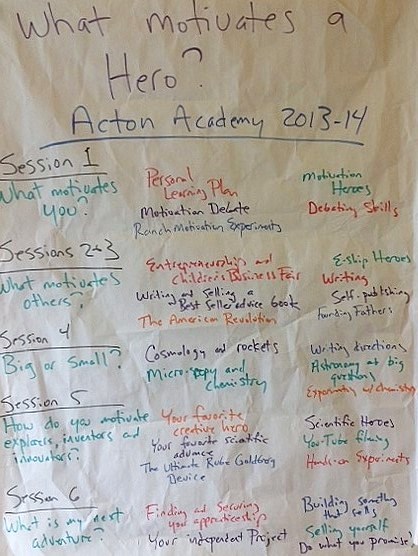
At a special open house during SXSWedu earlier this month, kids at Acton Academy explained to a crowd of adults—locals and out-of-towners alike—how their unusual school works. Concluding the event, cofounder and guide Jeff Sandefer spoke fervently about his vision for the future of education. Today Jeff joins us as a guest contributor to share some of those thoughts and a few glimpses of daily life at Acton.

I predict that the 21st century will see the rise of learner-driven communities, a disruptive educational force wherein self-directed learners, in a community tightly bound by personal covenants and contracts, use the full power of the Internet to craft a transformative, personalized learning path. Even better, I believe these learner-driven communities will be able to deliver a transformational education for less than $2,000 per student per year.

Sound like a fantasy? It might be, except that I’ve been amazed as I have dug deeply into the research of Sugata Mitra and his Hole-in-the-Wall experiments, where children in some of the poorest villages in Africa and Asia, armed only with an Internet terminal—and no teacher—have outperformed the best privates schools in their countries.

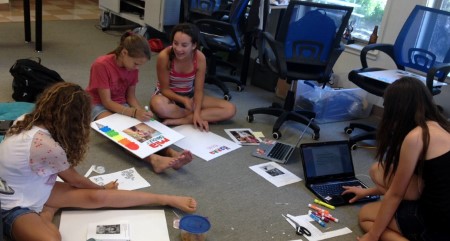
And I have seen it with my own eyes as a middle school guide at Acton Academy, an Austin-based school that uses multiage classrooms, the latest game-based adaptive computer programs for core skills, and questlike adventures for deeper learning in a studio increasingly run by the students themselves.

Our young people at Acton, each believing he or she is on a hero’s journey that will change the world, are learning that courage, grit, and perseverance matter far more than regurgitating facts that easily can be accessed on Google. They are mastering process and technique at a rapid rate, beginning to create personalized courses from expert knowledge, simulations, processes, and challenges that the Internet puts at their fingertips. 

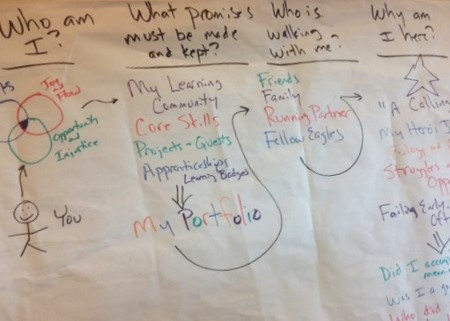
In a learner-driven community, each learner chooses his or her own path and challenges, keeping track of multiple projects as early as age six using SMART (specific, measurable, attainable, results-oriented, and time-bound) goals and seeking to earn a series of badges that demonstrate proficiency. The studio is completely governed by the learners, using a series of written covenants and a governance system developed from scratch every year.

There are no grades or homework, though every piece of work is judged or force-ranked by a rigorous peer review, compared to world-class examples, or in a public exhibition. Adults are forbidden from answering a question while in the studio, instead encouraging learners to find the answers on their own or in collaboration with their peers.

By earning badges and collecting work in personalized online portfolios, young heroes in learner-driven communities can prepare to earn apprenticeships at an early age, experimenting with which path might lead to a personal calling in life.

Just as importantly, because these communities are largely self-governing, fewer and fewer adults need to be in the room. This means not only that learning accelerates as it arms our Acton Eagles to become lifelong learners who can tackle real-world challenges, but it may also allow us to deliver a superior education for $2,000 per student per year, as opposed to the $9,000 to $15,000 annual cost per student of a typical traditional school.

Learner-driven communities: an emerging educational force that just might change how we think about learning in the 21st century.

Jeff Sandefer

More Making at the Thinkery

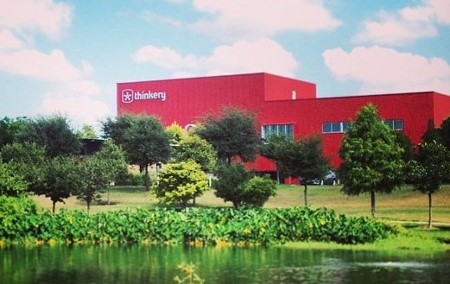
Guest contributor Emily Weerts is the Innovators’ Workshop Manager at the Thinkery, the new Austin Children’s Museum. Emily grew up in Northern California and is the daughter of an avid crafter and a handy model maker. A “Maker” before there was a “Movement,” Emily attended the first Maker Faire in California in 2006 before moving that summer to Austin, where she subsequently attended the 2007 and 2008 Austin Maker Faires. Emily dabbles in many Maker pursuits including screen printing, traditional and e-textiles, glass arts, paper crafts, robotics, and kitchen concoctions.

If you’ve been to the Thinkery, you may have noticed the two-story climbing structure or the drenching water exhibit, but before you got to the Light Lab, did you stop by a project table? Maybe you chatted with a resident artist working on a sculpture made from recycled materials. Or perhaps you spent some time tinkering with some LED lights, batteries, and conductive play dough. Did you pop into Kitchen Lab and create something out of corn starch plastic?

Making is a fundamental experience that the Thinkery wants to encourage and share with visitors of all ages.

In 2007 when Maker Faire came to Austin, staff at the Austin Children’s Museum recognized a shared value of learning through Making. In 2008, the Museum partnered to bring an extensive Maker Kids area to the Faire, and in the summer of 2009, the Museum developed and presented a Maker Kids feature exhibit to bring the Maker experience to many more visitors.

In designing the new museum, opportunities for Making and hands-on creative problem solving were at the heart of the planning process. Since the Thinkery opened in late 2013, Making has taken many forms. Visitors stopping in for an hour or two are most likely to encounter Making at the project tables in the Innovators’ Workshop, Spark Shop, and Kitchen Lab.

Here at the Thinkery we define Making broadly and encourage all people to think of themselves as Makers. At its simplest, Making is the act of creating something; from a quilt to a batch of cookies, there are learning opportunities at every step of the way. Making emphasizes skill development, like learning how to properly use a power drill or how to stitch a seam.

When presented in the context of a project, difficult concepts become more manageable. Multiplying fractions makes a bit more sense when done in the service of quadrupling a recipe. Suddenly, while designing a quilt, finding the hypotenuse of a triangle really is as easy as a2 + b2 = c2.

In developing Maker activities and programs at the Thinkery, there are a few guidelines we like to follow. We hope these tips and principles ring true and prove useful for educators everywhere:

  • Use real tools. Toys are lots of fun, but there are also many safe ways to introduce real tools to novice learners. Use a wooden mallet instead of a hollow plastic toy hammer. Introduce a three-year-old to stitching by using a yarn needle and plastic canvas.
  • It’s okay to fail. No great Maker gets perfect results every time. Far from it! Often the best learning happens during the process of making something and learning from mistakes. Take (calculated) risks, and don’t take yourself too seriously.
  • Making takes practice. Learning a new skill can be intimidating, but remember that the best Makers didn’t start out as experts; they had years of practice. With lots of practice, you can be great at anything.
  • When people are encouraged and equipped to make things themselves, they gain a strong ownership over their learning.  Let the Maker and the project guide the learning process.
  • Forget “Do-it-Yourself.” Making is most fun and productive when it’s done with others. Pair novice Makers with Maker Mentors to see how much everyone learns from each other. Let’s start a “Make-it-Together” movement!
  • Embrace your own “I don’t know” moments. It’s okay that you don’t know how to solder or use a sewing machine. You can still help learners by colearning, finding resources, or connecting them with Maker Mentors.
  • Resist the urge to “do it for them.” Keep your hands off the tools and materials as much as possible. Show learners how to do something and let them try it themselves.

If you aren’t sure where to get started, consider coming up with a Maker Resolution. At the Thinkery, we had all our staff set Maker Resolutions for 2014. Our diverse and creative team came up with a huge spectrum of projects for the new year, from creating a stop-motion animation music video to baking and decorating a three-tiered cake. One of our staff members resolved to learn how to make a website, and one of our Teen Volunteers plans to make her own prom dress.

May this year and all the years to come be filled with creativity, innovation, tinkering, and Making!

Emily Weerts

Join Emily and other Thinkery staff and volunteers on May 3 for some all-ages Making at this year’s Austin Mini Maker Faire!

A place at the table for failure

Educational psychologist Breana Sylvester, PhD, is leading her family on a journey through the alternative education landscape, observing and chronicling for others what she learns about noncoercive, interest-based learning communities. Here she shares an essay on failure adapted from her own blog, Dandelion Adventures.


Recently
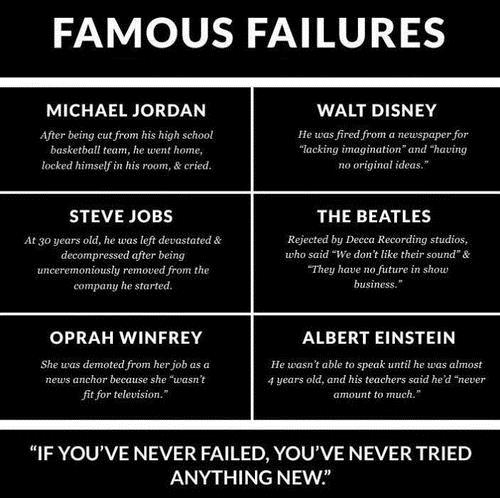
Ashton Kutcher made a surprise appearance at TEDYouth and decided to talk not about his successes but rather about his failures. Since then my corner of the internet has been atwitter with people sharing fun ideas, and I have seen a terrific number of illustrations of the utility and beauty of failure. Here’s an anonymous one currently making the rounds on social media:

What an incredibly important message to give to learners, child and adult! Failure is an opportunity to learn and grow. Sometimes it also helps us choose direction. Rarely will failure ruin all our plans for the future; usually it tells us we need to find new ways to approach our goals, and sometimes it even gives us hints as to how. In fact, not allowing children to fail can be impairing.

Yet our culture attaches a great deal of shame to failure. What do we lose, though, if failure is not an option? How does fear of failure influence how we treat one another and ourselves?

The above comic triggered some connections that I would like to share from what I have learned from educational psychology. In particular, Goal Orientation Theory and self-compassion came to mind.

Goal Orientation Theory, also known as Achievement Goal Theory, posits that our reasons for working toward goals can vary greatly and that our orientations toward our goals have implications for how well we learn new things and how we deal with failure in the process of learning. When we learn things because we enjoy the process of learning, we are more likely to remember what we learned and also more likely to see failure as a natural part of the learning process. This is known as adopting a mastery orientation.

Another orientation posited in earlier work on goals was called performance orientation, wherein the learner’s motivation behind work toward a goal was primarily that of success at that goal, whether it be making a good grade or obtaining recognition (or avoiding failure). It is possible to have a mix of more than one orientation toward a goal. Psychologists have done a great deal of research on these goal orientations and over time have modified the theories. (You can find updated information and research findings here.)

It seems clear to me that high pressure to succeed in the form of high-stakes assessments and competition for recognition such as we find in most, if not all, traditional school settings could only contribute to the performance orientation. I find myself wondering, then, what would a learning environment that supports a mastery orientation look like? What if failure and success weren’t so dichotomized?

The second concept that sprang to mind was that of self-compassion. I used to teach a college course on applied learning and motivation theory, and we would talk about inner voice and its influence on motivation. When we got to the part about the influences of our inner voice on our motivation and emotion, students would tell me how cheesy the idea of positive self-talk seemed to them. So at the beginning of the next class I would ask them to write down what they would say to a friend who was failing two classes and was afraid of losing his financial aid at the end of the semester. Once they were done, I’d ask them to turn over the card and write what they would say to themselves in the same situation. It wasn’t uncommon to hear nervous giggling and even gasps at the realization that their words to themselves were far harsher, and frequently unhelpful.

I was fortunate in my graduate school experience to learn a good bit about the psychological concepts of mindfulness and self-compassion from Kristin Neff, an expert on the study of the latter as a psychological construct. Of course, both mindfulness and compassion are appropriated from Buddhist philosophical concepts, but there is a lot of promising research on how they are currently being used in counseling settings.

It’s true that we rarely afford ourselves the same understanding, patience, and acceptance in our failures as we do those we care about; it takes practice and even hard work to learn to see failure as a necessary part of the human condition, but by freeing ourselves from the judgment of failure, we can more clearly see the path forward and enjoy the journey!

An Example: My own fear of failure

Recently Jerry Mintz, director of the Alternative Education Resource Organization (AERO), asked me what my goals were in regard to our family’s adventure in learning about alternatives to traditional educational settings. Up to that point, I’d felt that I had a somewhat clear idea of the things I knew I wanted to learn and those that I could pick up along the way. Even so, his question initially felt scrutinizing, given the early stage of our adventure planning. On reflection I realized that the reason the question made me feel uncomfortable was that I am afraid of failing, afraid of letting down the people who devote their lives to the learning environments I am just beginning to explore.

Just the tiniest shift in mindset—allowing myself to acknowledge my fear of failure and approaching his question as a learning opportunity—led me to experience a much deeper and more thought-out conceptualization of our adventures, which will, in all probability help me convey my goals to those I hope to work with. Yes, there’s a chance I may still fail at my ultimate goal of encouraging a large number of people to think more critically about how we educate students and teachers, but once my fears have been acknowledged, I can see past them, and I can see that what we gain by trying will be an experience of great value for me, for my family, and hopefully for others!

Here’s wishing you all wonderful opportunities to face your fears!

Breana Sylvester