Inspiring STEM learning in Austin youth

Alt Ed Austin doesn’t often publish guest posts from representatives of large corporations, but both the local Girl Scouts and the Microsoft Store staff were so excited to share the fun learning they’ve been doing together that we couldn't help but pass it along. Guest contributor Marco Cervantes is the store manager of the Austin Microsoft Store at The Domain, which offers free YouthSpark summer camps.
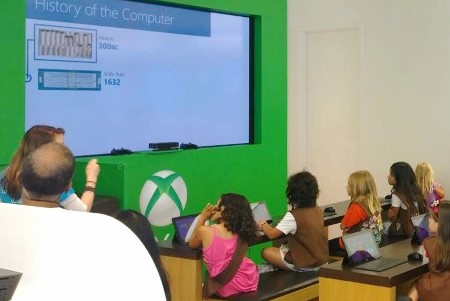

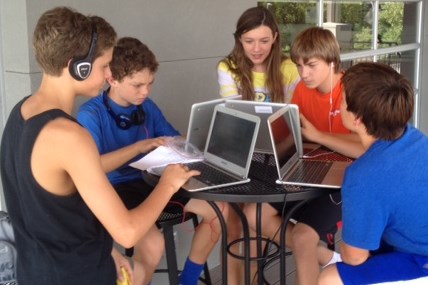
Brownies learn about the history of the computer to earn their “Computer Expert” badge in a recent workshop.
With all the available tech currently on the market, it’s easy for today’s youth to get sucked into a stream of unconscious thumb scrolling and finger tapping. As a manager at the Microsoft Store in Austin, I find frustrated parents sometimes pointing the finger at us, claiming that we are the source of their children’s lack of focus. However, our intention is quite the opposite. Microsoft is taking action to help involve today’s youth in meaningful and productive activities.

Amidst Austin’s booming tech scene, the next generation is deeply immersed in the digital world and will soon be the new employees managing projects and writing code. Yet these skills are seldom taught in elementary, middle school, and high school classrooms. To address this issue, the Microsoft Store at The Domain offers workshops to local youth to give them a head start in the fields of science, technology, engineering, and mathematics (STEM).

The Girl Scouts of Central Texas (GSCTX) is one of the many nonprofit organizations we have partnered with in the Austin area since the store opened in April 2012. To help meet the growing demands for hands-on STEM learning and to provide increased opportunity for girls, Microsoft has donated more than $500,000 in software to GSCTX. We host merit badge workshops two or three times a week for the Girl Scouts to teach them about internet safety, apps, and more. We extend free instruction to GSCTX staff members as well, with dedicated sessions to share Windows and Office proficiency tips so they can better organize and lead their troops.

“We strongly believe that investing in today’s youth and providing opportunities beyond the classroom are some of the most beneficial ways we can help set up the girls for a successful future,” says Lolis Garcia-Baab, director of marketing and communications at GSCTX. “We are helping to create the female leaders of tomorrow. By offering an outlet for youth to learn about technology, we are empowering them to reach their full potential, which may not be possible in many traditional classrooms.”

Microsoft’s dedication to helping the next generation extends far beyond the store walls. In addition to donations, our companywide YouthSpark initiative aims to create opportunities for 300 million youth around the world, including 50 million young people in the United States, by 2015. Through partnerships with governments, nonprofit organizations, and businesses, we connect them with education, employment, and entrepreneurship opportunities. For example, through our DreamSpark program, students gain access to professional developer and designer tools at no cost so they can get a head start on their careers or create the next big breakthrough in technology.

We are excited to help Austin youth create the world they want tomorrow, starting today. To learn more about Microsoft’s community and educational activities in Austin, please visit the store website.

Marco Cervantes

Step outside for learning

The Inside Outside School is known for its innovative incorporation of the outdoors into its academic curriculum. This guest post from IOS director Deborah Hale is adapted from photo essays she posted earlier this month on the school’s blog. Reading this might just lead you to try a few of these activities with your own kids this summer!


We are always looking for ways to get outside for math and science. Some of the most popular ways at our school involve math trails. In fact, a few months ago I decided to write a book about math trails. I thought it would be easy because I am so passionate about the topic, but it’s hard to convey on paper the excitement of an outdoor math adventure. I'm wondering if this should be a movie instead.

On this math trail there are a few stations where students find a whiteboard with a problem typical of what we've been doing in class. They have a trail map to record their work and answers on a clipboard.

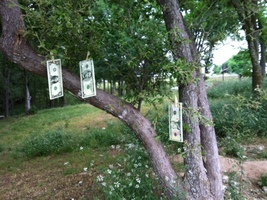
The magnetic garage door of the theater building is an excellent stop on the trail, now that we have a set of large magnetic money.


By the way, when you are studying money-related math outdoors, money can grow on trees . . .


. . . and even in the garden. This kind of math adventure is so much fun because it is a lot like an Easter egg hunt!


Speaking of Easter egg hunts, at station #3 on the trail, students found three eggs hidden under a traffic cone, each with six shells in it. The traffic cones are a great way to make it clear where the math stations are set up.

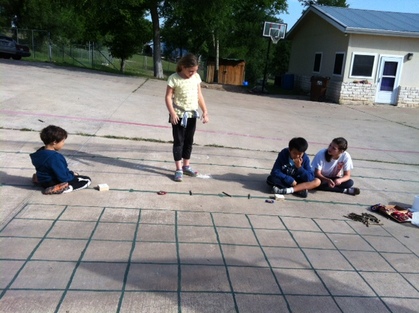
The driveway is part of our outdoor classroom. We used concrete paint to mark large number lines and a blank hundreds chart.


Here you can see examples of some of our manipulatives: wooden number blocks that the shop classes helped to create, felt number patches made last year in sewing classes, and wooden ten sticks. This student has just solved 82 minus 29. These activities all happened on the school grounds not far from the buildings.

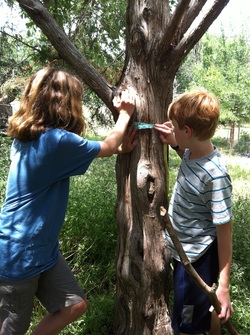
Next we found out what a math trail can look like in the woods down by the creek. Upper elementary students used the stick method to measure the height of trees. All you need is a stick and a measuring tape. They also worked to find the diameter of trees after determining the circumference. The circumference is measured at 4.5 feet up from the ground. Then you divide the circumference by pi (3.14). It is great to estimate before measuring, and then you can always throw in a little subtraction when you determine the difference between the estimate and the actual measurement. A final activity was measuring the canopy of a tree.

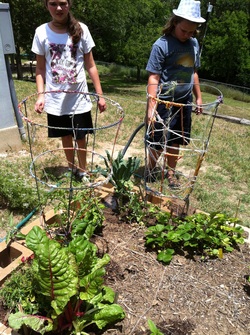
Another great way to integrate math and science is with a square foot garden. You can see the string that the students used earlier in the year to mark off the squares after measuring the perimeter and area of the planting space. Once the garden is divided, students must research the plants they want to cultivate to find out how many each square will support. We have harvested and replanted this garden throughout the school year. Growth of plants can be measured, recorded, and compared.

Another part of gardening is weighing the harvest and recording the data. Then you get to use the basil and tomatoes for making lasagna! Integrating math into cooking is another great way to make connections. This has been indoor work for us so far, until we get the rest of our outdoor kitchen set up (unless we are using our cob oven).

During our Native American cultural study, students created active learning connections in the garden by setting up a “three sisters” garden with Helen, our nature science teacher. We even “planted” a dead fish from our creek to enrich the soil. The corn provides a pole for the beans, the beans stabilize the corn plant and fix nitrogen, and the squash acts as mulch to prevent evaporation of moisture in the soil. The nutritional elements of these foods add additional material for learning.

Helen recently noticed some caterpillars and chrysalises on a mustard plant, so she brought in a number of books for the students to use to find out what they were seeing. It turned out to be a cabbage butterfly, and the following week we all got to see one of them freshly emerged and drying its wings.

We encourage you to step outside whenever you can, too, and see what you can learn!

Deborah Hale


Preparing for the SAT by means of alternative education

Michael Strong is co-founder of the Khabele Strong Incubator, a new Austin school serving students of middle and high school age. He is also author of the book The Habit of Thought: From Socratic Seminars to Socratic Practice, a frequent speaker on TEDx stages, founder or co-founder of several successful schools, and an advocate for nurturing the entrepreneurial spirit as a force for social good. In this guest post, Michael addresses an issue I hear often in my consultation work with parents considering alt schooling for their kids: What about the SAT?

Many of those exploring alternative education models do so in part because they are repelled by the lockstep curriculum and testing regimen associated with traditional schooling. They are committed to a “follow the child” philosophy, according to which educators support student interests rather than test prep.

While I am committed to personalized education that nurtures a child’s interests, I am not hostile to the SAT. In fact, I find that, under some circumstances, an alternative education can result in superior SAT scores.

This perspective is based on my own experience. I was raised on a farm with a 1.5-hour bus ride each direction. Our small black-and-white television received two channels occasionally; my siblings and I had to be pretty desperate to try to watch TV. Within this context, I became a reader—a voracious reader. In sixth grade, a friend and I recorded the books we were reading. I was already reading a 200-page book every night.

At the same time, he and I would play chess on the long bus rides to and from school. Because the chess pieces would often fall off the board as we went over bumps, we became good at remembering where they were on the board from memory. Eventually we quit using the board entirely and played chess games with each other in our heads as we endured the long rides to and from school.

My real learning took place during reading and chess. I also did well on “memorize-and-forget” tests at school, doing almost no homework. I was admitted to Harvard without ever studying for the SAT (really without knowing what the SAT was). My parents, good working-class people, had no idea that Harvard was hard to get into; all they knew was that I was going to college back East somewhere.

Thus my own experience was dramatically different from that associated with children of angst-ridden “helicopter parents” today. All I did to get into Harvard was have fun reading and playing chess. What’s the big deal?

As an educator, I’ve focused on creating schools at which kids mostly have fun. But because of my natural intellectual bent, the form in which the “fun” tends to manifest itself is largely intellectual: we read and discuss intellectually serious articles, we play around with mathematical and scientific ideas, etc. And it is all a natural, spontaneous process based on engaging students’ authentic interests.

Not all students will necessarily obtain high SAT scores. But high-level academic performance does not require tedious studying. If one can create an environment in which students have fun engaging in intellectual activity, then high-level performance on the SAT is often a natural, spontaneous outcome.

There are a couple of reasons why the SAT is associated with stressful studying rather than spontaneous joy:

  1. Conventional schooling provides little intellectual development. The majority of class time is devoted either to classroom management or to “memorize-and-forget” activities. If we were able to monitor blood flow to the prefrontal cortex of most students during most school days, we would find little activity going on there. Most students most of the time are bored, flirting, joking, or goofing off in school. Insofar as much school activity is nonlearning, of course students are stressed out by a measure of cognitive functioning—their brains have been turned off for years, and now we ask them to turn it back on?
  2. Some parents place their own anxieties related to social status onto their children. In some cases they force children into competitive college admissions when such a direction is entirely inappropriate for that particular child. The result is anxiety and resentment toward the competitive process itself.

Young people are sponges who absorb their environment. If they are placed in an environment in which others are trying to avoid learning as much as possible, most will also work to avoid learning. If they are placed in an environment in which the play is primarily physical, or social, then most will become excellent at physical or social forms of play. If they are placed in an environment in which the play is primarily intellectual, then most will become excellent at intellectual forms of play.

It is a bizarre artifact of coercive schooling that intellectual activity is the one domain in which people are least likely to understand the playfulness of it. For many people, the term “intellectual” has heavy, unpleasant connotations. Just as alternative educators would rejoice in supporting their theatrically gifted students to star on Broadway, or their musically gifted students to win on American Idol, we should rejoice in supporting those with intellectual appetites in achieving in the manner that gives them the most joy.
For me, play and excellence are intimately related no matter what a child’s gifts. When I work with young people who are brilliant theatrically or musically, I want to help them develop their gifts in a playful, yet serious, manner. When I work with young people who thrive on social engagement, I love showing them ways in which the world richly rewards their gifts when properly directed (such as sales), and encourage them to interweave play and the development of extraordinary skill.

My mission as an educator is to identify the genius within every child, and then coach him or her to a joyful expression of that genius. From such a perspective, taking the SAT for some is really no different from an audition for others—simply a natural part of their particular journey. Sometimes “follow the child” implies creating an intellectually rich, yet playful, environment that happens to lead to great SAT scores. Sometimes it means creating a dramatically rich, yet playful, environment that happens to lead to an extraordinary range of acting skills.

Someday all students will attend “school” where most of the time they are engaged in joyful, yet serious and demanding, activities. And we’ll all wonder about that peculiar institution of the twentieth century that resulted in teen rebellion and the mass drugging of an entire generation of young people.

Michael Strong

Kinetic learning with the Horse Boy

Alt Ed Austin is honored to share this moving story from guest contributor Jenny Lockwood. Jenny is an educational psychologist and alternative educator who works with a child known worldwide as The Horse Boy and with other remarkable children and their families at Horse Boy World in Elgin, Texas.

In April 2004 Rowan Isaacson was diagnosed with autism. At the age of two and a half he suffered from neurological tantrums that could last for hours and that his parents were powerless to stop. He could repeat long passages of text from his favorite books and movies but was unable to tell his parents he was hungry, thirsty, or tired. He was incontinent and unable to make friends. At age three his speech therapist “gave up” on him and told his parents that he would never use expressive language.

That was almost ten years ago. Rowan is 12 now, and earlier today he told me that he wanted to open his own zoo to provide “a forever home for animals that are abused and neglected.” He is ahead academically, has friends of all ages, and wants to help other special (his word) kids like himself learn to talk, read, and write. So what changed?

When he was almost four years old, Rowan ran away from his father, Rupert, into their neighbor’s horse pasture and threw himself down on the ground in front of a horse called Betsy. His Dad, a lifelong horse person, was terrified that his precious son was about to be trodden on and certainly did not expect Betsy to lower her head and begin to sniff and breathe on Rowan whilst he giggled in delight.

Up until this moment Rupert had been keeping Rowan away from horses, afraid that he would get hurt. But now both his son and the horse had given him a clear sign. He approached his neighbor, Stafford. Instead of worrying about liability, Stafford, a true southern gentleman, gave Rupert the key to his barn and said, “Have at it.”

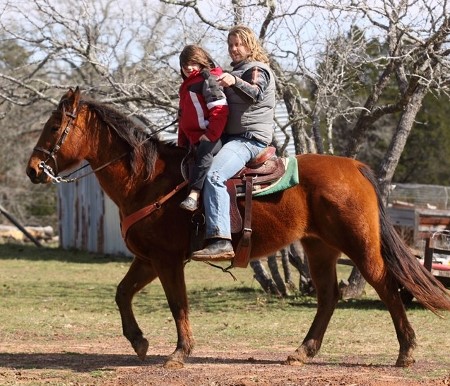
From that moment onward, Rowan and Rupert lived in the saddle together. And the more they rode, the more Rowan began to talk. You can learn more about this story and the family’s subsequent trip to Mongolia in the book and film The Horse Boy.

Around the same time that Rowan met Betsy, his parents made the difficult decision to pull him out of school. He had been stuck all day in a windowless classroom with unmotivated teachers who kept the television turned up loud to drawn out the noise of the kids. Rupert began to homeschool Rowan, and Betsy was a huge part of that. They did a lot of learning, from letters and numbers to reading and writing to basic arithmetic and fractions, up there in the saddle together. When Rowan was on the horse, he seemed to be in an ideal position to soak up new information and make it his own.

Over the years we have discovered that the reason this works is the movement that the horse provides. Children with autism are often kinetic learners, meaning that they need to move in order to be able to learn. Force them to sit at a desk, and all they will learn is how to sit at a desk. Allow their bodies to move, and their brains will be free to receive and retain information.

I have been Rowan’s main teacher for about five years now. We discovered how important movement was to his learning after I had been working with him for about a year. Back then, we still did all his academics inside at a desk but allowed him frequent breaks to go outside and bounce on the trampoline or ride. We always supplemented what he was doing on the horse, of course, but when it came down to “serious” academics, we went inside.

Then one day I decided it was time to start his multiplication tables. He flew through his 0 and 1 times table, but when we got to the 2 times table he began to struggle. The more he struggled, the more he rocked in his chair, so that he eventually fell off and the chair fell on top of him. That seemed a good time to take a break!

So outside we went to the trampoline to blow off some steam. Then I had a brainwave: Why not learn the multiplication tables outside whilst bouncing and having fun? He loved the trampoline, so he was motivated to be on it . . . maybe the movement would help him pay attention?

Little did I know how true that would turn out to be.

By the end of a 30-minute bounce session, he had already mastered the 2 and 3 times tables. By the end of the week, we had done all 12 and were moving on to division (and I had lost more than a few pounds to boot). It was so successful, in fact, that from that day onward we abandoned any thought of trying to teach Rowan at a desk and instead created a whole curriculum for him based around movement. He learned angles through chase games and equations through treasure hunts. We discovered how to calculate the relationships among speed, distance, and time on bike rides and did force, mass, and acceleration through wheelbarrow rides.

What’s more, we began to try the same techniques with other children—some on the autism spectrum, some not—and it worked just as well, as long as the games and activities were adapted to those kids’ interests and passions and we incorporated movement, movement, and yet more movement.

We now work directly with hundreds of children on the autism spectrum each year and indirectly with thousands through the trainings we provide for equine professionals, teachers, and parents. To find out more about our work, please visit our website or contact me at jenny@horseboyworld.com.

Jenny Lockwood

Making mayhem: The perils of project-based learning

Wes Terrell directs the science department at Skybridge Academy. You can see and play with some of the cool projects his students have made—despite all of the obstacles Wes discusses below—at the Austin Mini Maker Faire on May 3, 2014.
 

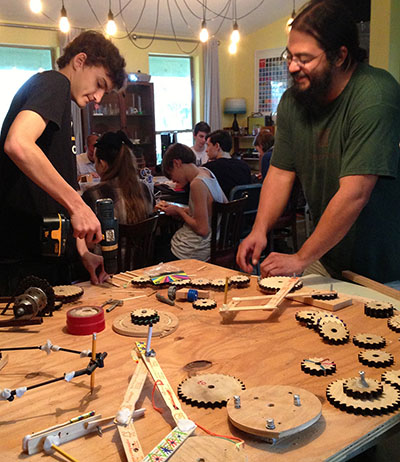
Flynn and Jacquelyn, who will be our first two Skybridge graduates, building a 3D printer. We could have simply bought a printer, but they wanted to build one. And I love the idea that our students are leaving a maker legacy for future Skybridge kid…

Flynn and Jacquelyn, who will be our first two Skybridge graduates, building a 3D printer. We could have simply bought a printer, but they wanted to build one. And I love the idea that our students are leaving a maker legacy for future Skybridge kids to use for creating.

Making stuff is central to who I am as a person. I’m happiest when I’m in the midst of a project. So when I became a public school teacher, I set out to bring making to the masses of bored kids in the hopes that they would all be transformed and realize their inner maker.

In my mind, the opportunity for making was the only thing they were missing. We held a schoolwide junk drive and collected tons of awesome junk. I brought in every tool I owned, since the science department at my school had a $15,000 ventilator hood but didn’t have any $30 cordless drills. Then I told the kids to make something amazing. I showed them a bunch of pictures and videos of cool stuff that other people had made.

What followed was not the maker fantasyland that I had envisioned. Kids destroyed lots of things. They broke my tools. They even stole stuff. And worst of all, no one made anything spectacular. It dawned on me that I had grossly underestimated the energy that was required to maker-ize the public school system.
 

Cainan working on a solar-powered phone charger from a hacked phone charger that plugs into a cigarette lighter and a solar panel from a garage sale.

Cainan working on a solar-powered phone charger from a hacked phone charger that plugs into a cigarette lighter and a solar panel from a garage sale.

As time went on, I got better at developing systems that were more conducive to the outcomes I wanted. In some cases, I simply stopped expecting certain results. Eventually I took a job at Skybridge Academy, where many of the barriers to this kind of work were removed and the administration was in full support of this approach to learning. I thought that I could finally have the maker space of my dreams, but it turned out that there were still some pretty big obstacles to overcome.

I’ve read a lot lately about the value of getting kids to make things. If you’re someone who has been thinking about embarking on such a mission and you’ve read up on the subject, you might have the impression that these maker spaces are whimsical wonderlands of innovation. You hear less about the messy part. What follows is a brief survey of some of the hardest parts of doing this kind of work with kids. I wish I could follow this with a list of solutions. I can’t. But I do think these points are useful to keep in mind for anyone considering how to implement project-based learning activities with kids:
 

James converting a broken-down gasoline-powered go-kart into a three-wheeled electric vehicle. 

James converting a broken-down gasoline-powered go-kart into a three-wheeled electric vehicle.


Kids don’t know how to use tools. This sounds obvious, but I didn’t fully realize it when I started working with kids. Of course not many kids have used a chop saw before, but surely they know how to use a hammer. It turns out most of them don’t. I’ve seen kids use a drill as a hammer, a saw as a drill, and vice versa. If you’re going to use real tools—and most experienced project-based educators agree that you should—then you have to teach these things explicitly. It takes time, and tools will be destroyed in the process.

Beth and Sami getting some Arduino practice. They will build a gumball machine that releases candy only when you give the machine the correct secret knock. 

Beth and Sami getting some Arduino practice. They will build a gumball machine that releases candy only when you give the machine the correct secret knock.


Kids suck at putting things back where they belong. So you built shelves and got separate bins and even labeled each one. Kids will not put anything back where it belongs. I covered our hammers in plastic wrap, hung them from nails, and painted them with bright red paint to make bright red silhouettes of hammers that would compel a hammer user to put it back where it belongs. If you want to find one of these hammers, you’d be better off looking in the “Screwdrivers” bin. No matter how good your system is, kids will ignore it.

Teenagers are never going to act as excited as you want them to. You’ll think you’ve come up with the most exciting project these kids have ever been exposed to, when, without fail, someone will say, “This is lame.” It can be demoralizing, but you just have to remember that the most vocal opinions usually don’t represent the most popular.

Wyeth and art teacher Johnny Villarreal working on a drawing machine. 

Wyeth and art teacher Johnny Villarreal working on a drawing machine.


Lots of parents aren’t convinced that making is for their kids. Some people think that “hands-on” learning is synonymous with vocational learning, which is synonymous with my-kid-isn’t-going-to-college. Lots of parents think that their kids will be better prepared for university by memorizing electron configurations and that making stuff is for the less ambitious.

Kids hate failure. Celebrating failure has become a popular mantra lately. At least a dozen presenters at SXSWedu last month mentioned it [and multiple guest contributors to this blog have discussed it.]. The idea is that kids learn to embrace the struggle and find little nuggets of wisdom in each failed attempt at creating something. The truth is that this is way easier said than done. Kids want to celebrate their failure about as much as they want to celebrate their acne. I’ve done prototyping activities with my daughter’s kindergarten class where literally half of the kids are crying. This is not a reason to stop trying to teach this valuable lesson; in fact, it’s exactly why you must teach them that failing is okay. But it’s not pretty. I think it’s easier if you point out your own failed attempts at something, but it takes a lot of training before kids start to get this.

My messy maker classroom.

My messy maker classroom.

Some kids won’t ever be makers. A common belief among the maker crowd is that everyone is a maker. I want to believe this is true, and it’s my goal as an educator to try to prove it to all kids. I want every kid to experience that feeling you get when you create something. Some kids just don’t see the value in toiling away to create something that they can buy at the store for $10, especially when their version doesn’t look as nice and or work as well.

Kids aren’t as creative as everyone makes them out to be. I know this sounds like a terrible thing for a parent or educator to say, but it’s true. We’re told that kids are these magical little creatures that are just brimming with fantastic ideas, and that if we just give them the chance they will shine. The fact is that creativity is a skill that has to be taught, just like any other. Most kids have had their creativity stifled along the way, and so they must relearn this skill. Creativity can be taught and nurtured and refined, and we have to create environments in which this can happen. Just don’t be surprised when a group of kids fails to amaze you with their creativity. This is not to say that I am not often blown away by the ideas that kids come up with; I am. But I’m also frequently not blown away. I don’t find this discouraging; it just reinforces the idea that for me, teaching creativity is as important as teaching literacy.


I am a full-fledged supporter of the maker movement, but I know it’s not all fun and games. It’s messy, frustrating, and even depressing when it’s not going well. We can learn from each other and find out what works and what doesn’t, but there will always be challenges that lead us to question our approach.

Of course, if it were easy, then everyone would be doing it. And if we want kids to be motivated by their failed attempts, then we’d better be sure that they see us doing the same. Hats off to all those who fight the good fight.

Wes Terrell

Learner-driven communities: The future has arrived

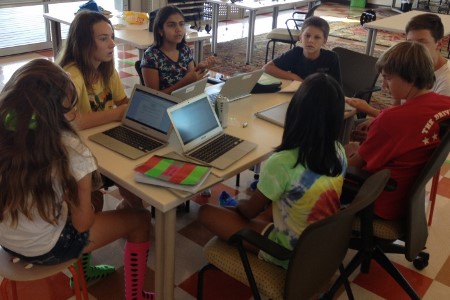
At a special open house during SXSWedu earlier this month, kids at Acton Academy explained to a crowd of adults—locals and out-of-towners alike—how their unusual school works. Concluding the event, cofounder and guide Jeff Sandefer spoke fervently about his vision for the future of education. Today Jeff joins us as a guest contributor to share some of those thoughts and a few glimpses of daily life at Acton.

I predict that the 21st century will see the rise of learner-driven communities, a disruptive educational force wherein self-directed learners, in a community tightly bound by personal covenants and contracts, use the full power of the Internet to craft a transformative, personalized learning path. Even better, I believe these learner-driven communities will be able to deliver a transformational education for less than $2,000 per student per year.

Sound like a fantasy? It might be, except that I’ve been amazed as I have dug deeply into the research of Sugata Mitra and his Hole-in-the-Wall experiments, where children in some of the poorest villages in Africa and Asia, armed only with an Internet terminal—and no teacher—have outperformed the best privates schools in their countries.

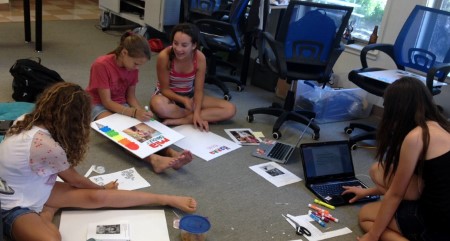
And I have seen it with my own eyes as a middle school guide at Acton Academy, an Austin-based school that uses multiage classrooms, the latest game-based adaptive computer programs for core skills, and questlike adventures for deeper learning in a studio increasingly run by the students themselves.

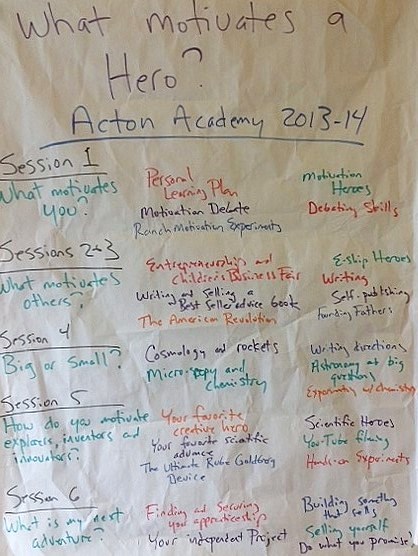
Our young people at Acton, each believing he or she is on a hero’s journey that will change the world, are learning that courage, grit, and perseverance matter far more than regurgitating facts that easily can be accessed on Google. They are mastering process and technique at a rapid rate, beginning to create personalized courses from expert knowledge, simulations, processes, and challenges that the Internet puts at their fingertips. 

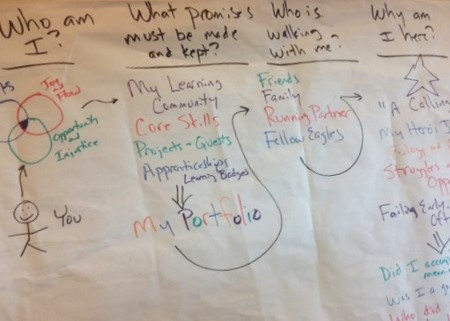
In a learner-driven community, each learner chooses his or her own path and challenges, keeping track of multiple projects as early as age six using SMART (specific, measurable, attainable, results-oriented, and time-bound) goals and seeking to earn a series of badges that demonstrate proficiency. The studio is completely governed by the learners, using a series of written covenants and a governance system developed from scratch every year.

There are no grades or homework, though every piece of work is judged or force-ranked by a rigorous peer review, compared to world-class examples, or in a public exhibition. Adults are forbidden from answering a question while in the studio, instead encouraging learners to find the answers on their own or in collaboration with their peers.

By earning badges and collecting work in personalized online portfolios, young heroes in learner-driven communities can prepare to earn apprenticeships at an early age, experimenting with which path might lead to a personal calling in life.

Just as importantly, because these communities are largely self-governing, fewer and fewer adults need to be in the room. This means not only that learning accelerates as it arms our Acton Eagles to become lifelong learners who can tackle real-world challenges, but it may also allow us to deliver a superior education for $2,000 per student per year, as opposed to the $9,000 to $15,000 annual cost per student of a typical traditional school.

Learner-driven communities: an emerging educational force that just might change how we think about learning in the 21st century.

Jeff Sandefer