College admissions is not a meritocracy. It’s a game.

Antonio Buehler is a college admissions consultant and cofounder of Abrome, a unique online learning community based in Austin. With degrees from Harvard, Stanford, and West Point and experience working in top-tier admissions, he has plenty to tell you, especially if attending a highly ranked college or university is your child’s goal. Many thanks to Antonio for sharing these valuable and timely insights.


College admissions is not a meritocracy. It’s a game. Those who know how to play the game began years ago. They’ve donated consistently and substantially to their alma maters, they’ve provided their children with ample opportunities to stand out in the admissions game through their experiences, they’ve provided the support necessary for their children to get top grades, and they’ve paid for SAT prep courses.

The college admissions season is nearly one month in; the Common Application went live on August 1. Those who know how to play the game have already paid an admissions consultant to help their children craft their essays, and their kids are cozying up to their recommenders and getting ready to submit an application to their dream school (or their strategic reach school) via Early Action or Early Decision. If your child (or you) plan on attending a highly selective college or university next year but have not started the application process, you’re already behind the curve.

This past year, only 2,145 out of 42,167 (5.1%) of Stanford’s applicants were accepted.  Of Stanford's applicants from 2008 to 2012 with SATs of 2400, the highest score possible, 69 percent didn't get in. Over 24,000 of the applicants vying for one of Stanford’s 2,145 offers had a 4.0 or higher GPA.

The odds at Harvard weren’t much better; only 2,048 out of 34,295 (6.0%) of the applicants were accepted. It is said that Harvard rejects four out of every five valedictorians who apply, and this past year over 3,400 applicants who were vying for one of the 2,048 slots were ranked first in their class. While most colleges don’t have the benefit of having 20 applicants for each available spot, even state schools such as the University of Texas now reject more applicants than they accept.

Many guidance counselors will claim that the admissions process is random and that every applicant who wins a spot at one of these coveted institutions is extraordinarily qualified for admissions, but that is a lie. There is nothing random about admissions, and the process is not fair.

Many people mistakenly believe that where the process is the least fair is that athletes and underrepresented minorities have an advantage in the admissions game. Schools need to balance the need to field winning sports teams and to ensure that their classes are sufficiently diverse, but athletes who are among the best in the country (e.g., Stanford football or tennis, Harvard crew or squash) and also are outstanding students can hardly be considered unworthy, and while underrepresented minorities get a small benefit in the admissions game, the ones who are admitted are typically well qualified. The average SAT score of black students in the Harvard class of 2017 was 2107. (Diversity is measured in many ways, not just along ethnic or racial lines. Diversity can also come in the forms of family circumstance, socioeconomic status, geography, nationality, religion, sexual preference, life experiences, and academic and extracurricular interest.)

Where the process is less fair is in the advantages it offers children of professors and alumni. These connected students are essentially double dipping, having benefited from their parents’ education and/or source of income, and then receiving the added bonus of gaining admission to elite schools over better-qualified applicants. However, where the process is least fair is in the benefits that underqualified children of the very wealthy, corporate elites, and the politically connected receive. This benefit is so large that “[r]esearchers with access to closely guarded college admissions data have found that, on the whole, about 15 percent of freshmen enrolled at America's highly selective colleges are white teens who failed to meet their institutions' minimum admissions standards.”

So what can you do, now that it is almost the eleventh hour, to play the game well and ensure that your child gets into her dream school? Sadly, if you haven’t been giving your child the opportunity to lead a remarkable life by allowing her the space to dive deep into areas of interest, to develop and demonstrate her intellectual curiosity, to attain excellence in ways that are relevant to her life, you are behind the eight ball. However, I have specialized in helping students who are behind that eight ball get into top colleges and universities for years, and there is plenty of gaming that can be done even at this late stage.

First and foremost, your child must be able to tell a story that convinces the admissions committee that he has led a remarkable life filled with excellence based on what he has experienced. He may not have started a company, done graduate level research, or started a social movement, but he should have unique interests that he can speak to. The process of doing an audit on one’s life experiences and then organizing and presenting those experiences in a compelling way through the essays is time-consuming but necessary. In the admissions game, packaging is as important as substance; without either, the chances of getting into a top school are zero, but with one, there is a chance.

Second, applications to the elite schools must be as perfect as possible. GPA (if the student goes to a traditional high school) is set, and SATs are unlikely to shift much. However, the candidate has full control over her essays (her story) and significant control over the recommendations. Those essays must be perfect because they are the most important part of the application. Unlike law school, where a perfect GPA and LSAT will get you into Harvard, a perfect GPA and perfect standardized test scores are no guarantee that you will get into a Top 5 undergraduate program. The story that comes through in the essays (and to a lesser degree in the recommendations) must accompany the numbers in a way that convinces the admissions committee members that they need a particular applicant in their incoming class. That story is much simpler for the children of senators and Fortune 500 CEOs than it is for a middle-class or upper-middle-class child, but not even Harvard or Stanford can completely fill its incoming class with development cases, legacies, children of professors, recruited athletes, and diversity candidates.

Third, your child must begin working on her applications today. Creating those perfect essays and ensuring that the recommendations are just right takes time. It is not uncommon for my clients to do up to 20 turns of an essay before they are ready to submit it. Every single word must add value to one’s story, even articles and conjunctions. And the candidate must begin today because she must submit an Early Action or Early Decision application this fall, before she submits the bulk of her applications by the regular decision deadline for most schools.

Those who play the game know that the chances of admission skyrocket through Early Action and Early Decision. At Harvard, for example, a candidate had a 21 percent chance of being accepted through Early Action, but only 3.1 percent of regular admissions candidates (which included deferred Early Action applicants) were accepted. Stanford, meanwhile, accepted 10.8 percent of their Early Action candidates, compared to only 4 percent of regular admissions candidates.

The time to act is now if you want your child to get into Harvard, Stanford, or another top program. The time to act is now, as well, if your child wants to attend a competitive state school or a more local private college such as those listed in the table above. If your child is applying this year, he should be working on his essays each day, working with his recommenders, and continuing to excel academically and at extracurricular activities.

However, if your child is not applying this year, and has several years to prepare, then she can play the game by simply focusing on living a remarkable life, today. Those clients are the ones who are always the easiest to get into top programs.

Antonio Buehler
Use crowdfunding to engage students and develop 21st-century skills

Guest contributor Paul Phelps is cofounder of culturebooster, an award-winning curriculum and fundraising platform for 4th–12th grade students to raise money for self-directed projects benefiting their school and community. Students design and lead a 35-day crowdfunding campaign while learning real-world employability skills for their careers, including business fundamentals such as marketing, design, customer service, budgeting, and much more. Parents and educators can learn more about the curriculum here.


Crowdfunding is an online activity in which a person or group asks for small amounts of money from many people. When combined, these small amounts are enough to fund that group’s idea. Successful crowdfunding projects have included motion pictures, music albums, published books, scholarships, theatrical productions, inventions, small businesses, and many more. Recently, LeVar Burton raised $4.5 million to produce new episodes of his legendary Reading Rainbow TV series using crowdfunding.

Collaboration

Many teachers are thinking about the benefits of crowdfunding for classroom needs using sites like Donors Choose and our own culturebooster.com. But they should also consider getting their students involved in their crowdfunding campaigns. This will benefit the fundraising efforts, but more importantly, including them is a huge benefit to the students. It’s an ideal project to forge great social bonds and trust right from the start of your school year because it’s a team effort with you as the mentor.

Crowdfunding inspires students to drive their own learning as they learn how their own natural abilities and interests need to be applied to making real-world projects come to life. It also gives them an opportunity to work together as a team and introduces them to career options that could be good choices for them. When you lead kids through these experiences, their fundamental question of why they need to learn the content you’re teaching them becomes self-evident. Behavior problems are minimized as kids want to work with you and cooperate with the team to succeed at the class crowdfunding goal.

Problem Solving

Crowdfunding campaigns are also an excellent way to develop students’ problem-solving skills. What should the goal of the campaign be? What rewards should be offered to the campaign boosters? How can we tell the world about our campaign? By allowing the students to take charge of the process, educators give them a self-defined purpose and a sense of responsibility for the project. The learning that happens during the campaign can be enhanced if you use a well-constructed set of lesson plans like those at culturebooster.com. Guiding kids through such lesson plans also fulfills academic standards like using applied financial math and persuasive writing in a real-world project.

Creativity

Traditional lecture-style classrooms can work for students with the right skill set and temperament for that style of learning. For others, though, this structure can lead to boredom. Your “other” students are likely extra-creative, social, artistic, or just bursting with an energy they may not know how to channel. In a traditional classroom, it is easy to see how these students would come to believe they have less value than their “easier to manage” peers. But those same character traits are real advantages in many careers. When students see how their personalities are great for a classroom crowdfunding campaign, they become engaged in the learning process even beyond the crowdfunding classroom. Their skills and personalities will be valued in a crowdfunding campaign, just as they will be valued when they begin pursuing careers and hobbies as adults. These are the kids who may invent the incredible, fun rewards that your supporters will love, while others double-check that the team’s math and message (and deadlines) are on track! Harnessing your creative kids is a real boost for their own self-confidence and that of the entire group.

Communication

Recently, culturebooster had a class of fifth grade students. One in particular admitted he had been a bit of a troublemaker until he joined his peers in an ambitious crowdfunding campaign for the school. There, he found his skills for communicating and his unbridled energy perfectly suited for making outbound calls to local businesses he thought would consider donating to their campaign. When he convinced not one but two local businesses to donate $300 each, he discovered he had a unique value and a marketable skill. His self-confidence soared and his peers celebrated his successes, providing him more focus in the classroom going forward and a renewed sense of purpose to his education. You can see Bradlees’s comments about his experience in this video.

What’s your why this year for your classroom?

For even the most studious learner, engagement is a challenge when they are unable to determine why they are being asked to learn something. A crowdfunding campaign is an excellent way to introduce students to the real value of learning. Math is used for budgeting. Writing skills are needed for the video script and for press releases. If funders are located around the country, or around the world, geography comes into play. And when using a well-designed curriculum, these lessons can be aligned with education standards such as Common Core. Crowdfunding is a straightforward approach to keeping students of all backgrounds engaged in the learning process.

Give your why a try

Is there any classroom in America that couldn’t use some extra resources today? Why not plan on making that ask a little differently this year: Involve your students in a crowdfunding campaign and watch their engagement and learning soar (and your job get more fulfilling and easier to manage)!

Paul Phelps

How should a four-year-old spend her day?

Nicole Haladyna has a great passion for the outdoors and has been teaching in natural environments for years. She founded the Woodland Schoolhouse, where she is currently enrolling children 3-1/2 to 5 years old. In this guest essay for Alt Ed Austin, Nicole provides a sparkling window into the world of Woodland kids.


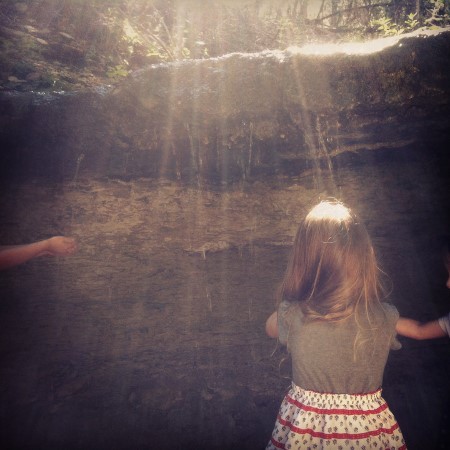
The morning after the downpour, we hike to our favorite creek and check out “our waterfall.” The air is fresh and damp. Some of us sit in a meditative-like state, arms wrapped around knees, watching water flow over rocks. Some scale the surrounding embankments seeking a higher perspective. Others crouch, carefully collecting small fossils or making fairy houses.

Whispers and giggles are muffled by the moving water.  We notice the discarded insects beneath a spider’s web and ask each other “How?” and “Why?” Then we retrieve our sketch pads and draw what we see. We shake wet branches and pretend it’s raining as their leaves empty upon us.

New discoveries are always welcome, but there is something more profound about knowing a place. Really knowing a place. In our short lives we’ve been here so many times—not just visited but been here with all of our senses.

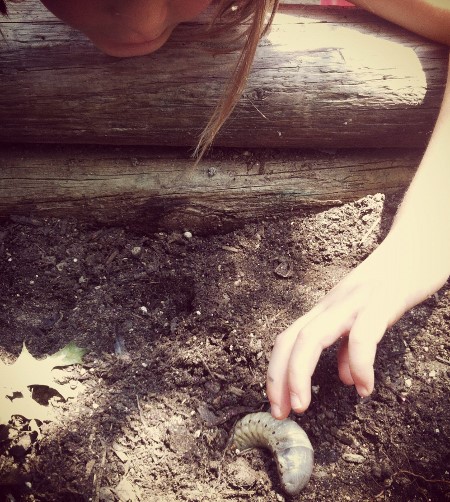
We’ve felt this place weather the seasons. We know its sounds when brisk or icy. We know its voice when the air hangs still and hot. We’ve crunched on its leaves, sipped its raindrops. We’ve watched its caterpillars descend from the trees and reappear as delicate butterflies and moths. We’ve buried our hands in this gritty soil. We’ve dipped our bare feet in these creeks. We’ve observed how buds spring from the tiniest twigs and transform into lush leaves in only a matter of days. We’ve snuck up on deer—so many deer!—beneath our special tree. We’ve discovered their bones beneath the fallen leaves. We witness signs of birth and death every day, and we embrace it all. We seek to understand it all.  


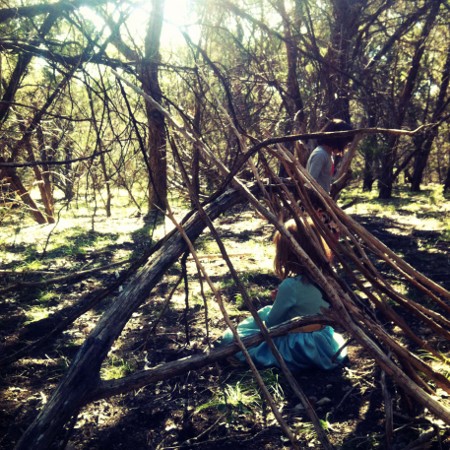
Every child deserves to have such an intimate relationship with the natural world.  This sense of place does not develop through periodic field trips but with learning and loving one place first.  Holding and protecting a place and its inhabitants so dearly, knowing it isn’t yours at all: this is the most beautiful lesson in sharing, empathy, and gratitude. 

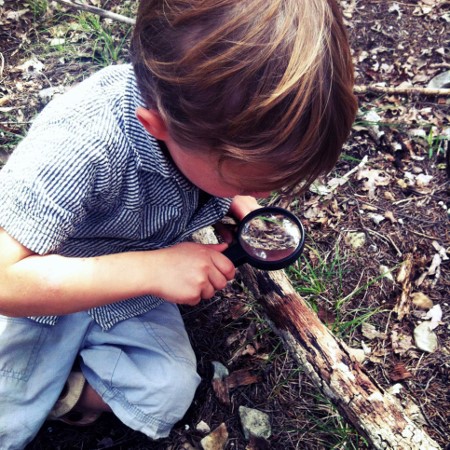
Much of our curriculum at Woodland Schoolhouse derives from our inspirations, and in this place, inspiration and wonder envelop us. There are countless creatures, relationships, landforms, and concepts here worthy of in-depth study. We re-create our findings in paint, clay, pencil, and more. We document our questions and make a plan for learning answers.


In pursuit of these higher objectives, unintended lessons abound. We bump into each other, intellectually and physically, and practice navigating these conflicts constructively. Without the rigid time constraints so often present in a preschool schedule, we take our time and really get to the bottom of the issue. We’re eager to master basic mathematical concepts when they’ll help us confirm exactly how many tadpoles are here today versus last week, or how high that deer had to reach to eat the fruit from that branch. Writing is meaningful when we’re drawing and labeling animal tracks we’ve discovered or dictating a letter to our grandmother about the bird’s nest we found . . . and how we can’t wait to see her again.

We do not need to be pushed or coerced into learning. We must be trusted, supported, and inspired. 

Can you think of a better way for a four-year-old to spend her day?

I can’t.

Nicole Haladyna


The Austin Maker Ed Meetup

Mike DeGraff is a former high school math teacher currently working with secondary STEM teacher programs across the country as part of the UTeach Institute. He is passionate about education and extremely interested in the role of the emerging maker culture in schools. As a new guest contributor, Mike is here to invite Alt Ed Austin’s readers to the first in a series of Maker Ed Meetups on Wednesday, August 6, 7–9pm at the TechShop in Round Rock. Join the group and RSVP for the event on the Meetup page.


Making, the heart of the growing “maker movement,” has become one of the most exciting developments in education. You could barely attend a session at last year’s SXSWedu conference without hearing about it. Even the White House is into it.

Part of what makes it exciting is that making is so accessible and is starting to happen everywhere. Right now, for example, Make magazine and Google + are hosting the third annual virtual Maker Camp (July 7–August 15), where anyone with a computer or access to a library can participate in making cool stuff. According to the Maker Camp FAQ, “many of the materials you need for the projects are likely already available in your home.” This means we’re not talking about projects that need to be done at a place like TechShop with extensive equipment.

Speaking of TechShop, it is AWESOME! If you are an educator, you should seriously check it out. It has the tools for you to build anything you can imagine (even battery-operated human exoskeletons).

In fact, you should make plans to be there Wednesday, August 6, at 7pm for the very first Austin Maker Ed Meetup. There will be amazing maker educators showing off super cool stuff like the MaKey MaKey (banana piano? why yes!), stop-motion animation, and a mini nerdy derby. It’s open to makers, educators, and anyone else interested in this movement.

The Austin Maker Ed Meetup is a result of my interest, and then immersion, in maker culture over the past few years. I am a former high school math teacher with an interest in project-based/inquiry-based/constructivist approaches to education. As I got into maker culture, I found that it resonated with my understanding of and beliefs around how people learn and how schools can support hands-on learning.

I finally jumped in with both feet after attending the World’s Maker Faire 2013 in New York City. I saw a lot of people already making explicit connections between education and the maker movement, most notably the Maker Education Initiative (launched in 2012) and the associated space at the Faire dedicated to these efforts.

I came back from that event eager to get involved with the maker education activities in Austin, but I wasn’t sure how. So in true maker fashion, I began doing instead of just reading and thinking. I reached out to the maker organizations in Austin, like the Thinkery, Austin Tinkering School, Austin Mini Maker Faire, TechShop, and others. Not surprisingly, maker folks were willing and excited to show me all the things they were doing in the realm of education.

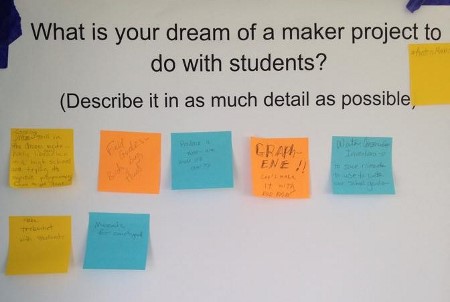
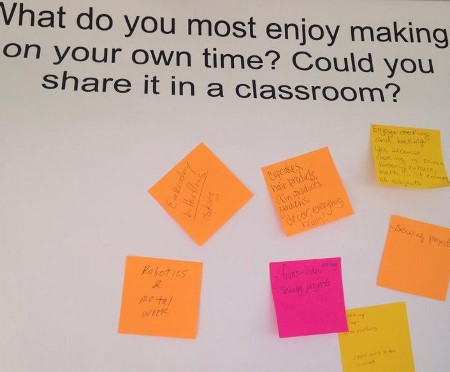
We’ve met several times over the last year as a loose collection of people with a shared interest. And we put together an Educators’ Lounge at the Austin Mini Maker Faire last May, connecting with a ton of educators with similar interests. Lots of great discussions and connections took place, some prompted by open-ended questions we posted:

The meetup at TechShop is our effort to continue those discussions and strengthen the connections between makers and educators. We’ll have cool stuff to share and do, with the hope that educators will be introduced to new ideas that can have a positive impact in their classrooms. However, the power of this group will not be what it shows educators, but in the exploration and connection between two overlapping groups: makers and educators. What making looks like in our schools is just now entering the national education discussion, so there’s plenty of room for experimentation and innovation.

A lot of this national discussion is about the specific tools and resources of the maker culture, such as 3D printing, CNC machines, laser cutters, and other innovative technology. I think all of this stuff is worth the discussion; it’s amazing. But what excites me most is not the flashy new tech, but the connections to the progressive education movement, which has been around since the late 19th century, and other current research-based practices. Some examples include an emphasis on understanding over rote knowledge, a focus on critical thinking, learning by doing, and personalized education based on students’ individual interests.

The tech will come and go (and hopefully come again after kids destroy and rebuild it into new stuff), but this approach to learning seems much more accessible, targeted, and individualized. I hope it will prove to be the most influential aspect of the maker movement on education.

Mike DeGraff

1964–2014: A half century since Freedom Schools and “How Children Fail”

Earlier this summer I had the privilege of hearing Ron Miller’s keynote address at the annual AERO conference. Ron is a respected scholar and prolific author on holistic education. His sweeping history, placing alternative education within the context of the great social movements of the past 50 years, made for an unexpectedly sobering session at a largely upbeat conference. Yet it was exactly what many of us needed to hear. Ron’s eloquent talk was refreshingly honest, and it resonated with my own concerns. I am deeply grateful to Ron for granting Alt Ed Austin permission to publish his (slightly edited) prepared remarks here in full.


The title of my talk suggests that this year is a historical milestone for the educational alternatives movement; it is, and I’ll get around to that. But I also want to look a little deeper, to consider the history of the past 50 years as a way of understanding the situation that educators, and our entire culture, are facing today. I want to draw some lessons from my own career, which took place during 30 of these past 50 years.

I’m going to make two basic points. One is that alternative educational ideas and practices will not be adopted on a wide scale until our culture as a whole changes significantly. Nothing new there; I’ve said this in many of my talks and writings.

But my other point is new: After all that I have seen and learned during the three decades I worked in this field, I no longer hold out much hope that our culture is going to change in positive meaningful ways; I am more inclined now to think that it is going to continue on its insane and destructive course until it collapses from its own excesses. At least, though, this collapse will provide the opening for building a new culture, the seeds of which the educational alternatives movement has been diligently planting all these years.

Read More

My school is my chalkboard

Guest contributor Peter Hobbs is a cofounder and teacher at Progress School, a relationship-based learning community in Central Austin where work and play nurture whole child development. The school is currently enrolling students five to ten years old and now offers options to attend one or two days per week in addition to its three-to-five-days-per-week program. Progress School is hosting an open house on Saturday, August 9, from 10 a.m. to noon.

I remember cleaning erasers and chalkboards in elementary school. Every student had a turn. You’d have to take the erasers outside. When you clapped them together just right it would make quite a bang. If you got too excited you just might end up with a face full of chalk dust. After you were done with the erasers, you’d go back inside, fill a bucket with water, and soak a big yellow sponge.

It was on a Friday, I think, that the chalkboards would get cleaned, so there was a week’s worth of writing and erasing. With the wet sponge you’d wipe the entire board clean. I remember starting at the top from one end and making columns. Up and down, up and down, up and down, like the Karate Kid. If you weren’t too careful or went too fast you’d lose the sponge and maybe even catch a fingernail on the board. Arghhhhhh!!! Column after column, the chalkboard would become a dark glistening green, only to slowly dry and dissolve into a dull blank board, awaiting another week of spelling words, random sentences, math facts, lists, rules, names, diagrams.

I didn’t know or even imagine back then that I would become a teacher myself someday. Perhaps watching a teacher stand in front of a chalkboard all day wasn’t very inspiring (I can’t even remember her name). Maybe it wasn’t a profession that was really encouraged or sincerely valued, in spite of the lip service paid to the importance of teachers in our society. And yet, I am a teacher. I don’t, however, stand in front of a chalkboard (or a dry-erase board for that matter) all day. I teach at Progress School, where, I like to think, we put a little more “progress” into progressive education.

At Progress School, the entire school is my chalkboard.

Schools have changed since the days when you would see chalkboards in every classroom and the desks were arranged into a uniform grid. Resources have improved in quality, seating arrangements have broken classes into groups or stations, and curricula have identified additional skills and knowledge that are deemed essential for every student’s comprehension. But there is a fundamental difference between change and progress where education is concerned. Change is often static and superficial. Progress is living and evolving. Teachers can change the design of a classroom (provided they have the permission of the administration), but how does education progress beyond what we expect from a school? How could education evolve if teachers and schools had the freedom to live the innovation they aspire to create?

At Progress School I have the freedom to teach because our students have the freedom to learn. We have designed our school so as to allow children to learn wherever, however, and whenever their innate desire to learn takes them. What our students find is that you don’t just go to school to learn some stuff like math and how to read and spell; you learn how to learn. Moreover, you learn that reading, writing, and arithmetic are only as important as the relationships in your life that allow you to share and use the knowledge you gain.

When you go to Progress School, you don’t learn just from teachers, but from everyone around you. You don’t just learn in class and have fun at recess; you learn that learning happens everywhere and all the time (yes, even when you’re playing):

  • At Progress School learning happens when you’re snuggled up with a teacher on the couch with a lap full of books you chose to be read (even if it’s the same one three times in a row).

  • Learning happens when you can go outside whenever you want (except when there’s lightning!), because you just have to run, and you find a 100-foot-long ruler chalked on the basketball court, and you run 5, 10, 15, 20, 50, 100 feet five times, which means you ran 500 feet! Water break!

  • Learning happens when you want to build a plane in the woodshop, but first you need the A encyclopedia for airplane, and then you need to choose what kind of plane you want to build, and then you find a piece of wood, and then you measure how long the wings should be, and then you get a ruler and draw a line, and then you get a saw, and then you hear “Capture the Flag! Who wants to play Capture the Flag?” and then maybe you work more later, or tomorrow, or next week.

  • Learning happens when you’re inside helping me measure vinegar for a science experiment this afternoon and you decide to write signs to put up all over the school inviting everyone else to come if they want to come, at what time, and how do you spell today?

  • Learning happens when you and a friend are bored and decide to get out a puzzle and put it together, but when there’s one last piece, you both want to finish the puzzle, and you start to argue, and it’s not fair, and—hey, why don’t we do another puzzle and I can put the last piece in for that one? Yeah!

And all this could happen in a single hour of a single day at Progress School. Because our students have the freedom to move throughout the school and choose what activities or projects they want to participate in or initiate on their own, I am teaching all the time.

  • When I have prepared a game about nouns and maybe just one or maybe six students give it a try, I am teaching—even when we turn the game into noun tag and have to go outside.

  • When I’ve started a project about sedimentary, metamorphic, and igneous rocks and one student asks if he can trace the labels I’ve written in marker and another wants to weigh the different groups to see which is heaviest, I am teaching.

  • When I am pushing a student on the swing and we’re talking about why Halloween is the best holiday ever, I am teaching.

  • When I am helping a student design his own board game and we count the spaces for landing on a square that doubles your roll, I am teaching.

  • When a little girl is curled up in a ball crying because her friend said her picture was dumb and I quietly sit next to her and ask if she would like to help me draw a really dumb picture (maybe a dog wearing a tutu and flying a kite underwater while a shark is playing the piano) and she slowly lifts her head, sniffs, and smiles, I am teaching.

Teaching is challenging in any school. As a teacher at Progress School, the challenge for me isn’t getting my students to complete a worksheet, turn in their homework on time, or achieve a specific learning outcome during a compulsory activity. My challenge—my lesson, in fact—is finding learning in every moment of a child’s day, whether it be in a book, with a pencil on paper, during a game, from a conflict or a joke, in a box with a fox, or with a friend or a teacher.

My school is my chalkboard. Every day we start with a clean, blank surface and end with a work of art.

Peter Hobbs