Transforming education: How a grassroots movement is changing the world

Michael Carberry is the founder and director of the Whole Life Learning Center in Austin and a cofounder of the Education Transformation Alliance. He is also a writer, speaker, and educational consultant. Michael is currently completing an M.A. in Holistic Education from the SelfDesign Graduate Institute. Here Michael sums up his views on the current state of education and what truly meaningful reform looks like. At the end of his guest post, you can watch a lovely new video about his revolutionary (and expanding) school.

I believe in standardizing automobiles. I do not believe in standardizing human beings. Standardization is a great peril which threatens American culture.
                                                 —Albert Einstein

It seems like common sense today that a highly standardized education system will only hinder the creativity of both teachers and students, ultimately damaging their ability to teach and truly learn. Students are often lost and disenchanted within this vast, competitive system. I propose that the highest aim of education ought to be supporting every student in discovering and cultivating his or her unique gifts, while promoting a lifelong love of learning.

Rather than stressing and obsessing over grades and test performance, we educators and leaders in the alt ed movement shift the focus to guiding and mentoring youth toward living more fulfilled, empowered, and joyous lives while promoting health and wellness, ecological awareness, and social justice. Author Ron Miller describes education as “the primary vehicle for cultural transformation.”  This is why it is so important to take a hard look at our traditional education system while researching the myriad alternatives that are sprouting up.

When choosing a school for your child, or deciding on an educational philosophy that you are aligned with, you have to ask the questions: What is the purpose of education? What do I want for myself and my child? And what kind of future do I want to contribute to?

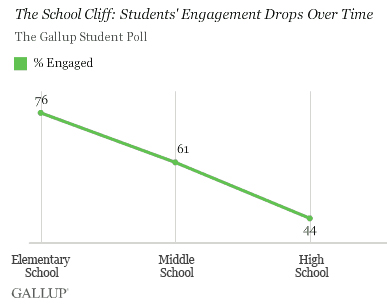
A 2012 Gallup poll demonstrated that the longer students stay in school, the less engaged they become with their own education. The Gallup Student Poll surveyed nearly 500,000 students in grades 5 through 12 from more than 1,700 public schools in 37 states. It found that about 80 percent of elementary students who participated in the poll were engaged with their education, measured in terms of “involvement in and enthusiasm for school.” By middle school it fell to about 60 percent, and by high school, only 40 percent of students would be considered engaged.
It’s no secret: public schools (and traditional private schools too) are focusing on the numbers and forgetting about the students. The most-watched TED Talk ever is “How Schools Kill Creativity” by Sir Ken Robinson. He makes the case that over the past hundred years our education system has basically emulated the industrial, assembly line model. What we need to return to, then, is a more organic model that understands human unfolding and learning as a natural process that requires diverse environments, specialized attention, and unique inputs in order to nourish optimal growth and well-being.
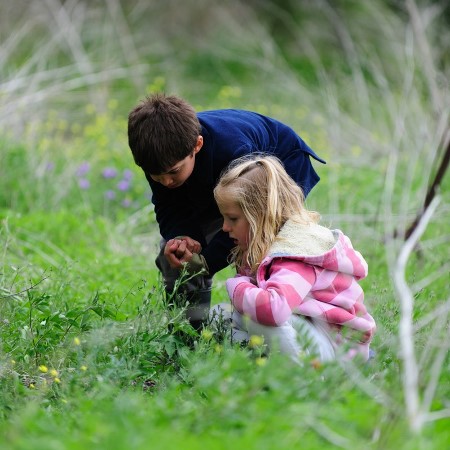
A glimpse of organic learning at the Whole Life Learning Center in Austin, Texas

John Taylor Gatto is another outspoken advocate of education revolution. Gatto was named New York City Teacher of the Year in 1989, 1990, and 1991, and New York State Teacher of the Year in 1991.  He shocked administrators upon his acceptance of this award by lambasting the public school system in a speech that he later expanded into his book, Dumbing Us Down: The Hidden Curriculum of Compulsory Schooling. Gatto asserts that schools confuse students by presenting an incoherent array of information that the child needs to memorize in order to compete in school. He explains that rather than teaching kids to be independent, creative, confident individuals, schools are teaching (through built-in contexts) emotional and intellectual dependence and indifference.

Despite these clear arguments for radical reform in our public education system, pervasive and corrosive programs like No Child Left Behind continue to stifle school districts throughout the country by attaching funding to test performance. The good news is that there is a growing movement of families and educators turning to a rapidly expanding array of alternatives.  The increasing drop-out rates and the steep rise in the number of medicated students are just a couple of examples of the fractured system they are leaving behind.

In the past, alternatives were fewer and farther between. Awareness around these alternatives was quite limited; perhaps people had heard through mainstream sources about Montessori or Waldorf education, but they probably had a very limited understanding of what those were or why they might be better choices for their families than the public school system.

Today the education revolution is in full swing, and it’s not led by any one model of education to universally replace public schools. It’s a movement comprising homeschoolers, unschoolers, co-ops, small independent schools, charter schools, families, and educators choosing options that they’re aligned with—options that see their children and students as more than cogs in a machine being prepared for the workforce, options that recognize that everyone learns differently and honor and support each child’s unique strengths and weaknesses, that recognize the importance of social-emotional learning along with academic study, options that facilitate a connection to nature and promote ecological awareness, social justice, and global citizenship.

Happy learners at the Whole Life Learning Center

An invaluable resource in this movement is the Alternative Education Resource Organization (AERO), which hosts an annual conference and acts as an international hub for all things alt ed. In Canada, a great example of government-funded measures to support homeschooling efforts can be seen in the organization SelfDesign, which supports parents financially and with a “Learning Consultant” who helps them create and follow through on an individualized learning plan for their child.

One of the cities at the forefront of this education revolution in the United States is Austin, Texas. Yes, that’s right, the home of the President who brought No Child Left Behind to the nation is also one of the most supportive states when it comes to homeschooling. Austin also happens to be a progressive oasis in a conservative state, so it has drawn a multitude of educational options for the many families moving to Austin every day. Beyond the typical alternative options of the Montessori and Waldorf schools, dozens of small, independent schools have sprouted up, each with its own unique learner-centered approach.
In 2012 educators representing a handful of these schools came together to create the Education Transformation Alliance (ETA). The ETA, a growing 501c3 nonprofit organization, now shares resources and organizes school fairs and other events to reach more families and let them know about all the great options out there. Alt Ed Austin, the family consulting service and online resource center that publishes this blog, works closely with the ETA and serves as a one-stop shop for parents interested in comparing the many educational options around Austin. Hopefully, more and more communities will catch on and follow this model of synergistic collaboration. 

Ultimately, the education revolution is not about fixing the current system or finding/creating another system to replace it. It is about supporting the creation of a diverse range of options for families to choose from, while making those options accessible for families, whatever their economic circumstances may be. Every child is unique, every family is different; so why should we continue to pump billions of dollars into a homogenized, one-size-fits-all education for our future generations? It is time we recognize that in order to transform our world to a more just, sustainable, and peaceful place, we need to start by transforming education.

We’re doing just that at the Whole Life Learning Center, and you can be a part of it! Please consider supporting our work by contributing to our crowdfunding campaign. Watch the new video below to learn more about our unique programs, our expansion project, and how you can help.


Michael Carberry, M.S.


Unplug & Play! A Living School book review

Paula Estes and her intrepid students at The Living School play a lot of games—and learn a lot while playing them. In fact, games are an intrinsic part of their curriculum. So of course they jumped at the chance to review a new book of games for Alt Ed Austin’s readers. Here are their educated opinions.


About a month ago, the students at The Living School set out to explore the book Unplug & Play! 50 Games That Don’t Need Charging, by Brad Berger. Each week we chose a few games to play, discussed our experiences, and worked to get an overall feel for this new book of games. We hope our review is helpful.

The fifty games in this book are grouped into six categories, allowing every student to find games that really spoke to them. While one set of games may require focus and memory recall, another may challenge your word building or problem solving skills. Some of the best games were the bluffing games, where reading the personalities of the other players was key.

We found that most of the games required personal interactions, and many of them led us to learn more about the other players. We were challenged to use our imaginations, let loose, and have fun. The scorekeeping and competitive aspects took a back seat to the laughter and silliness.  

The Six Categories of Games

  1. “Matchmaker, Matchmaker”—making lists to compare with others
  2. “Call My Bluff”—creatively learn more about other players
  3. “That’s My Plan and I'm Sticking to It”—strategy games designed to make a plan to reach a goal
  4. “Ready, Set, Go!”—speed to the answer before others playing the game
  5. “Try to Remember”—memory games
  6. “I’m Puzzled”—easy-to-create puzzles

We all agreed that there were some great new finds in this book. We tried more than 25 games and decided that at least half of those are ones we will play again. Our favorite games came primarily from three sections: “Matchmaker,” “Call My Bluff,” and “Try to Remember.” These games had us laughing hysterically and wanting to play again and again. Our three favorite games were Popular Match, What You Didn't Know about Bob, and Uncommon Combos.

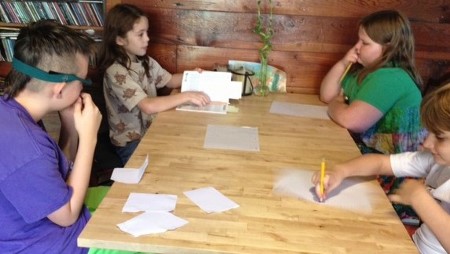
Learning a new game at The Living School
We discussed some of the pros of the book:

  • Great for playing in the car, around a campfire, on road trips, or as party games
  • Nothing but a pencil and paper required
  • A good variety of games, with something for everyone

Some of the cons:

  • It would be helpful to give a suggested age range for the games.
  • Some of the games had very complicated scoring. (We tended to make up our own scoring when needed.)
  • There were some games we tried but never played because the directions were too confusing and frustrating.
  • It would be helpful to put a range for the number of players for each game. (Groups of 4 or 5 seemed best.)
  • The book itself (a paperback) is a bit flimsy and might not hold up well over time and use.

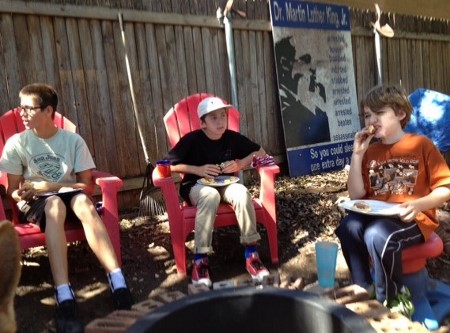
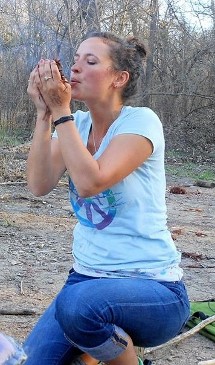
Living School kids play a bluffing game around the campfire

Overall, we think this book is worth the purchase, as it encourages many types of games that will get people laughing and talking, using their imaginations, and challenging their memories. We love games and will continue to play many of these at school, around the campfire, and with our families.

Paula Estes


Nurturing the creative spirit through art and storytelling

Guest contributor Heidi Miller Lowell teaches art and creative storytelling at The Austin Artery, where she draws upon current research in psychology and neurology in her work with children, teens, and adults.


I do not believe anyone who tells me they do not have a creative bone in their body. I usually translate that statement to mean, “Creativity is scary. I might make a mistake. Everyone will see it.” And they are completely right. Creativity is the ultimate act of vulnerability.

Creativity is our spirit and at the core of our heart. Each one of us has a valuable story to share that has the potential to change the world through the very act of making art and sharing our tale. Maya Angelou said, “There is no greater agony than bearing an untold story inside of you.” I know that these vulnerable seeds of creativity are waiting inside each of us for the right conditions to sprout.

We humans have an innate drive to tell our stories and connect. Throughout human history, we have strived to tell our stories, even before we had words for them. The earliest humans told their stories through pictures on cave walls. Even babies begin making their marks as soon as they are able. I will forever cherish the memory of watching my own daughter squeal with delight as she discovered her own power to make a mark as she held a paintbrush in her tiny hands for the first time.

Research shows that the happiest human beings are the ones who are connected and have community. For this reason, The Austin Artery cultivates creative storytelling and art-making communities. While technical skills are valuable, we believe that art and storytelling have something far more valuable to offer society. Art is a powerful tool for creating meaning, developing empathy, and furthering our education.


The Artery’s curriculum transforms “mistakes” from stumbling blocks into pathways to new opportunities. You cannot make the wrong choice. We use story prompts with a variety of media to create layered art pieces. These layers and lessons are metaphors for our life. Some psychologists believe that the stories and art we make, even when fictitious, create parallels to our life and provide opportunities for problem solving. Furthermore, X-rays show that Leonardo da Vinci painted 30 layers on the Mona Lisa. When we continue to explore with a variety of media and add layers to our art pieces, we develop persistence. The stories and art pieces can be more touching and stunning than anything we had initially envisioned.

Additionally, I want to honor each student’s unique stories and inspirations. This means that students at The Artery don’t follow a formula to create identical pictures. In this sense, there is a greater focus on the process and meaning behind each piece of art than on the product itself. This allows each artist to unfold at her/his own pace while developing a unique style and story.

This kind of approach is powerful because stories are how we think. They require structure, order, and clarity. Psychologists call this a script or mental model. We use stories and images to persuade others, market ourselves, create our identities, and teach social values. Stories also allow us to walk in someone else’s shoes briefly, increasing empathy.

Telling our stories and creating art are more important now than ever as our schools and society grapple with the issues of bullying and other violence. When we activate the right side of the brain and tell own our stories, we tap into the creativity that is the foundation for innovation, empathy, self-understanding, and change


We live in a world that is vastly different from that of the previous generations. We communicate globally and instantaneously. News is doled out in 140 characters. People love cat memes. However, that is not what we truly crave. We crave meaning, connection, and community. When individuals and organizations identify and nurture their creativity and core stories, they create something that others connect with and believe in. That is something that can create powerful change.

This is why I want to help you cultivate your creative side at The Austin Artery.

Heidi Miller Lowell


Why Shakespeare now?

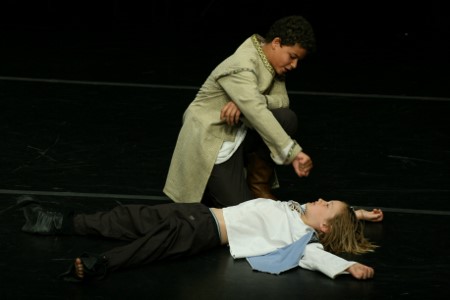
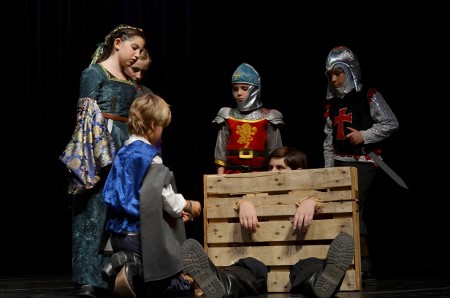
A scene from ImprovEd Shakespeare’s Hamlet
Guest contributor Andee Kinzy is the director of ImprovEd Shakespeare, a playground where kids and Shakespeare explore the past, the present, and the future—improving upon our own introductions to Shakespeare education.


Shakespeare, ugh. For many of us, the name conjures up feelings of dread. We’re reminded of the fact that we just never understood the archaic language, and if anyone drags us to see a Shakespeare show—it’s usually time to catch up on our sleep.

So if we, ourselves, are not excited about Shakespeare, why should we bother introducing Shakespeare to our kids? It can wait ’til high school, right? Wrong.

You should be introducing your kids to Shakespeare now. Think about it: the entire world is new to your children. As they’re growing, they are adding new experiences to their knowledge on a daily basis. If you can get Shakespeare in their hands before they reach the age of “coolness,” he’s just another new experience. There’s nothing scary or intimidating about new experiences when your purpose in life is to experience everything.

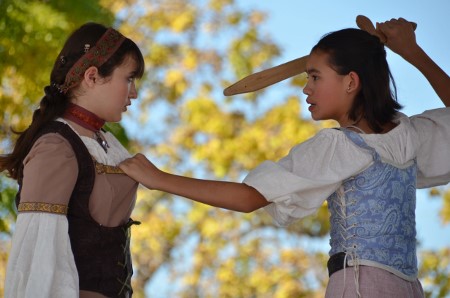
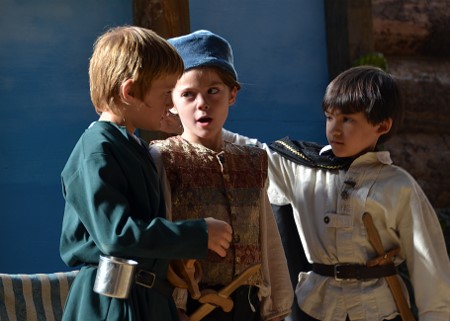
A scene from ImprovEd Shakespeare’s As You Like It

What about the language, you ask? I say, they’re learning new words every day. What about the adult themes, you wonder? Sure, there are some Shakespeare plots that should be left for later years. But for the most part, Shakespeare is following story themes that are ingrained in human psyche. In fact, much of the so-called “children’s fare” shares some of the same plots. The Lion King? Hamlet. Beauty and the Beast? Gaston is a bit like Lady M riling her husband up to kill the king. And let’s not forget Gnomeo and Juliet.

Okay, so this is all great and good, but how are you, a Shakespeare-phobe, going to add yet another of those things-to-make-you-feel-guilty-because-you-haven’t-exposed-your-child-to-it-yet to your To Do list? There’s too much, already!

Fair enough. And in the case of full disclosure, I have to admit that my organization, ImprovEd Shakespeare, exists to help solve your dilemma. So you could check us out online. But even that takes time, so here are three easy ways to add Shakespeare to your life:

  1. Pull up some of those famous quotes you hear all the time (everyone knows at least part of a Shakespeare quote) and ruminate on your daily happenings: “To be or not to be cooking dinner tonight?” “All the world’s a stage, and you, my little imp, belong on it.” “Out, out, darn spot!” The internet abounds with famous quotes, but if you’re feeling the need for more, these can get you started.
  2. Every time you use a word given to us by Shakespeare, say, “Thank you, Shakespeare!” Here are a few common ones: belongings (“Don’t forget your belongings! Thank you, Shakespeare!”); eventful (“Well, that was an eventful day! Thank you, Shakespeare!”); eyeball (“Ow! There’s something on my eyeball! Thank you, Shakespeare!”). Need some more suggestions?
  3. Check out some Shakespeare stories from the library: Tales from Shakespeare, by Marcia Williams; any of the Shakespeare for Kids books by Lois Burdett; Bruce Coville’s Shakespeare books; or a different Tales From Shakespeare, by Tina Packer.

Before you know it, you and your kids will be bedazzled (Thank you, Shakespeare!) by the bard and ready to welcome his fun into your lives.

A scene from ImprovEd Shakespeare’s King Lear

Or, if you live in Austin and are ready for more Shakespeare, check out a full-length production. Present Co. is performing The Tempest in October. Use one of those books from the library to introduce the story beforehand.

And, of course, there’s always our ImprovEd Shakespeare productions. One sure-fire way to get your kids excited about Shakespeare is seeing his work performed by kids, for kids. This November we present Henry IV (Part 1!). For more information about performances and Shakespeare for kids, visit our website or follow us on social media.

A scene from ImprovEd Shakespeare’s Twelfth Night

Andee Kinzy


Wilderness Awareness School: Professional development for alternative educators

This interview is adapted from one that recently appeared on Dandelion, Breana Sylvester’s blog about her family’s adventures in exploring educational alternatives. Thanks for sharing it with us, Breana! You can meet all three of the fiercely committed educators involved in the interview at this Saturday’s Alternative School Fair.

Ever wonder what your teachers did over the summer? Chances are, whether you went to public or private school, large or small, your teachers did some sort of professional development to become better at what they do. That might mean they took classes at a local university or attended a conference, or worked with other teachers to learn from experts in their field. I know teacher learning is very important, but I wondered, just as each alternative school tends to have its own style, does teacher learning take on its own flair in an alternative setting?

Laura and Michelle, two Austin alt educators, went to Wilderness Awareness School to learn the Art of Mentoring from experts. Instead of sitting in a classroom all day, though, they made the great outdoors their classroom, learned through experience, and brought home lessons in becoming better teachers and happier individuals. They shared experiences neither is likely to forget! 


Michelle Carbone, youth programs coordinator and instructor, Earth Native Wilderness School, an outdoor education program. Job description: Facilitating the building of connections with nature through games and songs, as well as teaching survival skills (e.g., friction fires, learning about edible plants). Background: Studied Environmental Affairs, worked at Keep Milwaukee Beautiful and Outdoor Education programs in Texas and Ohio.


Laura Ruiz Brennand, teacher, Radicle Roots Community School-house, an experiential democratic school. Job description: Mentoring child learning based on play, place, projects, and inspiration; balancing class lessons and self-directed time, with a focus on sustainability and connecting to nature. Background: B.A. and Masters from Texas State; taught 4th grade in Kyle, Texas, before learning about alternative schooling opportunities through Caitlin Macklin.

An interesting side note: Michelle and Laura did not know each other prior to this experience. Even though Radicle Roots was planning on working with Earth Native in the fall, these two educators hadn’t yet met. They were on the same plane and saw each other with their gear and wondered, but when they got to Wilderness Awareness School, they ended up together in the Chipmunk Clan. So it was quite a way to meet!

I had some questions for Michelle and Laura about their experience, and I had so much fun learning about their learning that I wanted to share it. So here’s my interview with these two amazing teachers!

*     *     *

What appealed to you about Coyote Mentoring before you went?

Laura: Wilderness awareness school is a model school for Radicle Roots, along with the Albany Free School. Caitlin [the school’s founder] had attended the Art of Mentoring program two summers before, and so she knew a lot about it. She talked to me about the 8 shields and the different philosophies. She gave me this big textbook, and it was really dense. She’s like, “Yeah, you’ve just got to go. You can’t read about it, you’ve just got to experience it.” This past summer we were able to afford to go. She wanted me to experience what she experienced, so that way our visions could be more connected. When I got there I was like, “YES! This is what she was talking about.”

Michelle: Dave Scott, the founder of Earth Native, he got his start at Wilderness Awareness School, so it is the model we look to for Earth Native. He went there and learned and he was very involved and then he stayed and taught there. It was his inspiration for starting Earth Native. [My experience with] outdoor education is definitely less structured than classroom education, but it’s somewhere in between a Wilderness Awareness model and public school. I’m still trying to figure out where I can use my experience as an outdoor educator. Going to Earth Native was very important for me to experience. I was teaching summer camp this past summer, and I threw myself into that, and part of me didn’t feel ready to go and have another experience, but it was the most rejuvenating experience I have ever had. Everyone should go, it’s magical. 

From your perspective, based on your experience, what is the philosophy of the Art of Mentoring program?

Laura: Finding your role as a mentor, getting to know your students really well as a mentor, and figuring out where your students are using the 8 shields, and then you get to help them grow. For example, if a student is highly motivated to a project but they’re not very organized, you can help them in that way. Or if they’re struggling with motivation, you can come in as the coyote trickster and get them super motivated by being goofy and silly and bringing joy to the process, and also remembering they’re kids and they have child passions in them like playing and singing and storytelling, and remembering that adults need to play as well. When you’re mentoring a student, when an opportunity arises, you find those opportunities and you figure out what kind of teaching style you want to use. If they’re ready for lots of information, you can use a more didactic style; if they’re curious, you can be more inquiry-based.

Out of everything you learned from the program, is there something that you either immediately wanted to share, or while you were learning you made a connection to how you could have used it in the past?

Michelle: My biggest struggle has been setting boundaries guidelines, because the idea of outdoor education is letting a lot of that go—so knowing when to intervene and when you just need to let the kid figure out their own boundaries through natural consequences. For me that’s really hard. When I see a kid struggling, my instinct is to help them and do whatever I can to keep them from harm. Trying to find that balance is really hard, so going into it that’s what I wanted to figure out. Students are often asking for something, like, “Hey, I’m really thirsty, and I have been running around and I’m dehydrated and now I don’t want to drink water, so I really need you to make me drink water.” Being able to go outside your comfort zone a little is important. I spend so much time doing trickster, and being goofy and crazy. I realize I need to be a little more didactic or use the art of questioning. It was humbling, and made me realize I had a lot to learn. Maybe children respond in another way, and not always the way I tend to do things. Learning that I need to get to know my kids on another level, it was really helpful.

Laura: I think the most beautiful thing about the whole process was that there were all kinds of people coming together. We all are naturalists, and all work with kids, no program was alike, and just knowing that all these people are coming together for the same things and then dispersing back to our homes to spread the warmth and nurturing we learned there was really amazing. I am really looking forward to storytelling. There was this amazing storyteller. He was a performer, and the way he told stories was really artful and inspiring. He brought in these characters that were really interesting, and so real. He brought lots of movements; his body was so dynamic. I want to do that, I want to be a better storyteller. He was so great that you realize the possibilities of storytelling are endless. I felt like I didn’t have stories to tell, but he mentioned that everyone has their own stories to tell. Use your own life experience, and stories will come to you; everyone has something to teach. I am really excited about using the different teaching methods as they arise, especially the trickster, because I think that is my discomfort zone. Thinking about putting on a costume or a mask and then coming into a character, it sounds so fun. I think I’m going to be a raccoon. I’m going to put on a mask and become a raccoon. 


What was something about the experience that surprised you, that you didn’t expect going in?

Laura: I was surprised by how much everyone let themselves be themselves, even in the mornings at 8:00 a.m., when we were all pretending to be penguins or salmon. Everyone got into it and was so open to the program. There were some pretty emotional experiences for some people, because it was such a safe environment. Everyone was really supportive. It was amazing to hear 30 adults singing these songs. We learned a lot of songs. I sing them in the shower, on my bike, on my walk. We wrote them all down. It was so beautiful out there, incredibly beautiful, and the connection with the land that everyone within the community had was also really beautiful.

Michelle: I met someone there, and he was a quieter individual. I could feel him watching me sometimes, and after a while he approached me. He said, “I don’t want to infringe upon who you are and what you’re doing, but I noticed you’re constantly apologizing for who you are and what you’re doing.” I do that. He challenged me that every time I apologized I had to say something nice about myself out loud. To me that felt gross, it was scary and uncomfortable, but I did. Since I’ve gotten back I still do it, in my head, and I’ve been really watching that when I do say I’m sorry, I truly am apologetic for my behavior, because I want to work toward being a strong woman. I was going to learn about mentoring, and I didn’t think I was going to have the chance to grow so much in such a small time. Everyone there was so awesome. You could just feel the love, and it was awesome. It was hands-on, experiential education, and I learned so much!

On leaving:

Michelle: At the end we were asked to say goodbye, to leave the space empty and not leave ourselves, and to leave our clan. It was really difficult! So we lay down on the ground with heads touching and made noises. The noises started working together and harmonizing and it ended up feeling sing-song, and then it was beautiful—we all stopped at the same time.

*     *     *

What a great way to say goodbye to the people, and the place, and the experience. Thank you, Laura and Michelle. I am really excited to have gotten to share some of your experiences with my readers!

A final note: Earth Native will be holding an Art of Mentoring program here in Austin this March! Please click here for more information.

Breana Sylvester


College admissions is not a meritocracy. It’s a game.

Antonio Buehler is a college admissions consultant and cofounder of Abrome, a unique online learning community based in Austin. With degrees from Harvard, Stanford, and West Point and experience working in top-tier admissions, he has plenty to tell you, especially if attending a highly ranked college or university is your child’s goal. Many thanks to Antonio for sharing these valuable and timely insights.


College admissions is not a meritocracy. It’s a game. Those who know how to play the game began years ago. They’ve donated consistently and substantially to their alma maters, they’ve provided their children with ample opportunities to stand out in the admissions game through their experiences, they’ve provided the support necessary for their children to get top grades, and they’ve paid for SAT prep courses.

The college admissions season is nearly one month in; the Common Application went live on August 1. Those who know how to play the game have already paid an admissions consultant to help their children craft their essays, and their kids are cozying up to their recommenders and getting ready to submit an application to their dream school (or their strategic reach school) via Early Action or Early Decision. If your child (or you) plan on attending a highly selective college or university next year but have not started the application process, you’re already behind the curve.

This past year, only 2,145 out of 42,167 (5.1%) of Stanford’s applicants were accepted.  Of Stanford's applicants from 2008 to 2012 with SATs of 2400, the highest score possible, 69 percent didn't get in. Over 24,000 of the applicants vying for one of Stanford’s 2,145 offers had a 4.0 or higher GPA.

The odds at Harvard weren’t much better; only 2,048 out of 34,295 (6.0%) of the applicants were accepted. It is said that Harvard rejects four out of every five valedictorians who apply, and this past year over 3,400 applicants who were vying for one of the 2,048 slots were ranked first in their class. While most colleges don’t have the benefit of having 20 applicants for each available spot, even state schools such as the University of Texas now reject more applicants than they accept.

Many guidance counselors will claim that the admissions process is random and that every applicant who wins a spot at one of these coveted institutions is extraordinarily qualified for admissions, but that is a lie. There is nothing random about admissions, and the process is not fair.

Many people mistakenly believe that where the process is the least fair is that athletes and underrepresented minorities have an advantage in the admissions game. Schools need to balance the need to field winning sports teams and to ensure that their classes are sufficiently diverse, but athletes who are among the best in the country (e.g., Stanford football or tennis, Harvard crew or squash) and also are outstanding students can hardly be considered unworthy, and while underrepresented minorities get a small benefit in the admissions game, the ones who are admitted are typically well qualified. The average SAT score of black students in the Harvard class of 2017 was 2107. (Diversity is measured in many ways, not just along ethnic or racial lines. Diversity can also come in the forms of family circumstance, socioeconomic status, geography, nationality, religion, sexual preference, life experiences, and academic and extracurricular interest.)

Where the process is less fair is in the advantages it offers children of professors and alumni. These connected students are essentially double dipping, having benefited from their parents’ education and/or source of income, and then receiving the added bonus of gaining admission to elite schools over better-qualified applicants. However, where the process is least fair is in the benefits that underqualified children of the very wealthy, corporate elites, and the politically connected receive. This benefit is so large that “[r]esearchers with access to closely guarded college admissions data have found that, on the whole, about 15 percent of freshmen enrolled at America's highly selective colleges are white teens who failed to meet their institutions' minimum admissions standards.”

So what can you do, now that it is almost the eleventh hour, to play the game well and ensure that your child gets into her dream school? Sadly, if you haven’t been giving your child the opportunity to lead a remarkable life by allowing her the space to dive deep into areas of interest, to develop and demonstrate her intellectual curiosity, to attain excellence in ways that are relevant to her life, you are behind the eight ball. However, I have specialized in helping students who are behind that eight ball get into top colleges and universities for years, and there is plenty of gaming that can be done even at this late stage.

First and foremost, your child must be able to tell a story that convinces the admissions committee that he has led a remarkable life filled with excellence based on what he has experienced. He may not have started a company, done graduate level research, or started a social movement, but he should have unique interests that he can speak to. The process of doing an audit on one’s life experiences and then organizing and presenting those experiences in a compelling way through the essays is time-consuming but necessary. In the admissions game, packaging is as important as substance; without either, the chances of getting into a top school are zero, but with one, there is a chance.

Second, applications to the elite schools must be as perfect as possible. GPA (if the student goes to a traditional high school) is set, and SATs are unlikely to shift much. However, the candidate has full control over her essays (her story) and significant control over the recommendations. Those essays must be perfect because they are the most important part of the application. Unlike law school, where a perfect GPA and LSAT will get you into Harvard, a perfect GPA and perfect standardized test scores are no guarantee that you will get into a Top 5 undergraduate program. The story that comes through in the essays (and to a lesser degree in the recommendations) must accompany the numbers in a way that convinces the admissions committee members that they need a particular applicant in their incoming class. That story is much simpler for the children of senators and Fortune 500 CEOs than it is for a middle-class or upper-middle-class child, but not even Harvard or Stanford can completely fill its incoming class with development cases, legacies, children of professors, recruited athletes, and diversity candidates.

Third, your child must begin working on her applications today. Creating those perfect essays and ensuring that the recommendations are just right takes time. It is not uncommon for my clients to do up to 20 turns of an essay before they are ready to submit it. Every single word must add value to one’s story, even articles and conjunctions. And the candidate must begin today because she must submit an Early Action or Early Decision application this fall, before she submits the bulk of her applications by the regular decision deadline for most schools.

Those who play the game know that the chances of admission skyrocket through Early Action and Early Decision. At Harvard, for example, a candidate had a 21 percent chance of being accepted through Early Action, but only 3.1 percent of regular admissions candidates (which included deferred Early Action applicants) were accepted. Stanford, meanwhile, accepted 10.8 percent of their Early Action candidates, compared to only 4 percent of regular admissions candidates.

The time to act is now if you want your child to get into Harvard, Stanford, or another top program. The time to act is now, as well, if your child wants to attend a competitive state school or a more local private college such as those listed in the table above. If your child is applying this year, he should be working on his essays each day, working with his recommenders, and continuing to excel academically and at extracurricular activities.

However, if your child is not applying this year, and has several years to prepare, then she can play the game by simply focusing on living a remarkable life, today. Those clients are the ones who are always the easiest to get into top programs.

Antonio Buehler