Why start a new private school in a good school district?

Eustace Isidore is a founder and director at 4Points Academy, a private elementary and middle school in Steiner Ranch, Austin. As a guest contributor to the Alt Ed Austin blog, he explains the rationale for starting a new private school in an area where the public schools have a generally positive reputation. Visit the 4Points website to learn more about this unique school—and check out its summer camps!
 

4Points Academy’s Microsoft field trip

4Points Academy’s Microsoft field trip

Why start a new private school in Steiner Ranch? It’s a question we at 4Points Academy often get asked when we meet with parents. After all, our school is located in a district with high achieving schools. Yet even with the success of these public schools, there are still certain gaps that parents acknowledge:

  • the need to have fewer students in a classroom so that the teachers are better able to understand and address the needs of every child in their care
  • the need to shift the focus back to teaching rather than focusing on getting students ready to pass the STAAR tests, which bring anxiety to so many students and their parents each year
  • that “X” factor, where many parents articulate that their child is not being challenged or that their child’s specific needs are just not being addressed, and how difficult it is for the child or the parent to really be heard in a large school environment

We created 4Points Academy to provide our students with a safe and nurturing environment that allows them to flourish and grow, and we provide our parents with a view into their child’s learning and a voice in navigating it. At 4Points, we emphasize core subject mastery and provide small classes to enable individual student attention. Our specialist teachers help deepen our students’ learning, and we offer 1-1 technology, foreign languages, art, music, sports mechanics, and more, to give our students a well-rounded academic experience.
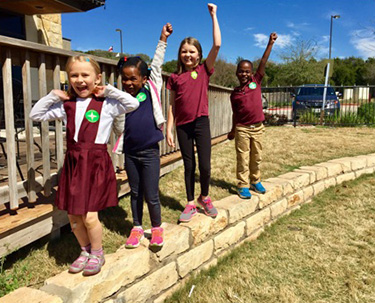
We also take the additional steps to understand each individual as a learner with unique needs and to foster an environment that that will allow all of our students to grow into confident, compassionate, courageous, and committed young men and women. We go beyond the academics to emphasize cultural diversity, global awareness, information technology skills, business and financial literacy, public speaking, and presentation skills, as well as proper handwriting, posture, manners, use of eye contact, and yes, even a firm handshake!  

Another important way we distinguish our program from public schools is that we do not waste valuable classroom time teaching to a standardized test. There is no STAAR exam to focus on. Instead, there is a continuous focus on individual students and meeting their academic and social needs.

Why all of this? Because we want our students to be confident and articulate, to be “book smart” as well as “world smart.” We want our students to be 21st-century students, academically and socially ready for high school, college, and beyond.


Eustace Isidore
 

Tools and tips for parents of teens with anxiety

Guest contributor Courtney Harris is a child-centered and teen life coach. She supports teens and tweens in moving from anxiety and overwhelm to self-love and intentional self-expression. She also partners with parents to integrate new skills and improve communication and connection within the family. Courtney Harris Coaching offers 1:1 coaching sessions and Austin-area workshops and events; follow Courtney on Facebook to learn more.

 
In my nine years in the classroom and one year working with young people and families privately, I have come to hear the terms anxiety, social anxiety, and overwhelm more than I can count. Starting at very young ages, our children are internalizing patterns of overwork, perfectionism, and constant public performance. According to Psychology Today, 7 percent of the population in the United States is estimated to have some form of social anxiety within any given 12-month period.

Many of our children, especially those who identify as introverts, are highly sensitive, or have learning or developmental disabilities, do not feel supported by society. They feel that their way of being is not acceptable according to many social norms. The pressures to perform both inside and outside of the classroom are often too much to handle, particularly when the young people are not affirmed for the patterns and behaviors that are most natural and comfortable to them.

During this past year, I have been working with a 13-year-old who prefers face-to-face communication over social media, which feels isolating to him, given his friends’ heavy technology use. Yet he found it difficult to identify shared interests to relate over in person when he had those opportunities. All the while, he was managing and worrying about his honors courses, feeling exhausted by the workload, managing demands and expectations from his parents, and struggling to ask for help. Under the weight of these pressures from home, school, and social life, this teen was exhausted! He felt robotic, disempowered, and stuck in his life. Every Sunday was a source of anxiety for him, knowing the the cycle of overwhelm was starting anew. After months of watching him living this way, his parents saw that he needed to slow down; they recognized his need to feel secure and grounded and to develop new patterns for being his most authentic self.

If your child is already beginning to fear the pressures of the upcoming school year or is refusing attendance at a summer camp, rest assured that there are pathways to greater ease and peace for your child and your family. I’d love to share some of the big tips and tools that worked for this 13-year-old on his journey, especially when starting a new activity or semester.

CourtneyHarris_resources.jpg

Most of these are simply opportunities to think about your own thinking and share your process with your child. By telling them about how you think and problem solve, you can invite them to develop their own (not necessarily the same) processes.

  • Show your tween/teen the planners, calendars, and time management techniques you use. Talk about how your system works, how you prioritize tasks, when you say “no” to things you can’t commit to (or don’t want to). Allow your child to choose the type of system they prefer.
  • Create family routines around planning the week ahead. On a designated day, at a set time, stop to talk about the upcoming week. Discuss which activities bring a sense of joy and ease, and which activities bring up stress.
  • When talking about upcoming activities or plans, you can share your inner dialogue about how you are preparing for the week. Describe what kind of things you need to do in order to be prepared for your meeting, or in order to have all of the meals cooked for the family, or in order to get the bills paid on time.
  • Encourage your child to mentally prepare as well. Ask questions like, “What do you need to do in order to feel prepared for the test?” or “What do you need in order to feel safe on the first day of school?” Letting your child name their own needs will give them a source of power and control, which will motivate them to take action.

Outside of scheduling and planning, there is a great deal of metacognition you can share with your child to help them develop self-awareness.

  • Talk about how anxiety feels in YOUR own experience. How does it show up in your body? Give qualities and descriptors to it. For example, do you get tense shoulders, a racing heart, shortness of breath, scattered thoughts, etc.? You also might consider giving your anxiety a number, using a 1–10 scale. In naming our anxiety, we can begin to understand that while it is something we experience, it does not define us. Over time, if you notice anxiety or tension in your child’s body, words, or behaviors, you can begin to ask them to notice what they observe or to rate their sensations. They will have the language for this through your modeling!
  • Make time to talk about support systems and resources. Tell your child about those you go to for help. Whom do you seek advice from? Where do you get your information? Whom do you open up with? Tell them what this experience feels like. Ask your child whom they feel comfortable asking for help. Help them identify the people they can socialize with comfortably. Role-play situations in which they ask for help. The more your child practices this with you, the more prepared they will be to advocate for themselves as needed.
  • Help your child generate a list of the top five topics they like to talk about with peers. Share the types of questions you like to be asked when meeting new people. Help them develop some go-to questions to ask new acquaintances and friends.
  • Share with your child about the ways you incorporate peace and quiet into your life. Do you read for 20 minutes before bed? Do you do a crossword over coffee? Encourage your child to commit to time in their day for quiet and calm. Help them pick places they can go during the day to recharge or get away from the chaos of school life. Having routines that offer safety and security will enable your teen to feel more equipped and energized for the other activities that may be more draining.

The more often you and your child engage in conversation about the ways we perceive and process the world, the more self-aware they will be, and the more connected you will feel. While transitions may still be challenging in your family, the more intentional practice we have with approaching new opportunities with authenticity, the more confident and grounded our young people will feel.


Courtney Harris


Lifelong outcomes and micro schools

There’s an exciting new middle school starting up in Austin, and our friends at Tiny Schools are here to explain the rationale behind the micro school model. You can follow Tiny Schools on Twitter and learn more on their website.
 

The World Economic Forum recently published its list of the skills every 21st century student needs.  A few years ago, Tony Wagner published his Seven Survival Skills for the 21st century.  I could go on . . .

Plenty of people have thrown in their submission to the “what do kids need to know?” sweepstakes. Or, calling it what it is, “what do we teach kids when the nature of jobs and the value of knowledge seem to change every few days?” And we aren’t wrong to wonder—the turmoil in both higher ed and the job market has a lot of people scratching their heads. But I’d like to consider that the list of what we should teach kids has never changed.

Let’s compare Wagner’s list with that of the World Economic Forum:

Wagner

  • Critical Thinking and problem solving
  • Collaboration
  • Agility and adaptability
  • Initiative and entrepreneurship
  • Accessing and analyzing Information
  • Effective oral and written communication
  • Curiosity and imagination

World Economic Forum

  • Complex problem solving
  • Critical thinking
  • Creativity
  • Communication
  • Collaboration
  • Curiosity
  • Initiative
  • Persistence/Grit
  • Leadership
  • Adaptability
  • Social and cultural awareness

Roughly 17 of these 18 skills listed overlap. The only non-overlapping skill is “social and cultural awareness.” However, I have a hard time believing that Wagner wouldn’t accept that skill as important. And it isn’t just these two lists that emphasize these skills or some variation on them. All the traits in the lists above basically capture the ethos of liberal arts education, not to mention that they show up in the story of just about every individual who has done something remarkable.

And we’ve always known the essential worth of these skills, usually through the lives of exceptional people. I bet we could cross-examine each skill, weigh it against monumental changes in technology and labor markets, and we’d arrive at what we already know: all these skills transcend time and place. People with some combination of these skills often rise above circumstances to lead extraordinary lives. The right question to ask may be: have people acquired these skills in spite of school?

In education we know the hard part isn’t the what, it’s the how.

The issue is that the educational system necessary to properly teach these skills doesn’t exist. The shortsighted, large-scale, factory-like system we use today won’t start manufacturing the answer out of nowhere. We need disruption. And to that end, methods like personalized learning, mixed-age classrooms, and Socratic dialogue all show promise. But if we want to make the right changes in education, we must encourage driven educators to launch new education programs quickly, and with as few administrative snags as possible. This idea is our lodestar at Tiny Schools.

The micro school concept offers a solution in which the focus is on great programs and great teachers. And this concept has taught us two important lessons about school change in today’s world:

First, you must start in the right place: good classrooms. If you have a great teacher who engages students, you have a working model. Great teaching occurs when teachers are unencumbered with the layers of management and minutiae that seems to permeate all schools. So hire great teachers and facilitate their ability to work independently in the classroom.

Second, throw out the bathwater. We’ve learned that it is quite hard to re-engineer an existing school from the inside (there are numerous examples of school leaders providing vision and funds to experiment; none “worked”). Toss out the legacy facets of schools and literally start with a basic premise: we’re going to build an environment that permits students to take risks with their learning. That means that young people will feel comfortable failing because they know it is part of the learning process and failure won’t mean the student is no longer favored. To borrow a phrase: fail fast and often.

If the challenge is to place great teachers in a position to be successful, then we believe the tiny or micro is the solution. Like a great cup of coffee, there isn’t a lot of mystery in education. Professionals that love what they do—and a milieu that nurtures that passion—will produce a successful setting for learning. Simple ingredients, a professional, and some “space” for them to work. Start there.

 
Tiny Schools
 

Creating your own high school


Kristin Kim, founder of Sansori School, is on a mission to transform the world collaboratively through compassion, community, and commerce. Along the way she has served in multiple roles: educator, Harvard program director, attorney, nonprofit developer, parent, and many more. She joins us on the blog today to announce a new program for teenage independent learners and to explain why she decided to create it.


Is your high-school-aged child charting his or her own path? Does your son or daughter already know what s/he wants to do (e.g., writing, dancing, firefighting, farming), pursuing in-depth training in that chosen field supplemented by community college courses in math and science? A dear friend recently shared her observation of this trend, and as someone who started an alternative high school in Austin last year, it made me pause and reflect. Of course, my initial response resembled fear—I wished for more students to come to our full-time high school program. But the more I thought about it, I couldn’t help but smile.

I have to admit that I like that these families are bucking even the alternative school model. They are going on their own and integrating a hands-on learning apprenticeship model. This path is not for everyone. Some need slightly more structure and/or more time to discover their passion or select among a few. But for those who are clear about what they want to do, at least for their first career, and are disciplined, creating their own high school allows for ultimate customization, freedom, and cost savings.

So I applaud these families, and would like to see teenagers who are inclined to follow this path do well. One way to encourage their growth is to bring these independent thinkers and doers together, to meet other trailblazers from our vibrant local sustainable business community, and to share and forge their ideas for living that are, as much as possible, free from the collective thinking that is so prevalent in our times.

I am proposing a once-a-week program for these independent teenagers to come together at Sansori to share what they are learning, reflect about life and being active citizens, meet local sustainable business leaders, and share music and art. This gathering of like-minded souls will strengthen, embolden, and liberate each person further than they could do on their own.

I invite teenagers who are already pursuing their own independent projects and taking one or more community college courses to find others on the same path and co-create a gathering space at Sansori. If your son or daughter is already on this path and this invitation resonates with you, please write to me (open@sansori.org).

The plan is to start with a Saturday gathering in early September 2017.

I am still learning about this amazing place called Austin, and I especially look forward to co-creating these Saturday gatherings with local mavericks.

At the core of the alternative education movement, we find our aspiration to liberate our children from the traditional model that is geared toward standardization. The more choice we can offer our children, and the more independent thinkers and doers we have, the better we all are.

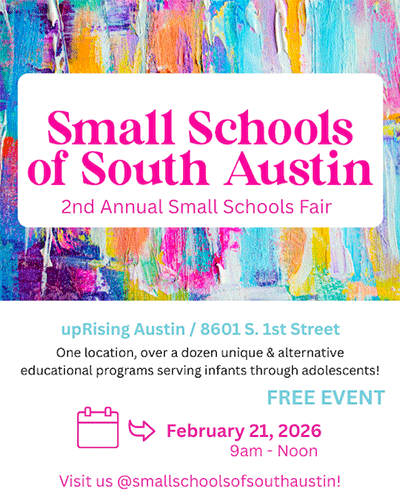
Sansori is located in South Austin, at 8601 South 1st Street (near Slaughter). It is an independent alternative school and is not affiliated with any religious, ethnic, or political organization.


Kristin Kim
 

Raising Resisters

We invited Antonio Buehler back to the blog to tell our readers about a new group that is working to nurture and strengthen the next generation of effective anti-oppression activists. Among his many other roles, Antonio is founder of Abrome, a local school centered on self-directed, meaningful learning for ages 5–19.


The 2016 presidential election campaign reminded many Americans that while our society likes to boast about its commitment to equality, justice, liberty, and tolerance, an often stronger undercurrent of bias, bigotry, oppression, and hate courses through the veins of American culture. Prior to the election of Donald Trump, and coming off two terms of America’s first black president, both the political left and right were generally dismissive of what appeared to be a rising tide of hostility toward immigrants, black and brown communities, Jews, Muslims, the LGBTQ community, and women. However, since the election, the hostilities against marginalized and oppressed groups have continued to rise, while fascist and white supremacist organizing has moved out from the shadows and into the streets. Although the fabric of society may have changed very little over the past year, the aesthetics have changed significantly.

As organic and organized protests began to grow after election day, and leading up to the inauguration, it became apparent that many previously inactive people were looking for ways to become engaged. While more established political and nonprofit entities were eager to pull those people into their organizations, a small group of Austin activists came together as the Oh Shit! What Now? (OSWN) Collective to find ways to introduce those people into more radical activist circles that focus on direct action tactics. OSWN has since helped organize and plan study groups, discussions, trainings, and workshops aimed at building a diverse community of resisters, and equipping folks with radical skills that they can share with others to push back against hierarchical and oppressive forces within society.

The younger generations have historically been one of the drivers, if not the primary ones, of radical social change, while their caregivers or guardians, as well as those who contribute to the development of the younger generations (e.g., teachers), help shape whether the youth believe that they can drive social change. That’s why OSWN came together with Abrome, the Crustacean Zine Library, and Austin Yawp to launch Raising Resisters, a discussion group that focuses on anti-oppressive parenting and education tactics.

Parenting, education, and activism have a long history of interrelatedness. Radical leftists and anarchists have often understood that oppression is more easily dismantled within the family than within societal institutions, and that young people could be spared being conditioned by mainstream schooling into accepting authoritarianism, capitalism, nationalism, and other hierarchical belief systems. For example, in the 19th century, Henry David Thoreau, Louisa May Alcott, Leo Tolstoy, and Francisco Ferrer Guardia all led alternative schools that were the precursors of radical free schools and democratic schools wherein children had full control over their educational experiences. In the 20th century, in conjunction with the rise of the free schools, writers such as Paul Goodman, George Dennison, and John Holt helped introduce the notions of deschooling and unschooling as a means of resistance into a wider counterculture that was already questioning American foreign policy, racial segregation, and assumptions about social norms. Holt, the most influential of these thinkers, even forewarned of today’s rise of fascism and the inability of system reforms to effectively stave off that rise.

OSWN, Abrome, the Crustacean Zine Library, and Austin Yawp invite parents and educators to join us at our monthly Raising Resisters discussion group meetings to continue the tradition of marrying parenting, education, and activism so that we can build community to resist, and create something better.

Upcoming Events (meetings at 6:30pm at Austin Yawp, 4548 Page St., Austin, TX 78723):

  • Thursday, June 15th
  • Thursday, Jul 20th
  • Thursday, Aug 24th
  • Thursday, Sep 21st
  • Thursday, Oct 19th
  • Thursday, Nov 16th
  • Thursday Dec 14th


Antonio Buehler

Finding the river within

Life Ki-do_Flow Like A River.jpg


We are delighted to welcome Sensei Jonathan Hewitt to share some of his deep wisdom with Alt Ed Austin readers. He is the founder of Life Ki-do Martial Arts, one of Austin’s most beloved, effective, and elevating enrichment programs.


Go with the flow. A profound way to live, but sometimes that’s easier said than done—and what exactly does it mean anyway?! Growing up, I powered through life. My goal was to be the best, the fastest, and the most popular. I was in control, and I was going to make it all happen. But wait— was I really in control? And even when I won the gold medals and got the approval, why did I feel so empty inside?

I realized at a pretty young age that I needed to look inside rather than outside for peace, fulfillment, and happiness. I spent many years searching for answers studying martial arts, psychology, mindfulness, and meditation. What I’ve come to is a place I call the River.

One of the reasons I like this word is that I work with children, and it’s an easy concept for kids to understand and relate to. But it also describes perfectly a beautiful way to live: rivers are always flowing and always moving toward something greater. Inevitably there will be obstacles in its way, but the River moves around those obstacles and never gets stuck. To me, the River is about putting your heart into life and giving it your all.

What it doesn’t mean is being perfect. I call the River’s two opposites Ice and Puddle. Being like Ice is trying too hard, feeling pressured and stressed. Being like a Puddle is not trying enough, feeling lazy, bored, and disinterested. The thing is that we are all like Ice and Puddle sometimes. It’s part of being a human being. The important thing is to not get stuck in judging ourselves and instead keep returning to the River over and over. It’s a fluid state, remember? Not a fixed, end-all state of perfection.

Life Ki-do_Elementary Martial Arts.jpg

Finding the River has not only transformed my life but also transformed the way I teach martial arts. I grew up in and taught for many years a rigid, traditional type of martial arts. The techniques were based on a set of preset circumstances—he does this move, so you follow with that move.

But life never happens that way, right? So why not practice martial arts in a way that reflects how we want to live life: dealing with spontaneous situations in a fluid manner? We practice how to take an opposing force and use it to redirect the flow. In martial arts, this might be a physical force, but in life it can be any circumstance or even (and most commonly!) our own inner emotions and thoughts.

The amazing thing is that when you are in the River, your experience with a partner becomes about connection, care, and cooperation rather than about comparisons, competition, and control. These are deep foundations for how to be in relationships with others in the world. Instead of seeing another human being as someone to fight with, or compete with, or compare yourself to, being in the River allows you to feel empathy and compassion for that individual. In our dojo, everyone supports each other to be their very best. Being not like Ice or Puddle allows you to be present and sensitive to your partner’s needs while also communicating honestly and clearly your own needs.

While there are many tools to stay in the River, the most effective by far is the breath, and we practice it all the time. With the kids, we call it Ninja Breathing to imbue the breathing with a sense of empowerment. Harnessing the power of the breath allows us to be relaxed, focused, calm, and present. Ready to see challenges as opportunities to grow rather than as obstacles that are impossible to overcome. Ready to let it come, let it go, let it flow. Like a River.


Jonathan Hewitt