Teaching improv

Carrie Carter recently wound up her work as an intern at The Hideout Theatre’s summer camps and teen intensives in downtown Austin. She graciously agreed to share some of the lessons she learned there as a young improv teacher.

When I first found my internship at The Hideout Theatre’s youth program, I thought it must be too good to be true. When I told my friends about it, they agreed.

During the school year, I attend Mount Holyoke College in South Hadley, Massachusetts. I study English and Educational Studies and am in the teacher’s licensure program for early childhood education. I love all of my classes, my professors, and fellow students whom I have the privilege of learning beside. The thing I love most about Mount Holyoke, however, is that the learning goes beyond the classroom. Education spills over into the organizations, traditions, and relationships one finds there.

Mount Holyoke is where I stumbled into improv. My best friends said, “You can totally do this, and if you don’t know how, we’ll teach you.” They allowed me to be brave, and I trusted them. So, lo and behold, they did teach me how to do improv. I trusted them because it was their best friends who taught them how to do improv. It is this chain of teaching each other that makes Mount Holyoke a wonderful place.

The college encourages this not only vocally but also financially. By that I am referencing Mount Holyoke’s Lynk Universal Application Funding Program, in which the Career Development Center agrees to fund students for an internship that pertains to their future career. Without this program, I would not have been able to study this summer at The Hideout Theatre. I wanted to make sure that in this blog post I expressed my extreme gratitude to the school that I attend.

So, I found this amazing internship, one that somehow encompassed two things I love—teaching and improv—and it turned out to be way harder than I ever expected. Before starting I thought, “I’ve worked at plenty of summer camps before: day camps, art camps, even an eight-week sleep-away camp. I’ve also done improv and am pretty okay at it. How hard can this be?”

Well, just because you are good at two things individually—no matter how many principles they share—doesn’t mean you can do them both at the same time. I found myself in a situation that I had never been in before: I had been “trained” in my program at school to follow the guidelines of what students are required to learn by the state when making lesson plans. But when teaching improv, that of course doesn’t exist. Where was my checklist of what the children must learn? What if I taught the principle of being obvious before I taught students how to agree with each other in the “Yes, and . . . ” lesson?

Teaching improv made me realize how reliant I had become on structure, and how it may have been squelching the growth of both my students and myself as a teacher in the classroom. When I went in, I found myself asking students questions and then answering them myself if they didn’t understand after a few moments. It is so obvious to me, now that I reflect, how silly and counterproductive that is—but, again, I had become caught up in the “checklist” that teachers often begin to follow religiously, and had forgotten about the needs of the students right in front of me.

There are a lot of “unknowns” in teaching. Your students might understand what you are teaching themin the way that you have written down on your lesson plan, or they might grasp the concept in ways that only they truly understand. Working with improvisers who are also educators this summer taught me how to dive into all of these “unknowns” and get comfortable with them. Whether you are doing improv yourself, teaching improv, or teaching something completely different, you never know what will happen next. And isn’t that the most fun part?!

Carrie Carter
 

An arts-based approach to literacy

In her second contribution to the Alt Ed Austin blog, art educator Heidi Miller Lowell discusses one of the inspirations for the new arts-based literacy program she is co-teaching this fall. You can read more about Heidi’s work on The Austin Artery website and blog, where an earlier version of her essay appeared.


Five years ago, I snuck into a crowded room in a Baltimore hotel, unaware that my ideas about education would be forever changed. Researcher Beth Olshansky became one of my heroes, as she introduced me to a constructivist model of education. I wished someone had taught me writing and reading in such an exciting and low-pressure way.

Beth Olshansky is the author of the book The Power of Pictures: Creating Pathways to Literacy Through Art and numerous published articles based on her years of research at the University of New Hampshire. She observed children who had minds filled with vibrant imaginings and stories but who did not like writing and reading.

This arts-based literacy program integrates children’s visual imagery into every stage of the writing process. Classes study the illustrations of famous authors and are introduced to art materials from the first day of class. Unlike traditional methods, this gives students a chance to tap into visual, kinesthetic, and verbal modes of thinking. Many children who have a hard time writing in other classes find that words come to them as they create art pieces for their books.

Children are motivated to finish the entire writing process so they can then create hand-bound books, complete with their own photographs on an author’s page. Each finished book is presented to the class, and the learner is invited to share his or her work in an author’s circle.

Research has shown that the learners in the arts-based literacy program display fuller expression than students in control groups. Personally, I have used this model to teach camps over the last several years, and I have been amazed with the results. Parents and students are often astonished by the quality of work produced in this program.


and The Austin Artery are excited to announce Austin’s very first arts-based literacy program beginning at Four Seasons Community School this fall. The lindergarten and first grade students will spend their Tuesday and Thursday afternoons splitting time between a quiet writing space and the art studio as they produce their own hardbound books and plays. There will even be an option for a limited number of homeschool students (grades K–2) to join me and my co-teacher, Jen Bradley.

For more information on arts-based literacy programs, you might want to check out visit Beth Olshansky’s website. You may also contact me at The Austin Artery for more information.

Heidi Miller Lowell

Nurturing young songwriters holistically

Havilah Rand is a multitalented artist, musician, educator, and coach. She’s back in Austin this fall after several months teaching in the Northwest, so I invited her to join us on the blog to talk about her popular and unusual songwriting workshops for kids.


When I was 9 years old, I spent most of my days exploring the wooded area behind our apartment complex, making up songs on our old piano, dressing up like Laura Ingalls Wilder, and teaching an imaginary classroom of kids. Now I’m 42, and besides the oversized dress and bonnet, things haven’t changed much. I love nature, I love working with young people, and I love writing songs. After two decades of recording and touring, eight years of public and private school teaching, I’ve honed in on where my true talents and passion lie: in helping others discover and express their own unique voice.

This has led me to create my dream job, which is leading songwriting workshops and camps for young people. The mission of these programs is to demonstrate to kids that when we explore the world from an artistic standpoint, we can express our perspective in a way that makes life more interesting and meaningful to ourselves and to others. By infusing a sense of fun and curiosity into all that we do, learning becomes an exciting adventure rather than a mundane routine. Finally, collaborating with others to create a body of work that reflects authentic feelings and experiences has a huge impact on the way we value our own voice as well as the voices of others.

Since their inception out of my one-bedroom apartment three years ago, the Young Songwriter Workshops and Camps have evolved considerably in scope and depth. This summer alone, we worked with approximately 30 kids who wrote over 60 songs using inspiration found in nature, urban adventures, artistic explorations, and connections with one another. We witnessed kids who were paralyzed with anxiety upon arrival yet singing and creating with wild abandon within hours.

Campers who were experiencing turbulence in their personal lives were able to process their feelings through their lyrics as well as through connection with new friends and mentors. For example, Leo wasn’t sure the Orcas Island Songwriting Camp was for him. He’s more of a hip-hop techno kind of a guy, and a songwriting camp with a bunch of little girls didn’t seem very appealing at first. He quickly opened his mind and attitude to the possibilities and took on the role of recording engineer and producer. We watched him exercise qualities of empathy, patience, and leadership as he supported the songwriters during the challenging and sometimes scary recording process. He even ended up emceeing our CD release celebration and was quite the entertainer.

It’s been truly amazing to watch these workshops and camps take on a life of their own with a minimal amount of guidance from adult mentors. I believe the most important things we provide is a framework from which to set goals and a sense of safety and freedom when it comes to self-expression. The goal is to write songs, but as is the case with all artistic endeavors, it is the journey and not so much the destination that really matters. Parents and campers alike have used words such as “transformational” to describe their experience at songwriting camp.

Each day we spend time journaling, manipulating words and pictures we find in magazines and various books, listening to music, exploring the outdoors, and observing humans in their natural habitats such as coffeehouses, grocery stores, and even laundromats. Before too long, the ideas we’ve captured through these activities take the shape of songs that we begin recording immediately so that they don’t “escape.” Participants are given as much freedom or support as their musical skills and personal interests dictate. Some find that they’d rather spend time working on musical ideas, while others focus more on lyrics. There are opportunities to practice performance and vocal skills, engineering techniques, CD cover design, and improvisation with various instruments. Through both introspection and collaboration, a collection of great songs is the final product of our creative effort.

Like every dedicated teacher and performer, I get anxious just before the start of each workshop. And without fail, as soon as we begin, I am delighted by the qualities that each young person brings and am reminded that children are innately nonjudgmental and creative and have a natural ability to open their hearts and minds to new experiences. Young Songwriter programs provide an opportunity to experience life as brave and open-hearted adventurers with an appreciation of uniqueness in ourselves and in others. This enables authentic self-expression, which ultimately leads to greater happiness and the sharing of our gifts with the world.

I am offering the following Young Songwriters Camps and Workshops this fall in the Austin area:

Young Songwriters Camp at Integrity Academy
For Ages 7–13
September 28 – October 1, 9am–3pm
Integrity Academy at Casa De Luz
$225

Young Songwriters After-School Workshops
Ages 7–18
October 6–November 11
Tuesdays 3:15–4:30pm, Integrity Academy
Wednesdays 3:45–5pm, Austin Village Academy
$150

Songwriting camps and workshops are mobile and adaptable to many settings and time frames. Contact me at havilahrand@gmail.com to explore the possibilities. And check out holisticartventures.com to learn even more.

Havilah Rand
 

Homeschooling: Where to begin?

In her second guest post for Alt Ed Austin, Pamela Nicholas, founder of the tutoring, assessment, and project based learning center PEBBLES, shares a few thoughts on how to start homeschooling in relaxed and joyful ways. Feel free to add your own suggestions or ask Pam a question in the comments below.
 

As I peruse the many homeschooling social media groups, I keep seeing parents who are just embarking on the journey of homeschooling and don’t know where to begin. With the multitude of curriculum options out there, it can be extremely daunting to know which to choose for our own families. I know, as a parent and teacher, that we just don’t want to mess up, EVER, with something as important as our children’s education.

I wish I could tell all of these parents to take a step back and breathe. It’s okay that there will be trial and error, and more trial and error, but eventually they will find their way through it.

I also think that it’s critical to let a child be an active participant in the process. Listing out and discussing learning goals with a child is the first step. Once he or she knows what needs to be accomplished, provide some choices on how to get there. A child who is given a choice in how to learn something will be more invested in it.


When I say “Give children a choice,” I don't mean that they should get to pick and choose what to learn and what not to. I think there has to be a balance. A child still needs to learn things that he or she isn't always going to be highly interested in, at first, so the choice will be in how to learn it. For example, in learning to write, at the beginning it could be simple choices like writing letters with a paper and pencil vs. writing in dish soap or perhaps with “invisible ink.”


Parents and their kids can brainstorm ways together that could turn something that may at first seem like drudgery into something that could be quite fun. It won't always turn out perfectly, but it will be a beautiful partnership where everyone can take ownership in their own learning!

Pamela Nicholas

Keeping your preschooler happy and engaged at the supermarket

A Montessori preschool teacher and director of many years, Jessica Salinas has two grown sons who taught her lots of fun ways to play while shopping. She lives in Austin with her husband; their dog, River; and their bird, Skyline Scalene Salinas. Gather more of Jessica’s wisdom at her blog, That Happy Hum.
 

Photo by Michael S. Frost

Photo by Michael S. Frost

Shopping with a preschooler can be a challenge—there are so many things designed for them to want! But we can’t always leave them at home, and even if you can, why overlook this opportunity to use the supermarket’s educational potential?

With effective questions, parents can help their child practice academic skills, especially math-related ones. And, with effective modeling, parents can help their child learn how not to be overcome with desires for products that, one aisle over, they didn’t even know existed.

Here’s how to do it.

When playing with math with your child, the most important vocabulary words are set and just as many. In the produce section, write a numeral between one and nine on a piece of paper, and show it to your child. Hold open the bag, and ask him or her to put in “just as many apples as that”: the number you’ve written. Don’t say the number out loud, however. This adds a layer of challenge to the task—decoding the number without the verbal cue, which children usually know better. It also gives you a gift – information about what your child knows and doesn’t know.

Suppose you’ve written a 6, and your child puts in 9 apples. Guess how many apples you are buying today? That’s right . . . you are buying 9. And furthermore, you aren’t going to correct your child’s mistake—at least, not by saying anything more just now beyond “Look at you counting! Go, sweetheart, go!” This is because we want to stay playful and keep your child feeling successful. Adults need to always look for what the child is doing right, and emphasize that. If you say, even sweetly, “Oops, that was a six—let’s see how many apples got into the bag . . . seven, eight, nine . . . oops . . . too many!” this correction only shows them they did it wrong.

No fun.

Here’s how to re-introduce that 6 means six: In the next aisle, you take the turn. Write down 9, and have your child tell you to get “just as many.” Then count out loud as you select cheese sticks, or whatever.

You can also bring a bag with the magnetic numerals from your refrigerator, and pull them out. This is actually even better, because it’s more tactile.
 

Photo by dvhansen, All About the Heart

Photo by dvhansen, All About the Heart

Now, to help your child learn to overcome the powerful sway of brands that call seductively from the shelves, you get to indulge your inner dramatic actor. Before you go into the store, say seriously to your child, “We are going into a place that is designed to make me want things I don’t even know exist right now. I might call for you to help me not to be susceptible. Will you help me if I need you?”

I love the word susceptible here—it’s expansive vocabulary, and even with a very young child, is evocative, and when he or she sees you standing in front of an enameled orange saucepan, all will become clear.

“Uh oh . . . I think it’s happening . . . help me, sweetheart! This orange enameled saucepan is very beautiful! I want to buy it, but we already have a saucepan! Quick, take my hand, pull me away.” Let your child pull you, even as you push the cart he or she is sitting in, while giving yearning glances over your shoulder toward the saucepan and reaching back for it. “So beautiful . . .” When you are far enough away, shake your head like someone awakening from a magic spell, and thank your child for saving you.

Happy shopping,
Jessica Salinas

Let’s be real people

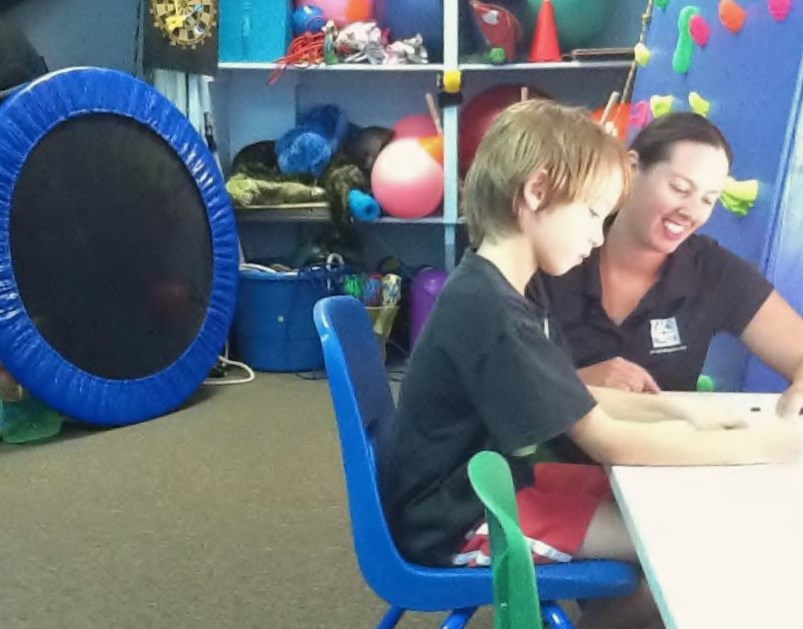
Melissa Menzes, an occupational therapist and founder of Extra Credit! LLC, is whole-heartedly dedicated to helping school-aged kids and families dealing with “hidden disabilities.” She has been successful in best treating children for nearly 15 years and is excited to offer a new specialty OT/educational facility here in central Texas. She joins our blog by sharing some of her own experiences with overcoming neurological dysfunction and early learning challenges.


As a pediatric occupational therapist, I frequently get asked certain questions from concerned parents on their first or second visit with me. It is all too often that I hear “Will he outgrow this?” or “Can this be fixed?” The underlying sentiment seems to be “Will my child ever be normal?” My answers to these heartfelt questions generally start with something like “Maybe. Time will tell. With a little bit of intervention and lots of love, understanding, and support, I think your child is going to be just fine.”

But what is normal, anyway? “Normal” is just a setting on a washing machine. I’ve seen variations of this phrase on cards, books, and social media platforms, and I really like it. Openness about being “different” in our society is becoming the new normal, and I think this might be a really good thing. I mean, how boring would we be as a culture without diversity? Nobody’s perfect. That’s a fact. We just are who we are and that’s okay. Adversities help shape us and guide our life paths, dreams, and purposes.

I have accepted the fact that I’m not what my profession would call “neuro-typical,” but I’m me, and I like that. So do my friends, family, and clients! I know that I’m doing just fine (if not better) because of my personal differences and the related support and knowledge I’ve gained over time. I think it’s of value to share my brief story in case it might help a concerned parent dealing with the stress of a new diagnosis or the worry of an uncertain road ahead.


But who am I? I am, in part, a child therapist who is passionate about helping others with unique differences and struggles. It’s something that I happen to be quite good at. I think my focus on serving families dealing with “hidden” neurodevelopmental and learning issues is primarily shaped by personal experience with certain adversities and an overwhelming drive to overcome them.

Perhaps it started for me when I had to repeat second grade in a “move-at-your-own pace” sort of Individually Guided Education (IGE) School. As emotional as it was for me to be unexpectedly separated from many of my friends, academically I moved from the bottom to the top of the class. I worked my hardest to stay there for the rest of my education until successfully graduating with honors in college. Talents in art and athletics, along with a supportive family, helped me cope with the many challenges of schooling (which I kept well hidden) and eventually led me to find an amazing career in occupational therapy. It was OT that helped me learn more about my own unique and “hidden” differences and how to best manage them.

In the early 2000s, while attending an educational workshop on helping people with dyslexia, it was discovered that I had a severe form of perceptual processing disorder called Irlen Syndrome. In short, my brain has difficulty perceiving incoming visual information. The effects of this diagnosis and my eventual treatment were astounding for me. Put simply, it changed my world!

This experience encouraged me to be more open to identifying and managing other conditions that had long remained under the radar. My postgraduate Sensory Integration certification coursework and SPD trainings helped me better understand and handle my sensory over-responsiveness. More recently, I accepted some assistance from a psychologist and counselor for some mild anxiety and attention issues that surfaced while I was starting a business. It was wonderful to see that tools I was using every day to help “my kids” could also help me heal myself.

Most people don’t recognize that I have any of these challenges until I tell them. I think this is because I’ve learned how to manage them better over time and how to leverage my many strengths. I’m beginning to realize that it’s okay to be open about who I really am and how I am different—i.e., a real human being, imperfect and completely normal! It not only helps me heal through a feeling of self-acceptance but also provides some extra encouragement to families of children battling similar issues.

Part of my mission as a therapist is to help my clients see that we all have unique characteristics, none of which are “abnormal” or need to be “fixed” but that might need a little extra support, acceptance, and understanding. Everyone has at least one strength or talent. We all have a cool difference or quirk. Most of us are aware of a particular weakness or need, and every person needs a little help with something. This is normal.

I know that I have grown a lot in the face of some previously unseen adversity. I am writing now to tell you that I am happy and successful. Despite my weaknesses, I will continue to reach my goals and even perhaps some dreams because of my numerous strengths. I’d love to help support the next person or family to do the same.

To learn more about my specialty OT and developmental learning center, please check out Extra Credit! Brain & Body Programs for Kids and like us on Facebook to receive informative postings.

Keeping it weird in Austin,
“Ms. Missy”