

Media Monday: Guns on campus

A few years ago, we would not have predicted that parents and kids would be spending some of their 2016 college prep time studying rules about concealed weapons on campuses. But given that the clock is ticking on legislation on the governor of Georgia’s desk right now, and the controversy is intense and immediate in Texas, we thought it might be helpful to have a few resources available, if it’s something you’re thinking about related to your own college-bound teens.

Surveys show that a majority of faculty, students, and administrators oppose weapons on campus, yet many gun rights advocates insist that campuses will be safer with more weapons in more hands, pockets, and backpacks. After eighteen-year-old Haruka Weiser was killed on the UT campus last week, Students for Concealed Carry argued that her death might have been prevented by more weapons on campus and criticized UT’s policies that would not allow rounds in firearm chambers on campus. UT President Gregory Fenves said he will continue to put the new campus carry policies in place with the goal of creating “a safe campus for everyone.”


As a recent article by Ian Bogost in The Atlantic noted, eight states currently allow gun possession on college campuses, with Texas being the latest to adopt such a law. The Texas law will take effect August 1 this year. Nineteen states currently ban concealed weapons on campus, and twenty-three allow each campus to decide.

Bogost takes a look at the larger world today’s college students live in and concludes:

The great tragedy and sorrow of the push to extend gun rights to every nook and cranny of American life is not that firearms make people feel greater power and greater control in those contexts. It’s that they are so stripped of that power and control that they should need to seek solace in guns in the first place.


Recent news stories on struggles over guns on campus:


Organizations that oppose guns on campuses:


Organizations that favor guns on campuses:


Shelley Sperry

 

Countdown to blastoff at Maker Faire Austin!

The songwriters are strumming, the fire dancers are flaming, and the robots are . . . gardening? Maker Faire Austin is back, and this year it’s filling the entire Palmer Events Center with amazing demonstrations, performances, and workshops that are the very definition of “family friendly.”

Read on (or scroll down, if you can’t resist) to enter our drawing for a free family pack of Maker Faire Austin passes!

The Maker Faire happens Saturday and Sunday, May 7–8, from 10 a.m. to 6 p.m. This year more than 200 creative engineers, artists, crafters, and builders from all over Texas will meet up to share their passions. A blacksmith will make swords on site and explain how it’s done. You can paint with LED light on a 30-foot wall, and then watch a robot drumline!

Kami Wilt, the Faire’s producer and chief evangelist, says she is expecting more than 12,000 visitors to the Faire in May. “I’m especially excited that for the first time we have a huge darkened hall as part of the venue. There we’ll have lots of interactive light exhibits. We’re really blowing the roof off the place this year. We’re not a ‘mini’ Faire anymore!”

Kami recommends taking a look at each day’s options on the website and planning so that everyone in the family can spend time doing what they love. “But also leave some time to just wander and explore,” she says. “Don’t over-prepare. You’ll walk in and be swept away by the sea of exciting stuff to see and do.” Families can buy passes for one or both days, which will allow them to go in and out at their own pace.

The best thing about the Maker Faire experience, Kami explains, is that it gives parents and kids a chance to get caught up and involved in the same activities and sense of wonder. “We see whole families intensely engaged—and parents rarely want to sit on the sidelines.”

This video will give you a little preview of what’s in store.

If you’re interested in volunteering to help with the Faire, there are slots available. Your volunteer job comes with a free t-shirt and admission. And if you’re a maker, there’s still time to sign up to show your stuff! The maker application deadline has been extended through April 7.

Please join us to share the maker experience, and set your imagination free.

Lots more information is available on the website. Or you can follow the happenings on Facebook: Maker Faire Austin; Instagram: @makerfaireaustin; and Twitter: @atxmakerfaire.

And here's your chance to win free tickets! We're giving away a family pack that includes two adult passes and two child passes, good for either day of the Faire. Enter our random drawing below, using the method(s) of your choice. And if you are not the lucky winner, you can buy advance tickets right here. Good luck!

UPDATE (4/5/2016): Congratulations to Sara, who won our family passes to Maker Faire Austin! And thanks to everyone who entered. We hope you’ll still be able to make it to the Faire. We can’t wait!

Shelley Sperry, staff writer
 

Reclaiming a lost tradition

Patricia Petmecky guides girls into womanhood through unique rites of passage. Along with Root to Rise cofounder Lydia Marolda, she is leading a special program for young teen girls this summer in the Hill Country. Patricia joins us on the blog to explain why rites of passage are important, now more than ever.


Throughout time, cultures around the world have honored rites of passage. It was commonplace for both males and females coming of age to participate in a series of rites that prepared them for stepping into new identities as adults. The ceremonies all involved a deep challenge and a passing of wisdom from the elders in the community to the individuals in transition.

In Brazilian Amazonian cultures, 13-year-old boys wear gloves filled with bullet ants to prove their strength and will. In Vanuatu boys come of age by jumping off a 98-foot-tall tower with nothing but a bungee-like vine strapped to their ankles. In a boy’s first dive his mother will hold an item from his childhood, and after the jump the item is thrown away, symbolizing the end of childhood. During the Apache Sunrise Ceremony, girls dance for four days and nights to songs and prayers and run toward the four directions. During this time they also participate in and conduct sacred rituals, receiving and giving both gifts and blessings and experiencing their own capacity to heal. Most Apache women who have experienced the Sunrise Ceremony say afterward that it significantly increased their self-esteem and confidence.

In our current culture it has become a rarity to provide young individuals with the tools to transition safely from childhood to adulthood. Adolescents inherently have a strong desire to take big risks to “prove” their new identities as emerging adults. When they are not offered a safe and constructive environment in which to do this, they often create dangerous situations in which they can test limits in unconscious and often physically harmful ways. Seen in this context, it is not a surprise that reckless sexual activity, drinking and driving, gang violence, dangerous drug use, and other harmful behaviors meet these young adults’ deeper needs.

Communities must work together to provide safe parameters for young teens to meet their psychological need for stepping forward powerfully. If we are not there to support them, they will unconsciously create their own “rites of passage” that can be harmful to themselves and the community at large. A young teen once told me, in response to a conversation about rites of passage, “All we get is our parents handing us keys to a car.” She went on to express her feelings of loss and dissatisfaction in the lack of structure in her own coming of age.

As more parents and other concerned adults realize the loss they themselves experienced in not having their own formal rites of passage, we are starting to see programs develop worldwide. Educators and facilitators are now offering some amazing modern rites of passage for both boys and girls in Australia through the Pathways Foundation and for girls in New Zealand through the Tides program. There are even a few in the United States scattered up and down the West Coast.

In 2011 while working with Central Texas high school youth at the Inside Outside School, we (Lydia Marolda and I) saw a need to bring a rites of passage program to the Texas Hill Country. Thus Root to Rise was born. We had our first initiation weekend in the winter of 2011, and it was magical.

Root to Rise gives girls an opportunity to choose a different way toward their own empowerment that is not dictated to them by social media, advertising, or external forces. We come together to honor their own uniqueness and to help them connect deeply to themselves so they may see themselves as powerful, creative, beautiful, strong, loving women who can make a difference in the world. A mother shared these words after participating with her daughter in Root to Rise:

When I picked her up I was struck with the magnitude of this event. I was so grateful for this ritual. The mother-daughter ceremony left me weeping and breathless for its incredible beauty and for the fact that I truly felt I was picking up a different person than I dropped off. The connection she and I felt was palpable. I am so grateful for this experience for myself and for my daughter. It feels so right.

For more information about Root to Rise, please visit our website or Facebook page. We will be offering a $100 discount on this summer’s program to those who register and pay the deposit before April 15.

Patricia Petmecky
 

Architecting a better school

We’re pleased to share this guest contribution from Tim Derrington, AIA + LEED AP. Tim is founder of Derrington Building Studio, a full-service architecture practice in Austin that focuses on relationship-based design, working closely with clients to deliver practical buildings that don’t sacrifice great design.  


Parents considering enrolling their kids in an alternative school tend to look into things like teaching philosophy, location, cost, classroom quality, educational achievements, and specialty programs when evaluating which one is best for their children. While all of those things matter a great deal, what if I told you that the built environment is among the most critical components to your child’s education and well-being?

The success or failure of children’s learning environment influences everything from how engaged they are in the classroom to their level of focus when learning new skills to even their performance. Environment sets the tone for our learning and future growth.

It is surprising, then, to find that most schools in the United States are made up of outdated facilities and failing infrastructure that do not meet modern-day health, safety, and educational standards. Not to mention the often uninspired facilities and dismal portable classrooms that many of our funding-deprived, overcrowded schools find themselves made of today.

So how can we change the state of our schools from designs that are outdated to designs that adapt to meet the needs of modern-day education?
 

The Case for a New Kind of School Architecture

I am an architect, and a few years ago I had the opportunity to design an addition to the Khabele Elementary School campus. It was my first time designing a school and an exciting project for me as an up-and-coming architect in Austin.

Immediately upon getting the project, I started researching precedents, pedagogies, building technology, and many other factors that might influence the seemingly infinite possibilities when it comes to designing a school. I explored the work and teachings of some of our greatest educational thinkers, both old and new—people like Maria Montessori, Friedrich Wilhelm Froebel, and Sir Ken Robinson. I studied buildings that seemed to push the envelope on what a school could be. There were so many ideas and perspectives on what makes a great environment for learning, yet so many failed school designs in existence.

Ultimately, I asked myself how architecture could affect a child’s learning potential and behavior. These were the factors I found to be most important and what I personally recommend every parent and educator consider when evaluating schools.
 

Flexible, Learner-Friendly Spaces

There are few things I can think of that are more limiting to a young mind than predictable, unstimulating environments. There are so many buildings that succumb to the constraints of budgets and building codes and forego the opportunity to imagine wonderful spaces—in particular, spaces that encourage kids to explore, dream, observe and reflect. This happens more often than not and is a condition my team and I strive to change in our day-to-day practice as architects.

What I have learned is that the most successful environments, especially those that focus on learning, offer flexibility and support a diverse set of activities and needs. Schools that have classrooms that can provide for everything from larger group discussions to small-group learning opportunities or individual creative exercises tend to win out and offer the best functionality.

Why?

A more flexible space doesn’t limit the child to one environment. This may seem obvious, but many of our schools today fail to provide flexible learning environments for their students. Students need options and the ability to choose what space they learn best in, which in turn helps increase their level of engagement and learning potential.

Want to provide a focused lesson to a group of 10 students? Need to perform individualized creative projects? Those scenarios call for very different spaces but are nearly always done in the same classroom.

When all of the parts and pieces of a classroom can be easily adjusted to meet the needs of the day, the space comes to life with unique characteristics that make up a better-functioning and diverse space to learn, wonder, and create.
 

Learning That Spans Both Indoors and Outdoors

Among other things, architecture is about striking a balance between providing shelter from the elements and encouraging connection to your environment. This balance has been found to be especially powerful as a learning tool, bringing people closer to nature as an educational space.

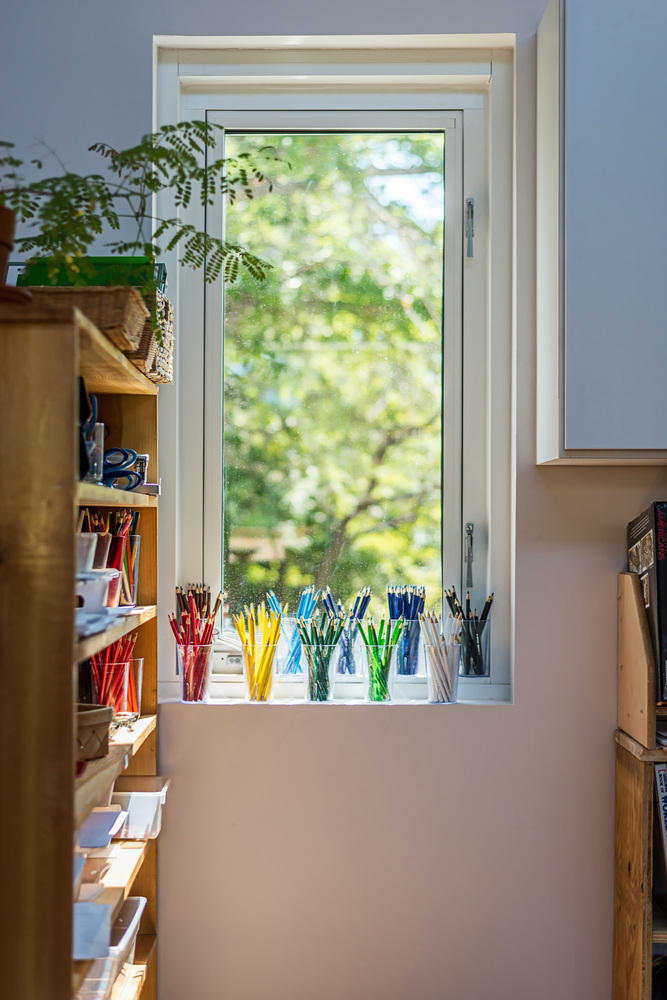
In the case of the Khabele school, a visible relationship to nature was especially important. All of the rooms have large windows that offer plenty of natural light and views of trees and the surrounding forest.

Lighting is the most important environmental input after food and water for controlling bodily functions and behavior. For this reason, optimizing natural lighting was a key aspect of the Khabele school design and should be a top priority in any new school development.

In our research, we found that full-spectrum natural lighting not only helps reduce energy consumption but also determines the body’s output of vitamin D, a critical component to a child’s health and development. It has even been found to raise students’ grade point averages and make children less “hyper.”

Beyond just the lighting, we found that windows overlooking the outdoors were crucial.

Outdoor learning environments are becoming more and more popular as a means of involving students in the study of ecology and greener environments. Integrating school structures with natural quiet areas as well as play areas is also very important. We wanted to encourage that connection by providing lines of sight to the trees and play areas outside the classrooms.

My team and I made a conscious decision to showcase beautiful natural material, including stone and wood, to mimic the existing building on campus while also blending in with the surrounding Texas hill country. The importance of infusing a child’s physical setting with a direct, physical connection to nature cannot be overstated.
 

Fostering Environments That Are Welcoming

The main entrance is the first thing every child sees when arriving at school. This entrance has the opportunity to be welcoming and approachable, or unfriendly and withdrawn.

I’d bet you that any parent and their child would want their school to look welcoming, for obvious reasons. A school should be a friendly place that encourages learning. Welcoming entrances also serve the role of orienting children as they move throughout the school’s campus, serving as a visible pillar of the school and giving it a sense of community.

Although Khabele already had a building on this campus, we considered how our addition to the school could serve to better welcome and orient students.

A wooden deck served as the main pathway to the new classrooms, signaling to students and teachers alike that they should enter the space.

The deck was made extra wide so that it could easily accommodate clusters of students moving back-and-forth from class while also being a visible point of reference for students and visitors.
 

Looking Forward: The Future of School Design

Designing the next generation of schools requires having an open-table discussion among students, educators, parents, and architects. With limited research in this area, it is up to us to determine what elements of a school design work best and what needs to be refined in order to create schools that support the growth and development of future generations. Through these collaborations, we can stop letting poorly designed schools limit great teaching moments and take their toll on student learning.

Most importantly, we can ensure that our schools’ philosophies are better reflected and supported by the environments in which they are taught while also encouraging a greater appreciation for the built environment.

Tim Derrington
 

Media Monday: Where do the presidential candidates stand on education?

The 74 Million’s presidential election coverage includes news, analysis, and opinion on the education policies of candidates from both major parties.

The 74 Million’s presidential election coverage includes news, analysis, and opinion on the education policies of candidates from both major parties.

We’ve noticed over the past few weeks that education policy is not getting much coverage by traditional media sources in the noise of the presidential campaign, so we went looking for some solid information comparing the candidates’ positions on a range of education issues, from pre-k to college. Here’s what we found. Please let us know if there are other sources you recommend!

One of the most interesting sites we discovered is called The 74 Million, named for the number of school-age kids in the country whose needs ought to be on our minds as we vote this year. It covers a broad spectrum of education issues, looks fresh, is easy to navigate, and adds new content regularly. There are opinion pieces from a variety of viewpoints as well as features on school-related topics, including reporting on SWSXedu here in Austin. But for our purposes, the section on Election 2016 is of interest for its coverage of what the candidates are saying and not saying about education. For a quick hit of information, the Election Scorecard details candidates’ stands on six key issues.

A “just the facts” site, Ballotpedia.org’s education page does a good job of rounding up presidential hopefuls’ statements on a broad range of topics and laying them out in one handy, clickable spot to make them easy to compare and contrast.

And if it’s higher education policy that’s of interest to you, take a look at the National Association of Student Financial Aid Administrators explanations of that hot election-year issue.

Shelley Sperry


Media Monday: Teaching “no to violence”

For Media Monday this week, we’re looking beyond borders and joining the international community in saluting a great teacher who works in some of the most difficult circumstances imaginable.

Some children may not directly experience things like arrests, or assault, checkpoints, and all the violence in our country, however they see it on the screens and in social media and that will affect them. . . . When I say no to violence, I pass it on to the students without them noticing it, through behaviors and ethics that I teach the students through playing games.

—Hanan Al Hroub, Global Teacher of the Year, 2016

In case you missed it, an innovative Palestinian teacher from Bethlehem who grew up in a refugee camp and now teaches refugee kids, was selected as Global Teacher of the Year yesterday. None other than Pope Francis announced the honor for Hanan al-Hroub, who believes in nonviolence and the power of play. Al Hroub explains her philosophy and her battle against violence in a YouTube video that’s a must-see:
 

 Shelley Sperry