The whole world in one Houston school


If you’re feeling in need of a tonic right now—something to nourish and pep you up and get you through the end of the year with a smile on your face—I have a suggestion. Have you seen the Houston episode of Anthony Bourdain’s Parts Unknown on CNN?

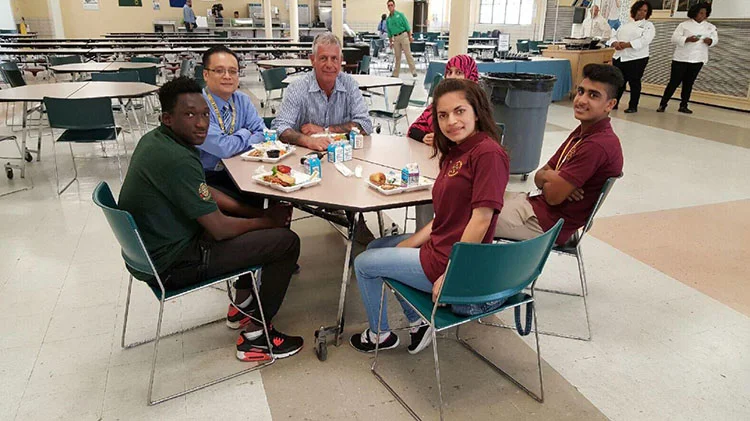
The full episode celebrates the gorgeous, charming, and fascinating people of Houston, including hip hop car enthusiasts, Vietnamese fishermen and shopkeepers, Congolese and Ghanaian urban farmers, Mexican American families, and a larger-than-life Indian American radio host. But for the Alt Ed Austin community, the most inspiring visit Bourdain made down in Houston was to Margaret Long Wisdom High School (formerly known as Robert E. Lee High School). Principal Jonathan Tranh, a Vietnamese immigrant himself, led a tour of “the most diverse high school” in a city where minorities are now the majority. At Wisdom HS, 80 percent of students speak English as a second language, and dedicated ESL instructor Gary Reed is one of the keys to the kids’ future success.

Suffering through a typical cafeteria lunch of chicken sandwiches, fries, and canned fruit salad, Chef Bourdain spoke to students from Iran, Pakistan, Burkina Faso, and El Salvador. You’ll love the little glimpses of these students’ dreams of engineering, fashion design, and soccer—and be sobered by the knowledge that so many of them come from dangerous places to which they dare not return. There’s one theme that’s repeated in every segment of the episode, in every corner of Houston, where each person interviewed praises the city’s compassion, climate, and boundless opportunity: “Welcome to America.”

If you have cable, you can probably see Bourdain’s episode “on demand,” and if not, it’s available on the CNN app, and for purchase on many platforms.


Shelley Sperry
 

Austin author's new book helps kids write loved ones' life stories


Jess Hagemann is an Austin-based ghostwriter and award-winning author. Her company Cider Spoon Stories helps people write fiction and nonfiction books. The newest Cider Spoon book, titled Notes from a Distinguished Life, is a DIY guide to family history for kids ages 8–22. It retails for $40 on the Cider Spoon website.


Even in heat-stricken Texas, the short, dark days of winter can make you want to hibernate. Last January, business was slow and Sunday afternoons were long when I decided to pass the time with crafting. I’d always loved collage art, and the unread magazines in our house were plentiful. With The X-Files reruns on Hulu in the background, I set to cutting out and trimming random bold words, colorful images, and isolated textures. Somewhere around the Martha Stewart Living caption “It’s time to share your stories,” I had the idea for a new book.

I’m a ghostwriter. That means I help people write books—life stories, in particular. A typical day for me is sitting down with a grandma or grandpa and my voice recorder and listening to them cry and laugh their way through recollection. It’s a time-intensive process, and while you can’t really put a price on leaving a definitive legacy behind, the service can be cost-prohibitive for some families. Enter Notes from a Distinguished Life.

Notes from a Distinguished Life is a 70-page, full-color, 100% interactive guide for kids to interview their family members. Each page of the book was originally hand-collaged, painted, and designed with an eye toward bright colors and maximum student engagement. Each page also has one or more questions, prompts, or activities to stimulate critical thinking and meaningful discussion. It’s a book meant for families who want to “ghostwrite” their loved one’s stories themselves.

No one underestimates the power of story. As children, we came to know firsthand the special ability of stories to transport the imagination. Foreign lands, exotic creatures, long-gone worlds, and far-distant futures unspool in the mind’s eye when we hear about them. They are, in some sense, made real. What people too often underestimate is the amount of time left to tell stories, and to listen to them. If I had a dime for every person who’s said, “I wish we’d hired you when Mom was still alive . . .” It doesn’t have to be that way. You and your kids can capture the stories now; you can craft a legacy that your loved ones will feel proud to leave behind!

My maternal grandfather’s name was Jackie L. Schrader. He was an enlisted sailor in the U.S. Navy, and later, chief arson investigator for the Wichita fire department. I was fortunate, while he was still alive, to help Jack write his life story. I didn’t have the same opportunity with my paternal grandfather, Donald Hagemann. Don was a lifelong farmer, permanently suntanned and wind-whipped and quiet in the way that introspective old men are. I never got to ask him if he liked being a farmer. Did he name all his cows? How did he feel about being a father to nine children (my father among them)? What was life like in the 1940s? I won't get to ask these questions, but you can.

Please do.


Jess Hagemann

Computer science is integral to a strong education

Lisa Zapalac is one of the co-owners of Long-View Micro School, an innovative new school in Austin that has a strong STEM focus. Lisa’s background in schools is extensive, as she has served as a principal, curriculum director, and teacher, working in both private and public schools, from preschool to high school. She is a dedicated proponent of early computer science and coding instruction and sees the results daily at Long-View.


We teach all children to write, but we don’t expect them all to necessarily become writers. In a world in which computing is ubiquitous and drives innovation in nearly every industry, it is important that we teach our children from an early age how to harness what is called “computational thinking.” Computer science is the broad area in which much of this would be taught to children, and computer science is now foundational to a strong education, right alongside reading, mathematics, science, and writing.

All kids will not end up as computer scientists, though we want many more to make that choice, as 71% of all new jobs in STEM are in computing and only 8% of STEM graduates are in computer science. However, most of our children will eventually find their jobs or their passions crossing over with computing. Whether they someday own a small business and recognize an app would accelerate revenue or they become a biologist who sees that the application of statistics, mathematics, and computer science holds the key to relations among several biological systems, computer science is key to being broadly educated and ensuring choice in future career pathways. This is sometimes referred to as the “double-deep” mandate, as the workforce will increasingly require sets of skills within technology and a secondary area, such as business, medicine, or sales.

Computer science is not just about sitting at a computer and coding. One might think of the relationship between arithmetic and mathematics (there is so much more to mathematics than only arithmetic!) when understanding coding and computer science. When taught properly, computer science will challenge students and teach them to approach problems in new and rigorous ways. It will stretch their logical thinking skills, and help them develop mindsets such as being curious and flexible. The core concepts and big ideas of computer science are broadly transferable, as CS is a discipline just like history, physics, or mathematics. It has a body of knowledge, and the thinking skills of the discipline will last students a lifetime. And there is ample evidence that the discipline of computer science is accessible to children in elementary school and onward.

What does it look like for young children to engage in a computer science class? Yesterday I watched a third grader, with a little bit of extra time on her hands, decide to challenge herself to code something she’d learned in math that day. She set forth to figure out how she’d write a program that allowed the user to consider two sets of numbers and then find the intersection of the two sets.

The third grader’s first thought was, “I don’t really know how to do that. The only thing I know for sure is that I can start with a print statement.” Using her knowledge of Python, she coded a few lines that would print onto the screen both sets of numbers, with six elements in each set. She then iterated her code by adding a line asking the user to consider both sets and then enter the value that represented the intersection of the two sets. After a peer tried out the fledgling program, the hard-working young computer scientist realized she had a problem to solve. What if the user inputted the wrong answer? How could she add to her program so the computer would respond by telling the user the answer was incorrect, and then allow for a new answer to be inputted?

The logical thinking and problem solving terrain that this young eight-year-old traversed, while also having to leverage her beginning knowledge of Python, is nothing short of remarkable. First and foremost, she was a curious learner who sought intellectual challenge. She found a starting point and had the stamina to continue breaking apart her problem. She was able to simultaneously think about the user’s experiences, the set theory she learned about in mathematics, and the coding language to which she’d been newly introduced. What a thinker!

As Jeannette Wing, Professor of Computer Science at Carnegie Mellon and VP of Microsoft Research, wrote in her seminal article in 2006, computational thinking “represents a universally applicable attitude and skill.” Her vision helped inspire innovation across the world, with England, as an example, leading as the first country to mandate computer programming instruction in primary and secondary schools. President Obama signed the U.S. education law called “Every Student Succeeds” and with it recognized computer science as a “critical academic field.” Our children live in a digital world, and we need to prepare them for the digital world by ensuring a baseline understanding. Computer science should be part of every child’s education experience.
 

Lisa Zapalac
 

“The gentle art”: Brazilian Jiu Jitsu and self-defense for kids


Chris Wilson, a student at Integração Jiu Jitsu here in Austin, joins us on the blog to explain the benefits of this Brazilian form of self-defense and how it differs from some of the better-known martial arts. IJJ is offering a free self-defense workshop designed for homeschooled kids this Thursday, Nov. 3, from 10:30am to noon.


What does it say about our society that many, if not most, parents don’t place self-defense skills very high on their list of important things to teach their children?

Perhaps we should see it as a good thing, an indication that today’s world is safer and less threatening, so spending time on self-defense seems unnecessary. I can see that perspective, certainly here in Austin. An article in Texas Monthly last year placed Austin as number 21 of the 24 most dangerous cities in Texas. That’s fairly good news, but it doesn’t mean self-defense isn’t important as a life skill.

The fact is that kids need to learn self-defense not so much to protect themselves from crime as to protect themselves from other kids. We all know the damage that bullying does to a person. I certainly do. I was bullied for several years growing up. The thing is that I was only attacked physically two or three times. But I was intimidated daily. I was afraid of other kids, even kids my own age, who were just bigger and meaner than I was. How I wish I had been taught to defend myself when I was growing up!

But I’m really not sure that it would have helped. In my day, if you wanted to learn to defend yourself, you took Karate or Tae Kwon Do. So, that’s what I did with my kids. I put them in Karate by the ages of 8 and 6. Sitting on the bench in the dojo one day, after both boys had been at it for over a year, it hit me. They had learned nothing. They punched and kicked at the air. They blocked imaginary attacks with gusto. But they had no actual skills that would protect them from someone who wished them harm.

Sure, they had the confidence that came from breaking boards and getting a new belt every 9 weeks, but they would not survive their first real fight. Why? Because most fights end up on the ground, where Karate and Tae Kwon Do have nothing to offer. Moreover, kicks and punches prolong fights and make them more dangerous—exactly the opposite of what I wanted for my children. I struggled with this realization and eventually concluded that I had to find something else to prepare them for the bullies and jerks of the world.

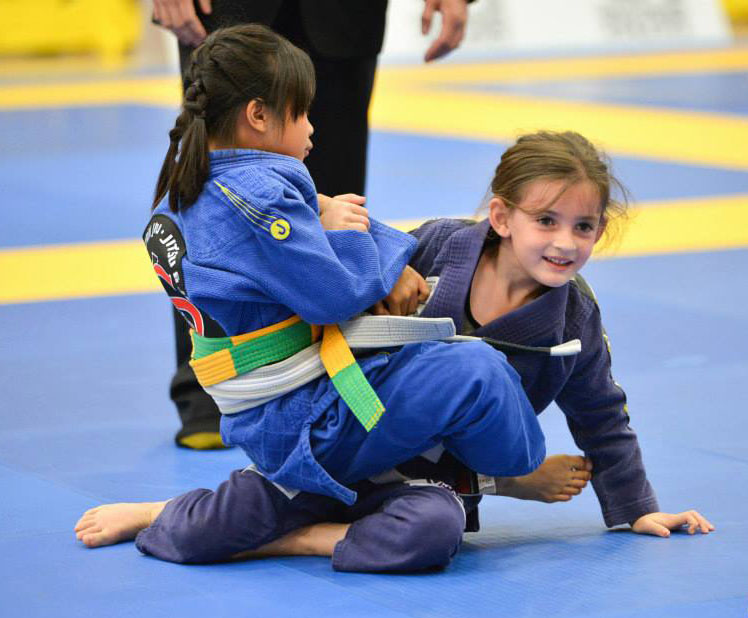
Then I discovered Brazilian Jiu Jitsu. The words mean “the gentle art” in Portuguese. Ironically, while it professes to be gentle and almost entirely defensive, Jiu Jitsu is, hands-down, the most effective approach to fighting and self-defense that exists on the planet. Don’t take my word for it. The Ultimate Fighting Championship was started in 1993 to showcase the superiority of Brazilian Jiu Jitsu over all other fighting styles.

The UFC in its early days was brutal. No gloves. No holds barred. Anything goes. It was bloody and often hard to watch. We saw giant men in overalls (street brawlers) face enormous chiseled wrestlers and black belts of all types, representing everything from Kung Fu to Boxing to Karate. And who won? The little Brazilian guy using his Jiu Jitsu. He won again and again. Even today, Jiu Jitsu skills are essential to success in mixed martial arts on any level. It’s just that effective.

But this is not about what it takes to become a top-level mixed martial artist. This is about what kids need to protect themselves from other kids. It turns out that the gentle art is superior for this, too. Here’s why:

  • The focus is on defense and on de-escalating conflict. To punch is to attack. To kick is to attack. Even if you’re counter-punching, you’re counter-attacking. That is not de-escalation. Kids who practice Jiu Jitsu do not spend time punching and kicking the air. They spend time learning how to stop or redirect punches and kicks as they gain control over an attacker. They spend time learning how to get the other person to simply walk away.
  • The objective in Jiu Jitsu is to get the aggressor to stop attacking. If a bully knows he cannot win, he will stop. Or, if she knows she will suffer injury if she doesn’t quit, she will stop. This is the fundamental premise of Jiu Jitsu.
  • Training in Jiu Jitsu is real. Students spar against one another in every class. A kid who trains in Jiu Jitsu knows what to do when a fight breaks out, and he or she knows what to do when it goes to the ground (which it almost always does). The mental preparedness that comes from regular sparring is a very big part of the self-defense equation. Being mentally prepared for a fight causes a kid to exude enough confidence to stop it before it starts.
  • Jiu Jitsu equalizes size and gender. This is because Jiu Jitsu relies upon leverage-based control holds to neutralize threats without violence. Students learn to use their opponents’ size and strength against them. These days, when a smaller kid stands up to a larger, meaner one, the big kid should be worried. There’s a good chance the smaller kid knows Jiu Jitsu.
  • Jiu Jitsu is intellectually stimulating. When kids realize the principles of applying leverage using their bodies, a world of possibilities opens for them. They start to recognize that every sparring scenario is different and what they can do is limited only by their creativity and experience. Practitioners of Jiu Jitsu often refer to it as “human chess.”
  • Jiu Jitsu is FUN! While there is certainly some structure to a Jiu Jitsu class, there is also a great deal of room for play. Kids can get great exercise while rolling around on the mats, competing with one another in a peaceful and friendly way. They often don’t even realize how much they’re learning.

All in all, Jiu Jitsu has been transformational for me and for my two sons. I only lasted about two months on the bench watching before I signed up and started training myself. That was four years ago, and now I have the privilege of owning a Jiu Jitsu school with a world-class Brazilian Jiu Jitsu black belt. It is such a pleasure to watch my kids and the other kids at the school grow through Jiu Jitsu.

It has given them all the confidence they need to stand up to anyone who wishes to push them around or intimidate them. It has given them the skills to not only look after themselves, but to defend those around them when no else can or will. Most importantly, it has taught them how to turn a potential conflict into nothing, which is the ultimate in self-defense. If you haven’t considered Jiu Jitsu as a self-defense/fun activity for your kids, I highly recommend it. Just google Jiu Jitsu in Austin. There are schools all over town. If you want to visit ours, just check out our site at www.ijjatx.com for class times.

Stay safe, Austin!


Chris Wilson
Time to get your story-loving kids on board for NaNoWriMo!


We WRITE, practicing the arts of storytelling and poetry. We SHARE—reading our own work aloud in the classroom, performing in public, or having work published; sharing brings writers in contact with readers, helping build literary communities in our own backyards.

—The Badgerdog writing program of the Austin Public Library Friends Foundation


For most of us, November 1st means digging a few sweaters and sweatshirts out of the back of the closet, ramping up the panic as Thanksgiving’s culinary pressures approach, and enjoying the sights, sounds, and tastes of peak autumn. But for a certain group of word nerds, November 1st means one thing above all: It’s time to begin the NaNoWriMo marathon and not look up from the notebook or keyboard until midnight, November 30th.

NaNoWriMo, an acronym for National Novel Writing Month, is an international writing challenge community that started as a tiny idea in 1999 in San Francisco and eventually turned into a nonprofit in 2005. Today, hundreds of thousands of people across the globe participate by signing up online and pledging to write the first draft of a 50,000-word novel in the month of November. If you make that goal, you “win” NaNo, but even if you don’t reach the word mark, participants get a great sense of camaraderie and accomplishment just from process.

NANOWRIMO_1.jpg

For young people, there is a special community, called the Young Writers Program, where kids of all ages can join in the challenge with their teachers and parents. In 2015, more than 80,000 students and educators took part, not counting the teens who participated, as many do, in the main NaNo community. Kids generally set their own word limits, and aren’t bound, of course, by the 50,000 goal, which is about the length of The Great Gatsby. For a little taste of the excitement involved in plotting, world building, and sharing stories, take a look at some of the many videos created by past teen participants by searching “NaNoWriMo2016” on YouTube.

In Austin, the place for young writers to learn more about the NaNoWriMo experience is at the Austin Public Library. At Faulk Central Library, kids ages 10 and older are invited to attend a NaNoWriMo kickoff Tuesday, November 1, at 5:30 p.m. called “What’s Your Story.” This will be followed by “Keep It Up,” a meeting halfway into the month, on November 15. At the end of the intense and fabulous month there will be a celebratory meeting on December 1, when kids can talk about their experiences, learn a little about how to revise the first draft they have created, and even share their work.

In addition to the library activities, if you have girls in 3rd through 8th grade who are aspiring writers, they may be interested in a couple of workshops happening on Saturday, November 5, as part of the We Are Girls TX conference. Here’s the schedule.

The NaNoWriMo activities at the library are sponsored by the Badgerdog writing program, which operates year-round and sponsors spring break and summer writing workshops for elementary, middle, and high school kids all over Austin.

Cecily Sailer, Programs Manager for the Austin Public Library Friends Foundation, says her best advice is that kids of all ages should have fun with NaNoWriMo and set their own, personal goals. “If you spend November writing a little more than normal, you win!” says Cecily. “And make sure to talk about what you’re creating with someone else—take it outside the keyboard or notebook and into the world.”

Follow the Library Foundation on Facebook for updates about this program, and definitely check out the Unbound blog, which features writing and artwork by students!

Need more inspiration?


Shelley Sperry

Media Monday: Locals we love

Did you Buy Local for your Halloween pumpkin this year? Are you giving out local Lamme’s next week—or at least buying some for yourself? Good. Now, how about some local video and audio fun for you and your kids?

Here are two truly terrific homegrown, certified local, and maybe even organic things to try this week:
 

ARTtv is a YouTube channel that wants your kids to do just one thing: MAKE SOME ART! The channel is the brainchild of Ron Pippin, an Austinite with 25 years of experience in film and video production. The topics on this vast channel of mostly kid-made videos include mini lessons on all sorts of skills and projects, from drawing faces to writing poetry about bats to making an automaton. Plus lots and lots of great music by and for kids.


ARTtv is connected to Outside Voice, a creative community for kids that you can help fund through Indiegogo. You can find out more about Outside Voice on Facebook and follow them on Twitter.


Tumble is a podcast for kids ages 8 to 12 about every aspect of SCIENCE! But honestly, I’m five times older than that target demographic, and I’m adding it to my playlist today. The hosts are partners in life and on the podcast. Lindsay Patterson and Marshall Escamilla love trivia, cool and gross stories, and dumb puns.  But mostly they love science.

In episodes that last about 15 minutes each, Lindsay and Marshall share fascinating facts about salamanders, electricity, and exploding stars.  As with most podcasts, the thing that will keep you coming back is the chemistry (!) of the hosts, who ask sharp, interesting questions of their scientist guests and do a lot of giggling. And if you end up loving it like I do, there’s also a newsletter you can subscribe to and a way to support the podcast through Patreon. Follow Tumble on Facebook and on Twitter.


Shelley Sperry