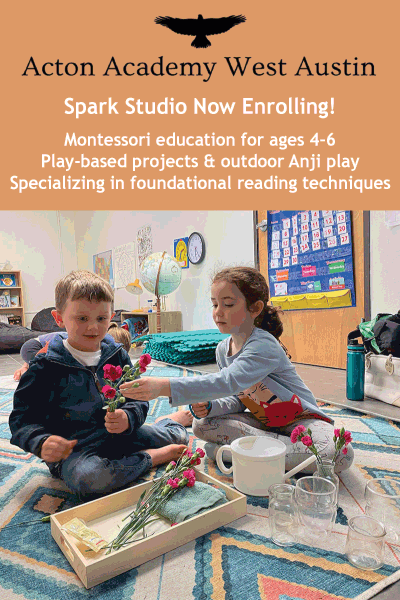
It’s not too late to have a great spring break!

Yes, the moment is drawing near when our fair city goes crazy and kids are in need of some serious recreation, enrichment, and camaraderie for Spring Break 2018. Most camps are filling up right now, so don’t hesitate if you’re interested in that precious week of March 12–16.  

Below we’ve made a list of our favorite spring break camp options that have some openings as of early this week, but no guarantees!
 

Autism and the art of fierce love

As guest blogger today, we welcome Dr. Laurence Becker, an educator and advocate for the autistic community and creative savants, who is also an award-winning film director and producer based in Austin. Dr. Becker first tackled the subject of autism and artistry 35 years ago in his film Eyes Wide Open, about artistic savant Richard Wawro. His new film, Fierce Love and Art, premieres on Mother’s Day, Sunday, May 13, at 7pm at the Performing Arts Center of Austin ISD. You can learn more and support the film via the website. You can also see art related to the film from February 25 to April 8 at Hyde Park Bar & Grill.
 

FierceLove_film-poster.jpg


To journey and to be transformed by the journey is to be a pilgrim.
—Mark Nepo, The Book of Awakening


My real mission with Fierce Love and Art is to open the eyes of the world. We need to realize that all of us are related, and we can all make the world a better place. In the film we meet individuals with autism and other disabilities who have been able to transform their own lives and contribute to their communities through art, music, and words as a result of powerful support and love from parents and grandparents.

The film explores the lives of seven savant visual artists, a savant musician, and an author and minister who are living extraordinary lives today because their families used art as a means of connection, bringing them home from solitary confinement on “Autism Island.”

Some of the incredible people we meet and spend time with in the film include savant musician Tony De Blois, who plays 23 musical instruments and sings in 11 languages. Tony is a Berklee College of Music graduate who plays in a jazz band and composes original music at his home in Boston.

Another great story I’m delighted to share is about Houston native Grant Manier, whose autism and obsessive repetitive behavior led him to repeatedly tear paper. With encouragement from his mother, Grant soon began collecting and recycling bits of paper, creating amazing collages, which he calls “coolages.” The artworks are a form of therapy for Grant but also a contribution to the eco-art movement, as he recycles materials and helps us all look at them in new ways. Grant now also participates in educational outreach to share his vibrant, colorful art and point of view with others. His slogan is “Different is More.”

Sadly, one of the young people we had the honor to work with for the film passed away in 2016 as a result of an injury connected to her epilepsy. Kimberly Dixon was a warm and lively spirit who wrote poetry and painted as a way of connecting with her family and community, despite being nonverbal in a verbal world.

I’m eager to have everyone join us in May to see these amazing stories. To me they’re a real testament to what happens in the lives of children with autism when their families fiercely take charge of their development—and also a testament to the power of art in all our lives.

Laurence Becker, PhD
 

Need to find the school that fits your kid?

We have the answers you’re looking for at the Austin Alternative School Fair. Read on for all the details!

When?  Saturday, February 17, 11am–2pm

Where?  A brand-new venue for our event: Spider House Ballroom, 2908 Fruth Street. Park in one of Spider House’s two parking lots, or in the free street parking in the surrounding area.

What?  A chance to talk with some of Austin’s most effective, innovative educators from learning communities where children and teens grow and thrive.

Each booth has some fun activities to engage kids while parents talk with educators about their schools and special programs, which are tailored to all ages from pre-K through high school. The schools represent unique, transformative programs from all over the metro area, including Cedar Park, Pflugerville, and Dripping Springs.

Food and beverages available for purchase next door at Spider House Cafe.

How is this school fair different?  Unlike many of the larger, generic fairs where schools compete for your attention, this one is a collaborative effort by alternative educators who know there’s not one right way to reach all learners.

Is it really FREE?  Yep. Just bring your kids and questions!

Who is throwing this shindig?  It’s brought to you by the Education Transformation Alliance, a 501(c)(3) nonprofit organization, and co-sponsored by Spider House Ballroom and Alt Ed Austin.

I’ll be there to chat and help find answers to all your questions about schools and transformative education in our community.

And we have a Facebook page you can check out to remind you of the time and place and to share with other parents.

I look forward to meeting you there!

Teri

5 ways to celebrate Black History Month with kids

Cargo plan for the wrecked slave ship Henrietta Marie at the Bob Bullock Museum

Cargo plan for the wrecked slave ship Henrietta Marie at the Bob Bullock Museum

We’re lucky to have a great array of Black History Month events and exhibits happening across Austin and the whole region that can spark kids’ imaginations and interest. Here are five options to consider checking out this month with your family:

Black-History-Month_hidden-figures-poster_375.jpg
  1. Black History Month Kids’ Day: On February 17, the George Washington Carver Museum and Cultural Center will host a big family event with crafts, activities, and learning opportunities about Black History Month from noon to 4pm. While you’re at the Carver Center, there’s also something for older teens: HBCU Day, when Texas Historically Black Colleges and Universities visit the center to recruit and show off their talents.
  2. At the Bullock Museum, a new interactive exhibit can offer kids a way to explore the tale of a wrecked slave ship, the Henrietta Marie.
  3. The Austin Public Library is celebrating the month with tons of first-rate movies telling some amazing stories that will inspire and educate, including Hidden Figures, Glory, The Jackie Robinson Story, and Akeelah and the Bee. You can check out the schedule on the library’s website.
  4. If you want to take your kids a little farther afield for some knowledge and fun, consider heading to San Angelo and the Fort Concho National Historic Landmark anytime, but especially on February 28, which is Buffalo Soldier History Day. This is a living history experience honoring the African American soldiers who served in the 19th century at forts across the United States.
  5. A little closer to home, you can pile family and friends in the car for a field trip to San Marcos and the Calaboose African American Museum’s exhibits on Buffalo Soldiers, the Tuskegee Airmen, and jazz pioneer Eddie Durham.

Shelley Sperry
Sperry Editorial


Talking with kids about social media

CourtneyHarris_headshot.jpg

As a child-centered coach for teens and parents, guest contributor Courtney Harris supports children ages 11–19 in finding their voice, growing confidence, and thriving. Through 1:1 and small-group coaching sessions, teens and tweens are able to overcome anxiety, disconnect, and isolation as they discover their truest sense of self and develop a deep sense of empowerment. Courtney supports parents in self-care, growing alongside their children, and developing balanced sensitivity toward the process their child is creating. Sessions with both teens and parents guide families in developing the trust, communication, and connection that's crucial for a life of ease.

The following is republished with Courtney’s permission from her “Talking to Teenagers” series on her website, Courtney Harris Coaching;  we encourage you to follow her on Facebook to learn more.
 

Courtney Harris_social-media.jpg


Teenagers spend up to nine hours a day on social media.

Let that sink in.

Now, consider: How many hours a day do you spend on social media? Right now, check battery usage under settings on your phone. Where have you spent your screen time in the last 24 hours and the last 7 days? And how much time have you spent? Let’s go ahead and admit that as adults, we struggle with device overuse, too.

Tweens and teens, however, have grown up socializing on and through social media to an extent that is unprecedented. During the teenage years, the brain is changing very quickly and can be easily influenced. Thus, impulsivity and the drive to impress others can occupy much of our young peoples’ thought processes. Enter social media and the ability to engage and interact 24/7.

This cocktail of impulsivity and nonstop stimulation can be a huge drain on teenagers and a massive barrier in family relationships. Parents often share with me that their teens have “unhealthy relationships” with their phones or laptop. They often continue, saying that they feel helpless and uncertain about how to help their teens navigate their relationships to technology and social media.

Get Curious About Your Teen

I’d like to invite all parents and supporters to work toward a curious approach when addressing social media with their teens and tweens. This requires letting go of our biggest fears about what they’re doing on their devices, our resentment over their addiction to their devices, and so on. While these fears and hurts may be real, it’s important that we loosen our grip enough to get curious and to listen authentically.

Here’s a list of open-ended questions (my favorite) that we can use to open space for our young people to share (and become aware of) their process:

  • What kind of posts (that you see or create) make you feel joyful?
  • What kind of posts (that you see or create) make you feel upset?
  • How does social media help you express yourself?
  • How does social media create a sense of competition?
  • How does social media feel like a tool for you?
  • How does social media feel like a chore/challenges for you?
  • Where do you go online for support?
  • Where, online, do you feel fearful or insecure?
  • What will you create online? In your online presence?

All of these example questions can be followed up with a “why” or a gentle encouragement to dig a little deeper. As our young people engage in dialogue with us, it’s important that we refrain from responding with judgmental comments or quick advice.* The goal is to give our young people space to put a name to what they’re feeling and to grow consciousness of their behaviors and patterns. We are careful, in this dialogue, not to fault or scold.

*Of course, if our teen shares that they or someone they know is in danger, we must take action, set boundaries, or intervene.

I also encourage parents to share their own responses to these questions. This is a sweet, authentic, and inclusive way of modeling healthy behaviors for social media and technology usage. It is also a pathway to relating to our children, acknowledging that we, too, are challenged by social norms and pressures of the internet.

Creating Routines

Another crucial piece of this conversation is about helping our teens create routines that help them thrive, not just survive, this highly stimulating time of life. Co-creating norms for technology usage supports teens in growing awareness of their thoughts, feelings, and actions, and it encourages them to self-regulate. Norms and routines must be created together for our young people to feel a sense of ownership and purpose. Thus, we may use another series of questions to empower our children:

  • What types of things do you need your phone for on a daily basis?
  • What time should screens be put away, so we can get the rest we need?
  • How long do you think you’d like to be on your phone for socialization each day?
  • Where will you keep your phone overnight so that it doesn’t disturb your rest?
  • What times or situations is phone usage not appropriate for?
  • What types of things do you find it useful/fun/joyful to post/share about?
  • What types of things do you find it unhelpful/hurtful/damaging to post about?

These questions allow our teens to develop habits that serve them, name their needs, and become aware of boundaries. Likewise, they provide parents the same opportunities.


Tips for Dialogue

  1. Start with one or two questions at a time. We aren’t interrogating or interviewing the child.
  2. Share the adult experience! This makes it a true dialogue.
  3. Adapt questions to individual languaging/style (but stay curious and receptive by using open-ended questions).
  4. Initiate this dialogue in a time free of technology-related conflict. Start with a fresh slate.
  5. Boundaries and safety are important. Trust your judgment if there’s something you know you need to intervene in.
  6. Revisit this conversation time and time again. Routines need to be updated as life and technology shift and change. Emotions and reflections will get lost in the daily pressure to perform from time to time. So, come back to these questions often. Come back to a calm, shared space of curiosity and conversation.


Courtney Harris
Media Monday: New year, new debates over tech in the classroom

My resolution for the month of January involves deleting quite a few news feeds and social media apps from my phone for a while. It’s not quite a media fast, but certainly a restricted diet to start the new year. At the same time, I’m becoming more convinced that my smartphone is an indispensable tool for research in my work and for exploration of the world of art and science.

Lately it seems that educators are in a similar pickle: how to balance the addictive and troublesome aspects of the digital world with the undeniable value of the information and interconnection our phones provide? How much smartphone use in the classroom is too much? When is a digital fast in order, and when should kids be gorging on the world of data, video, and stories available literally at their fingertips?

Many educators are wholly embracing the power of the computers in kids’ pockets by using Twitter, Facebook, calendar apps, and texting to connect with students about assignments; asking kids to learn about current events and scientific advances by exploring government data sites, magazines and journals,  and the latest scholarly papers; and watching academic panels and real-time experiments on video. Smartphones are also allowing for “flipped classrooms,” in which kids absorb key information online so that they can use precious class time to put their knowledge into active practice in discussions, labs, and group projects.

In the 2017 Digital Study Trends Survey, answers from high school students demonstrated that smartphones, tablets, and similar learning technologies are quickly expanding as part of most school curricula, with 60 percent of students saying that tech helps them improve their grades and prepare for exams.

One of the most exciting trends in educational technology is in the realm of assistance for kids with learning disabilities and special needs. Many phone apps allow students with a variety of reading challenges to translate written text to speech, for example.

But despite all the advantages, parents and educators are understandably concerned about the need for student privacy protections, boosting face-to-face human interaction in the classroom, and ending the use of technology employed in bullying and other forms of harassment. One recent Atlantic article sounded the alarm by suggesting that personal use of phones by teens—although not specifically classroom use—is “destroying a generation.”

It’s an issue that will likely grow even more critical in the next few years, as tech futurists are suggesting that we need to be preparing quickly for the not-science-fiction-anymore world when kids’ contact lenses will record video and artificial intelligence (AI) will help them find, read, and interpret research materials in new ways we can’t even imagine.

My resolution for the rest of 2018? To learn more about where the classroom tech debate stands now and where it’s going, and then report back here. If you’re interested, here are a few recent articles to start with:


Shelley Sperry
Sperry Editorial