What is critical thinking?


Guest contributor Stephanie Simoes is the founder of
Critikid.com, a website dedicated to teaching critical thinking to kids and teens through interactive courses, worksheets, and lesson plans.


“Critical thinking” is a trendy term these days, especially in the education world. Alternative schools in Austin commonly advertise that they encourage kids to think critically. Conversations about critical thinking are often accompanied by some version of the Margaret Mead quote, “Children must be taught how to think, not what to think.” But such discussions often neglect a crucial question: “What does it mean to teach children how to think?” Critical thinking is an abstract term. Are we all on the same page when talking about it?

As the founder of a critical thinking site for kids, this question is important to my work. We all get what “thinking” is, so the real question is—what makes it “critical”? I like to use a simple definition: critical thinking is careful thinking. It requires slowing down and questioning our assumptions.


Fast and Slow Thinking

Our brains are hardwired to respond to stimuli quickly, a crucial advantage in emergencies. When faced with a potential threat, immediate reaction is essential—there’s no time for deliberation. While this quick thinking might make us mistakenly perceive a harmless situation as dangerous, it’s a safer bet to err on the side of caution in high-stakes moments. It’s a matter of survival: better to assume danger where there is none than to overlook a real threat.

While fast thinking[1] is a valuable skill, it is prone to errors.

Here’s an example. Try to answer this question in less than 5 seconds:

If 1 widget machine can produce a total of 1 widget in 1 minute, how many minutes would it take 100 widget machines to produce 100 widgets?

After you’ve given your quick, intuitive answer, take as much time as you need to think about it.

Many people’s initial, intuitive response is 100 minutes. However, with more careful thought, we see that the correct answer is 1 minute. (The production rate per machine is 1 widget per minute. The rate doesn’t change with the number of machines.)

The key takeaway of this puzzle is that careful, deliberate thinking is often more accurate than quick thinking.

Applying slow, careful thinking to every daily decision would be impractical. Imagine how long you would spend at the grocery store if you conducted a deep analysis of every single choice! In many cases, our intuitive, fast thinking serves us well. However, problems can arise when we cling to the conclusions drawn by our fast thinking—especially in situations where accuracy matters.

In the widget machine problem, it’s relatively straightforward to recognize and correct our intuitive response with a bit of careful thought. However, letting go of our intuitive conclusions is not always this easy.


Humility and Critical Thinking

We might cling to our intuitive answers, even when faced with clear evidence or reasoning that challenges them, for several reasons.

First, it can be hard to change our minds when the intuitive answer feels very obvious or the correct answer is very counterintuitive. A famous example is the Monty Hall Problem. The correct answer to this puzzle is so counterintuitive that when Marilyn Vos Savant published the solution in Parade Magazine in 1990, the magazine received around 10,000 letters (many from highly educated people) saying she was incorrect!

It can also be challenging to let go of wrong answers when we have invested in them, such as by spending time and energy defending them. Sometimes, it’s simply a matter of not wanting to admit we were wrong.

Critical thinking requires more than just slow, deliberate thought. It also demands an open mind, humility, and an awareness of our minds’ flaws and limitations.


Building Blocks of Critical Thinking

Paired with slow, deliberate thought and humility, the following tools help us to be better critical thinkers so we can communicate more clearly—even when communicating with ourselves:

  1. An understanding of cognitive biases: These are systematic errors in our thinking that can lead us astray. There are many online resources that explore these biases in detail.

  2. An understanding of logical fallacies: These are flawed arguments. Logical fallacies can be used deliberately to “win” a debate, but they’re often made accidentally. Recognizing logical fallacies helps us to keep conversations on track. You can learn about some common logical fallacies in my Logical Fallacy Handbook or teach your kids about them with my online course, Fallacy Detectors.

  3. Science literacy: We were taught many facts in science class, but many of us never really learned what science is and how it works. This is the foundation of science literacy. For an introduction to this, I recommend biology professor Melanie Trecek-King’s outstanding article “Science: what it is, how it works, and why it matters.” Another important part of science literacy is knowing How to Spot Pseudoscience.

  4. Data literacy: Data literacy is the ability to properly interpret data to draw meaningful conclusions from it (and to know when drawing certain conclusions is premature). It means understanding how data is collected, identifying potential biases in data sets, and understanding statistics. Data literacy helps us make sense of the vast amount of information we encounter daily. You can introduce your teens to some common errors in data collection and analysis in Critikid’s course A Statistical Odyssey—a course that adults have enjoyed and learned from, too!


Preparing Kids for the Misinformation Age

A quick scroll through social media reveals a minefield of bad arguments and misinformation. You have probably come across logical fallacies like these:

“You either support A or B.” (False dilemma)
“Buy our product—it’s all natural!” (Appeal to nature)

The lack of science literacy among influential voices is also concerning. I can’t count how many times I have seen or heard the phrase,

“Evolution is just a theory.”

This phrase confounds the scientific and colloquial definitions of theory. If unintentional, it demonstrates a lack of science literacy; if intentional, this is a logical fallacy known as “equivocation,” in which a word is used in an ambiguous way to confuse or mislead the listener.

The need for data literacy is also apparent. You may have heard arguments like:

“Illness X has increased since Y was introduced, so Y must be the cause.” (Mistaking correlation for causation)
“There are fewer cases of food poisoning among people who drink raw milk than those who drink pasteurized milk.” (Base rate neglect)

We have an incredible amount of data at our fingertips, but without data literacy, we don’t have the proper tools to make sense of it all.


Critical thinking shouldn’t be taught as an afterthought; it needs dedicated, explicit instruction. Children face a battlefield of misinformation and faulty logic every time they go online. Critical thinking is their armor. Let’s help them forge it.


Stephanie Simoes | Critikid.com


[1] Nobel-prize-winning psychologist Daniel Kahneman calls fast thinking “system 1 thinking” in his book Thinking, Fast and Slow. I highly recommend this book to anyone who finds the content of this blog post interesting.

The adult in the room

Green field with pink wildflowers, courtesy of The Hedge School Cooperative in Austin, Texas


Dr. Erin Flynn, today’s guest contributor, founded and directs
The Hedge School Cooperative, a small, inclusive high school in Dripping Springs. This piece is adapted from the school’s blog and addresses a simple topic that is often overlooked in discussions about education: the importance of kindness.


I was recently talking with a friend [read: ranting]. Earlier in the week, I had been called "too kind/nice/sensitive" for the billionth time. My friend asked me why it bothered me so much, and this is what I parceled out: I grew up with the label, and it followed me into teaching and later as a principal. It is never said as a compliment; it is often said as an admonishment. It is seen as weak and ineffectual, as though a kind/sensitive person cannot possibly do a good job.

What is even more troubling about this, to me, is the idea that a person being kind to students, especially middle school / high school aged students, prevents them from being effective teachers or leaders. Why wouldn't someone want to be kind and sensitive when working in a position of responsibility for students?!

Let me be clear, I am not talking about being a "pal" to students. I set and keep boundaries. And I do this while prioritizing how the minor in this situation is feeling. I am the adult in the room. What does this mean? I believe it looks like the following:

  • I set the tone for the classroom, whether consciously or not, so I need to be conscious of what I am feeling and spreading.

  • I acknowledge when I have been wrong and/or hurtful.

  • I apologize.

  • I try not to take things personally.

  • When I fail at this, I do the following: take a break if needed; take the student aside to have a private conversation; acknowledge the harm caused by the comment/action (not the person); ask if they are doing okay and if I can help in any way; and always listen, listen, listen.

  • I do not hold grudges.

These are not revolutionary tactics; I learned them from other adults in my life. These adults were compassionate, kind, and kept boundaries with me. Being the adult in the room is possible both to practice and to do consistently. (Even when you're not in a room.)

Dr. Erin Flynn | The Hedge School Cooperative

Choosing among roads less traveled


Shawna Pitts is a parent and current staff member at
Clearview Sudbury School here in Austin, Texas. She joins us on the blog to share her thoughts on unschooling, Sudbury education, and a great podcast episode that discusses both of these and more. The podcast was produced by the Alpine Valley School in Denver, Colorado, where a group of Clearview students and staff recently spent a week.


The more I learn, the more I understand learning as a journey rather than a destination. It is wonderful to live and learn in a time and place where there are so many options for education, and so much recognition that there is not a single way that works for everyone. As a parent, I’ve traveled many paths with my children to help them find the right one. In their early years, a hybrid school led us to homeschooling, which led to my reading about homeschooling and unschooling, and then discovering the Sudbury model of education through the book Free to Learn by Peter Gray. My first entrée to the model was in 2016 through Clearview Sudbury School, right here in Austin.

I appreciate the similarities and the differences between unschooling and Sudbury education. Both paths have been a key part of our family’s journey. There was a point at which it made sense for us to move from our more family-based unschooling to community-based learning in a Sudbury school, but I don’t know that I could have articulated exactly why it felt right to me.

That is, until I heard this interview about one mother’s transition from unschooling to Sudbury schooling. Her insights resonated deeply with me, especially as my own children moved from the parent-focused phase of human development to the peer-focused phase. I found it difficult to give them freedom to follow their interests without facilitating and coordinating all of it.

I think that anyone interested in alternative education will enjoy this short episode of the Alpine Valley School podcast. It’s particularly poignant for me to share, as it features two of my treasured colleagues: Marc Gallivan of Alpine Valley School in Denver, and Cara DeBusk of the former Houston Sudbury School. Even better, the content mentions my family’s own beloved learning community, Clearview. I recommend listening to this as a great way to spend 12 minutes.


Shawna Pitts |
Clearview Sudbury School

When we dress up, do we become someone else? Or do we become more ourselves?

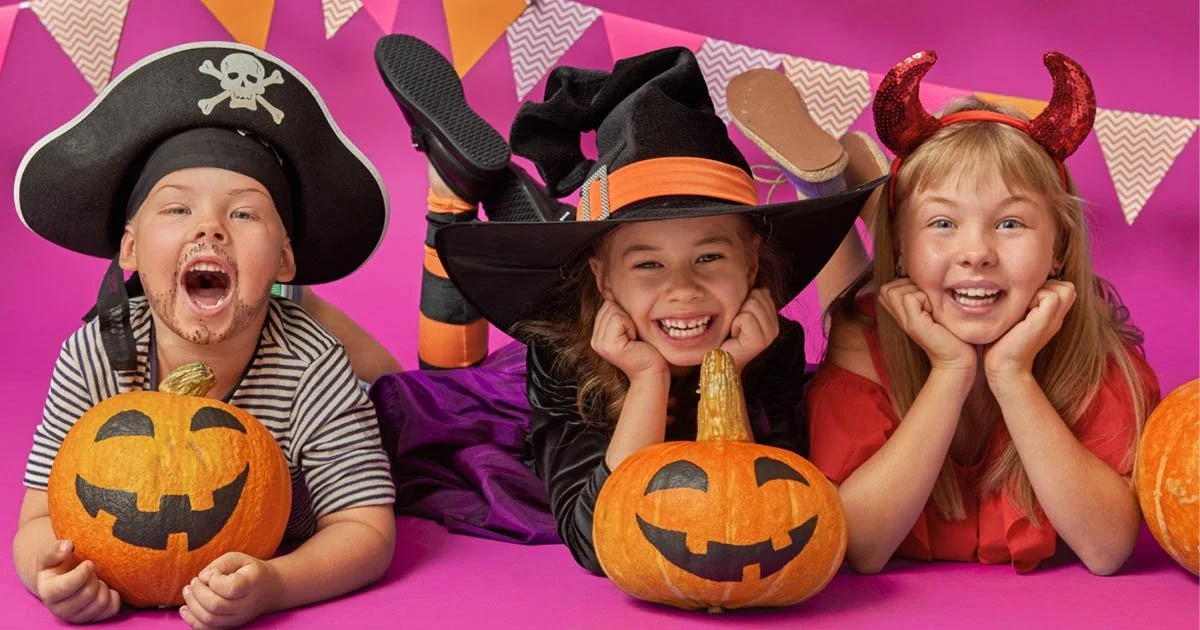
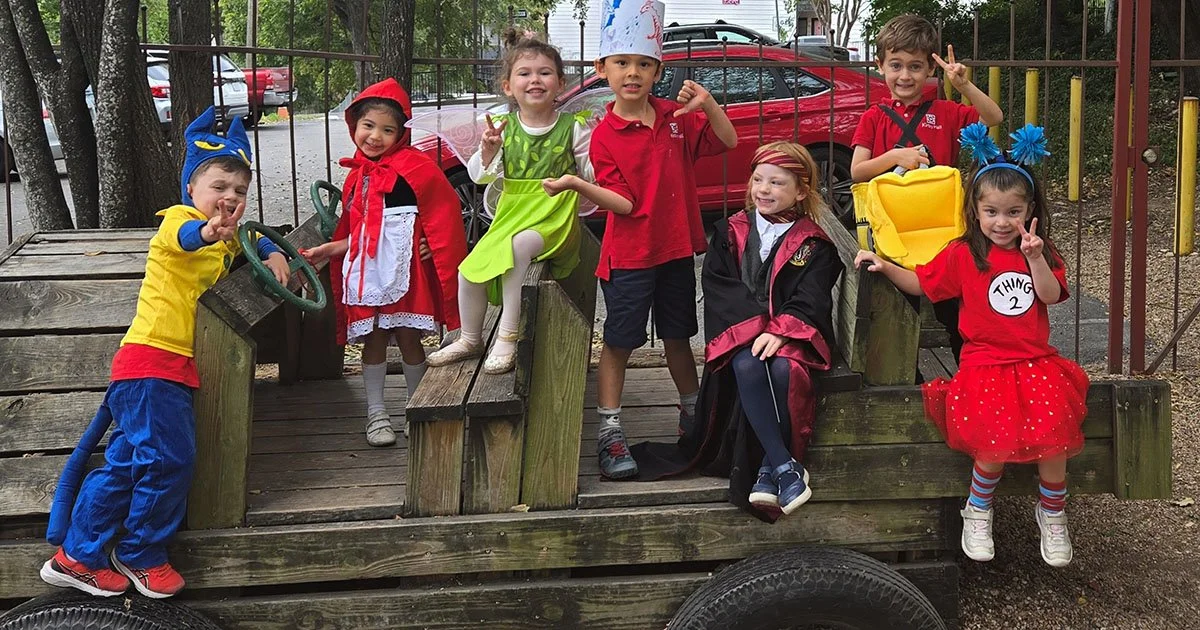
Marie Catrett, a frequent guest contributor here, has been looking back over ten years of documentation from her work with young children, compiling these stories into a book. She generously turned some of that material into this special photo essay about supporting young children in processing their feelings and questions about Halloween (and “dressing up” in general). Marie is the founder and lead educator at Tigerlily Preschool. You can meet her at this Saturday’s 2nd Annual Small Schools of South Austin Tour.

 
March 8, 2012

Willa: Is it a ghost or is it just Emerson?
Nayeli: No, it’s Emerson.
Willa: Let’s say boo to him, then the ghost will be Emerson again.


August 28, 2012

A set of magic wands appears in the dress-up corner.

Willa: Marie, what do you want to be turned into?
Marie: Hmm . . . turn me into a butterfly.
Willa: Okay, cause I’m a flying fairy.
Willa waves her wand over me and dances off.
Marie:
Now I’m going to be a butterfly?
Emerson: Now not going to be a butterfly. (Emerson waves his yellow wand over me.)
Marie: Did you turn me into something else?
Emerson: No!

I take Emerson to be saying here, “Marie, I need you to be my Marie.” He will often do this when monster play happens if someone in the play begins to refer to me as “the monster coming.” Emerson will tell them no, she’s not a monster, she’s Marie. He will ask me directly, with concern: you’re not a monster, Marie? No, Emerson, I reassure him. I am Marie.

Elias (who finds great meaning in interpreting the world through train talk): We can’t get on this train. This train is too small. We can’t get inside; we don’t have tickets. (His bubble wand is a train.)

Willa: Emerson, what do you want to be turned into?
Emerson: I don’t want to be something.
Willa: Okay. But this is real magic. You could be anything. Even a princess!
Marie (gently): Emerson, I hear pretending. You can choose about if you want any pretending.
Emerson (ponders, then): You could turn me into a BIG princess.

Later during the day
Emerson: (Waves wand): I turn you into a princess Marie.
Marie: Now I am a princess? Are you a princess?
Emerson (spinning happily): No, I’m not a princess. I’m nothing.
Willa: Are you air?
Emerson: No.
Daphne: Are you just Emerson?
Emerson: Yes! Just Emerson!


November 2, 2012

We return to school after Halloween. The children begin telling each other about what they saw.
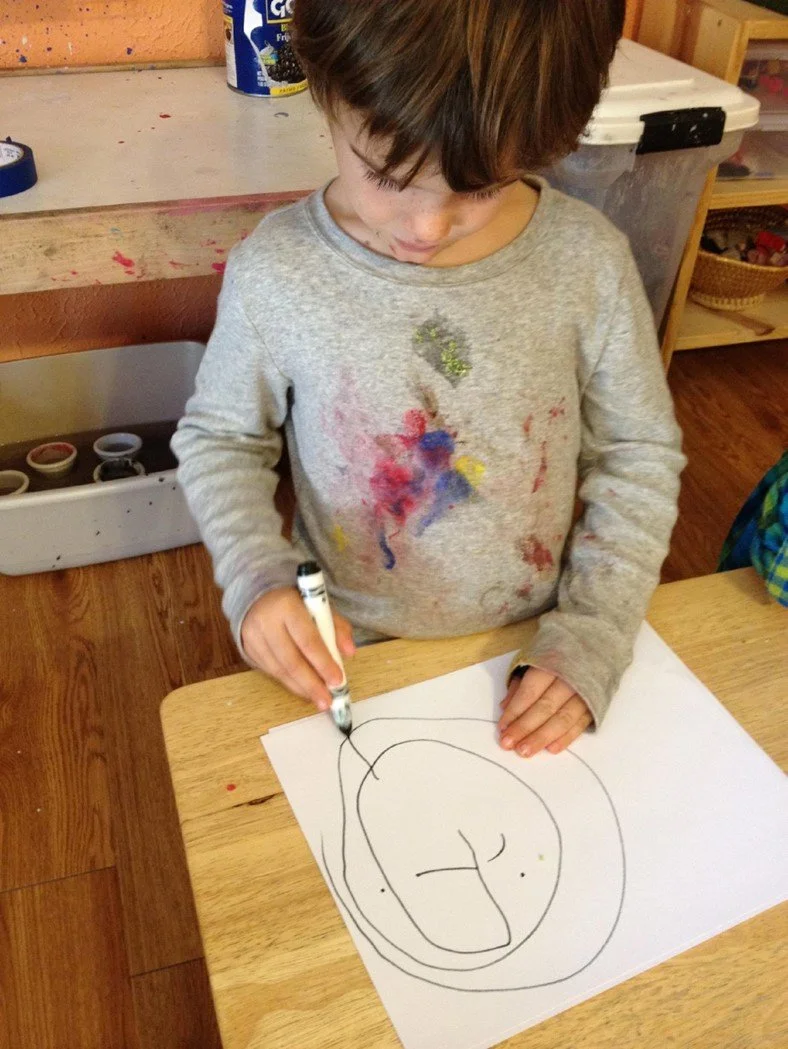
Marie: There could be more drawing about this, to show what you’re remembering about Halloween?
Yes, the kids say, oh yes, we’ll draw about our Halloween!

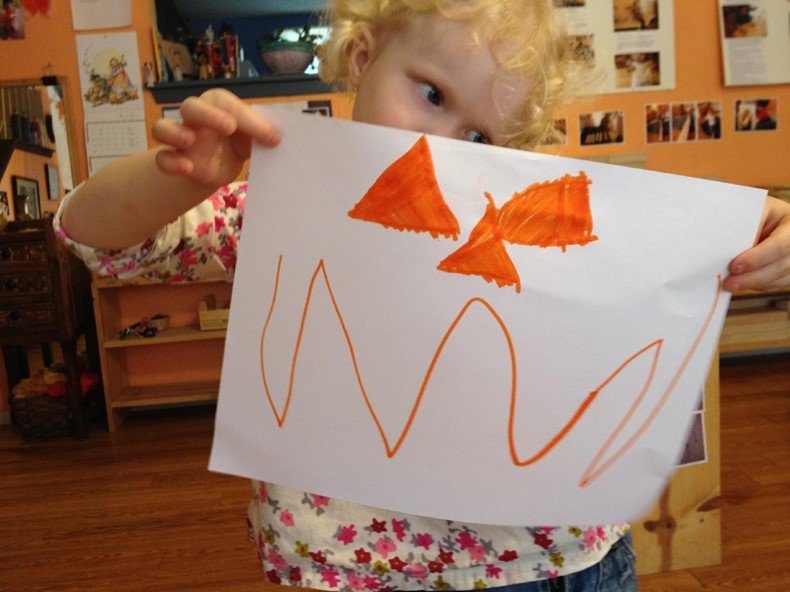
Daphne: Me and Daddy maked happy faces for our pumpkins and Mommy made a monkey face. And Mac didn’t carve any because he’s a baby. My pumpkin had fire in it.

Wyatt: I had a scary face of a pumpkin. A vampire face. My pumpkin had its eyes closed. My pumpkin had a triangle eye.

Willa: I saw a lot of shapes in the pumpkin faces on Halloween.
Elias: My pumpkin had a quiet face. I saw a witch. I will draw a witch. With black.
Daphne: I saw a witch! I will draw about a witch too.

Daphne: That’s the witch that I saw on Halloween.

Elias: With a tall black hat on its head!

Nayeli: I saw a spooky house.
Willa: Did you see a real ghost that someone didn’t dress up as?
Nayeli: No.
Willa: Did you see a spider? A monster?
Nayeli: We had to reach in a spider’s web to get candy!
Willa: Was it just a costume spider web?
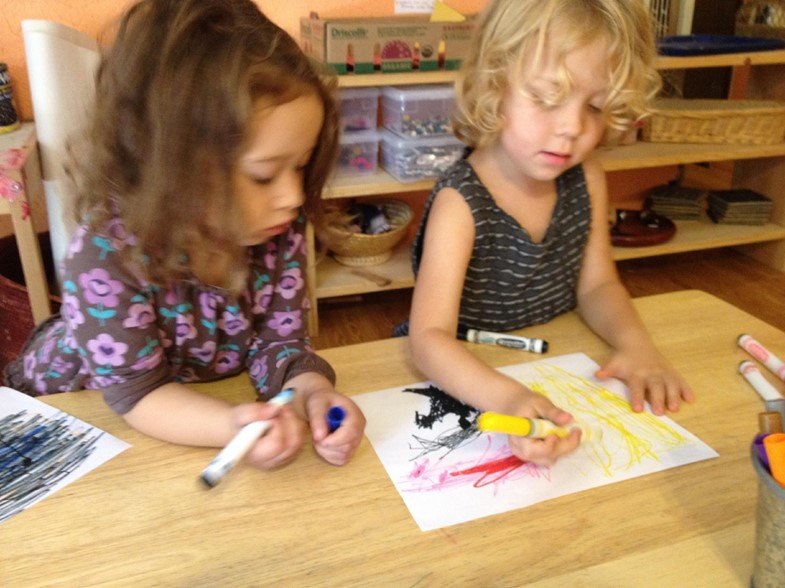
Nayeli: It was just a pretend spider web with no one inside it. Look how black my picture is.
Willa: Are you making the black night?
Nayeli (adding black lines over the orange ones): It’s making dark orange.

Willa (adding the spooky person, black figure in the lower right corner, with looser black lines, “the black night” wrapping around him, very pleased with the feeling she’s captured): Look what he looks like! When I went trick or treating there was a spooky person wearing all black. Outside. On their porch. He looks like a real haunted. I looked for a dark color to make it. And there was a sunset. I’m making colors because it’s sunset. All sunsets have color. And I make the black night, see? Moon, moon, a bright glittering moon! The moon is gonna be making a yellow sky.

I am struck by how deeply this Halloween stuff matters to the children and make a note to prepare more on this for our next Halloween together.

Here’s what that looked like, one year later.


October 30, 2013

“Me in my Little Red Riding Hood costume and I’m skipping, see? With roses on the basket and candy bread inside.” —Nayeli

Nayeli: Tomorrow is Halloween day.
Daphne: And we’ve been waiting a long time.
Marie: People are thinking about wearing a costume to school tomorrow if they want to. Elias thinks he might be a station master, Nayeli will be Little Red Riding Hood.
Nayan: I will be a giraffe. A costume of a giraffe.
Elias: I will be a costume of a station master.
Marie: And tell your grownups, bring extra clothes. Because maybe you want to be in your costume a long time or maybe you will want to change after a while.
The subject of “What will you be, Marie?” comes up.
Marie: You know, I am usually saying “I will be just Marie” as your teacher, here, when children are pretending.

Dear three-year-old Emerson, you and the other children taught me the importance of this last year!

Nayan: Just wear a little hat.
Daphne: Like with a headband. A headband, and how about different shoes?
Marie: Will you still know that I am me?
Daphne: Wear the same clothes. Your usual clothes.
Marie: If someone is wearing different clothes, are they still the same person?
Daphne: I’ll know everyone because I have really good hearing and really good eyesight.
Nayan: We’ll know you by your talk. Or if you took off your shoes or your hat or your headband.
Nayeli: Marie could be a Marie for Halloween!
Daphne: You just need to put on the same things. If we could go upstairs and see them, we could pick them out for you.
Elias: You have a double-decker house. At night you go upstairs.

Marie: What if I wore a shirt that kids had not seen before, would that feel okay?
Kids: Yes! One we haven’t ever seen before?
Marie (ah ha, I do have an idea now!): Yes. See, I have a new shirt that I just got but you haven’t seen it yet.
Daphne:
Like your piano shirt? (There’s a photo of me in some documentation on the wall wearing a concert shirt the children admire.)
Marie: Ah, a little bit like that, yes. But not a piano . . .

Later
Marie: So, we were talking about a costume for me, and people said I should wear shoes, maybe a hat. Here are some different hats of mine.

Nayeli (recognizing my garden hat): This one we know already!
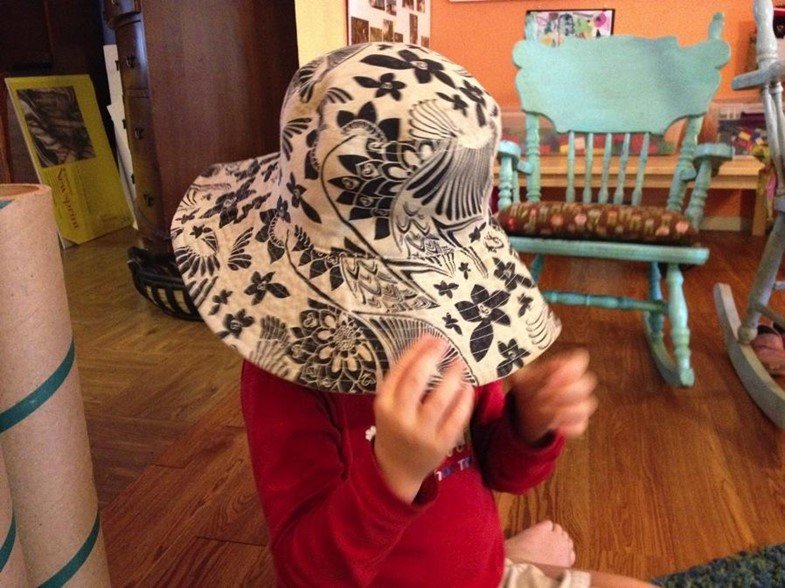
Marie: Yes, you know that one. See the straw hat with the polka dots? This is a hat I like to wear when I go to Barton Springs. It gives me a lot of shade. Now, here’s just regular me, right? And here’s me (putting it on my head) wearing my Barton Springs hat. Am I the same me when I put on the Barton Springs hat?
Daphne: Yeah!
Nayan: ’Cause I see some of your hair.
Daphne: And I see your shoes. Those shoes that I know.
Marie: Ah, ’cause my shoes didn’t change. But you’ve never seen my Barton Springs hat.
Nayan: But I do still know your shoes and your hair.
Nayeli: I would know you even if those shoes were pink.
Nayan: I would still know it was you if your hat was green!
Daphne: I would know you if you were a giant! Because you’re pretty giant.
Marie:
What do you think, Elias, is it still me if I put on this hat?
Elias: Yes! It just has this polka dots around your hat.
Nayeli: Your face stays the same. But your face is bigger than ours. Parts of your face is bigger than ours.
Nayan: And my face is smaller than yours.
Daphne:
And your hands are bigger than us. Because you’re older.
Marie: Am I the same Marie in my garden hat, in the hat you know?
Kids: Yes! ’Cause of your face and your shoes and the garden hat that we know.
Marie: Okay, and if I take my hat off, here’s just me again. And now here’s the third hat. This is my running hat.
Daphne: Oh, now you look different!
Nayeli: Much different.
Marie: I’m different when I put on the running hat?
Nayeli: But you are the same Marie, though.
Marie: I am the same Marie, but I look different in my running hat.
Nayeli: You look so different in the running hat because there’s no hair coming down.
Kids want to try on my hats.
Daphne: Right now, I can’t see the underneath of the garden hat because I’m wearing it.
Nayan (the Barton Springs hat hangs down over his eyes): Right now, I can’t even see where I am going!
Daphne: And I can’t even see where I am going!
Nayan (laughing): Where am I? This hat kind of looks like a cowboy hat.

Marie: So, tomorrow on Halloween you’re going to see people you know but they might be wearing something different. I’ve never seen Nayeli in a Little Red Riding Hood costume.
Daphne: Have you ever seen me in a butterfly costume?
Marie: I have never seen you in a butterfly costume.
Nayan: Have you ever seen me in a giraffe costume?
Marie: I have never seen you in a giraffe costume.
Daphne: Or in any costume!
Marie: Elias, I have never seen you in a station master costume.
Elias: No . . .
Marie: That is going to be different! Here’s a song I like to teach (holding the Barton Springs hat up over my face).

Who is underneath that hat, hat, hat?
All together: Whooooo is it? Marie!
(Marie taking hat away):
I see Marie underneath that hat!
Marie is underneath that hat, hat, hat!

Nayeli: I know that song, I know that song!

We sing many verses, with all our hats, together.

 
Marie Catrett | Tigerlily Preschool

Why should I take an art class? I don’t want to be an artist when I grow up!

studentworkingonart.jpg


Alison Pilon Nokes teaches art, among other subjects, at
Huntington-Surrey High School in Austin. Her guest contribution here is adapted from her recent post on the school’s own blog.


After about ten years in the visual art education world, I feel pretty strongly that everyone should take an art class—every year, if possible!

Throughout my own educational and professional experiences, I have always felt freed by the opportunity for creative problem solving and exploration of visual media provided through the visual arts. I was, and still am, able to process many different parts of my life through an art outlet. And while I do, personally, as an adult, identify as an artist, I think the benefits of working through an artistic process—much like the experience of working with the scientific method in a science course—are worthwhile for everyone to experience as they venture through their education, no matter what they end up doing and becoming. 

studentart2.jpg

We are living in a rapidly changing world. In many ways, we cannot even imagine what the work force and daily life are going to look like for our kids when they come of age. This year of rapid adjustment to virtual learning and social distancing has certainly given us all a taste of how flexible we need to be and how quickly our world can change. What we do know is that students who can think critically and creatively about a variety of complex problems are going to have the best chance for success in just about any setting. 

studentart1.jpg

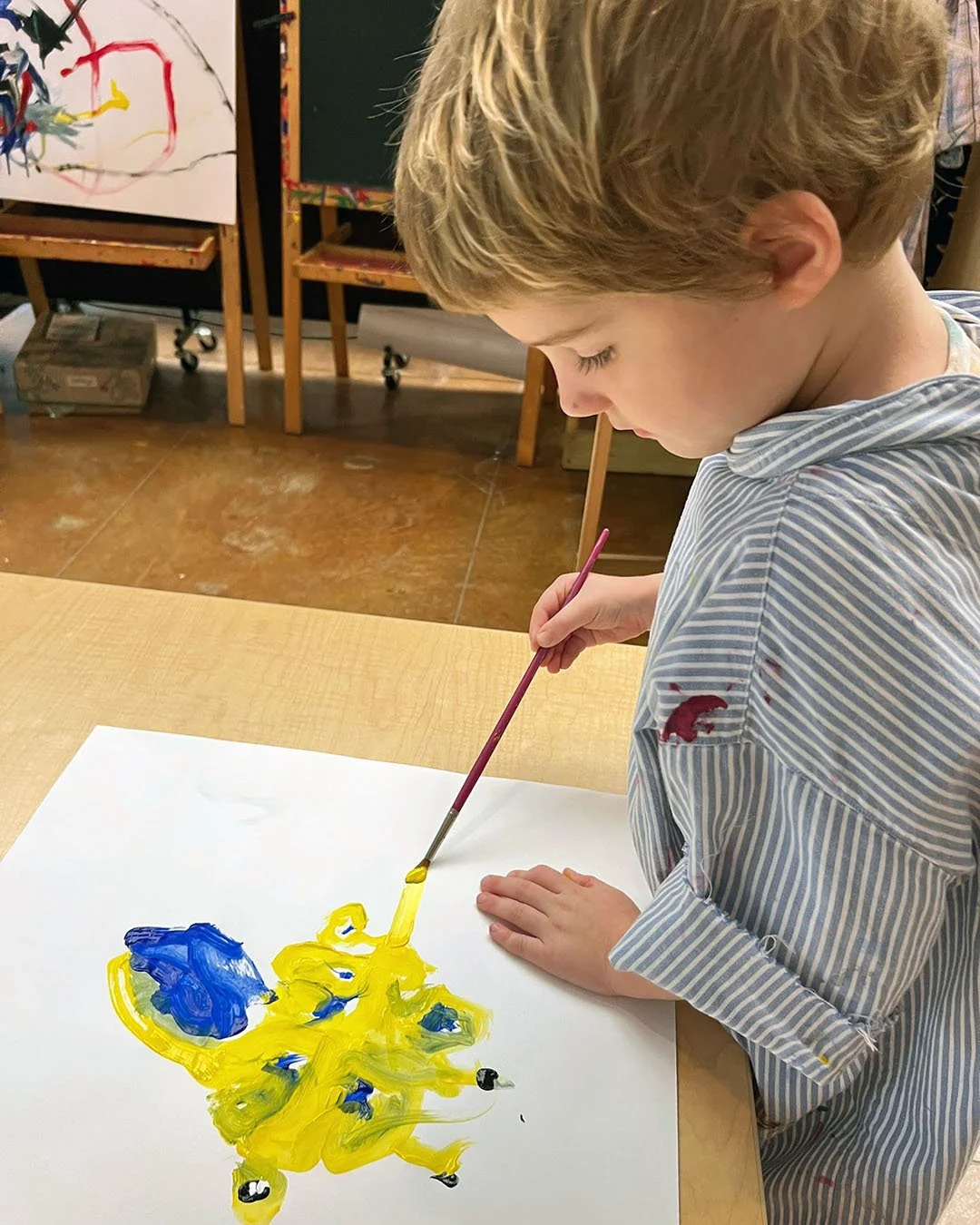
Not every student who is taking an art class is planning to apply to art school for college. In fact, most aren’t (just as not every student who is taking a biology course plans to become a biologist). It is with that in mind that I design lessons and projects for my art students. My lessons provide students with opportunities to play with materials they may not have used before, discover for themselves how those materials work, and consider how they can use them to meet their needs. My lessons present students with a problem, a dilemma, or an obstacle and ask them to come up with an out-of-the-box solution.

studentart5.jpg

As much fun as it is for families and friends to walk into a student art show at the end of the year full of beautiful finished work, the reality of art is that most often what students make is messy and strange. For every finished work of art that is “pretty,” there are often several unsuccessful attempts (I’m purposely avoiding the term “failures”). Those unsuccessful attempts—those messy and strange drawings, paintings, and sculptures—are what show the important lessons of art: the processes of working out a solution to a problem. As a teacher of art, the most important thing to me is not what the final product looks like. Rather, I want my art students to put forth their best effort, maintain a good attitude about trying, and work through the hard process of solving problems in innovative ways with materials that may be new to them.


Alison Pilon Nokes

An honest look at the fall

Huntington-Surrey_2.png

Pam Nicholas is an extraordinary educator who serves as executive director of Huntington-Surrey High School. Below, she shares her candid thoughts and feelings about the challenges and uncertainties of the coming school year amidst the COVID-19 pandemic that is currently surging here in Central Texas.


I, like many other parents and people in the education community, have been glued to any news or information about what school district plans are looking like for the fall. As both a teacher and an administrator for our small private high school, I have so many emotions running through me about the idea of returning to school in the fall.  I know that many kids learn best when they are face-to-face. I miss hugging my kids (okay, students) every day. I miss seeing them face-to-face, and I even miss going on my occasional Starbucks runs for them. It was hard to see them only online in the spring and to know that they too were emotionally struggling with so much going on in the world.

On the other hand, having my own personal health issues, I am not one to take my health or anyone else’s for granted. I was proud of the fact that my school managed to both help flatten Austin’s curve in the spring and provide our students with an excellent virtual education with no missed days of school. Now, these summer months are leaving me with time to reflect on what went well, what could be improved, how we can keep our students engaged, and how we can best support our kids, our teachers, and our families in these very disconcerting times. 

With hospitals in Austin getting close to being overwhelmed, it is troubling for me to hear elected officials talk about having schools return to face-to-face classes in the fall. There is so much talk about how the virus is mild in children, but the facts of the matter are that some children do get quite ill and children can transmit the virus between one another, to their families, and to their teachers. There is no way to predict right now which one of us will have a mild case, who will have severe illness or ongoing medical issues to contend with, and who will die. As a private school administrator, could I ever live with the fact that I did have the “luxury” of keeping school virtual but I chose not to, and someone were to get seriously ill or die because of that choice? I know some of my parents are really wanting to return to face-to-face instruction because, of course, it is the best way for their kids to learn and there is nothing like face-to-face social interactions with their friends. However, I’m not one to gamble, and I am certainly not feeling comfortable gambling with the lives of the people in my community. 

Huntington-Surrey_4.jpg

As a private high school, we were and are extremely privileged in the sense that our kids are old enough to be home by themselves, if need be, and our kids are already extremely familiar with technology. With our very small student-to-teacher ratios, we could still pay a lot of attention to each student during class times and were able to be available to them outside of regular class times for extra help. I won’t say everything went perfectly transitioning to live, online classes (we were Zoom-bombed only once, thank goodness!), but I know that our kids knew we were there for them, got to have some pretty interesting conversations, still managed to learn new skills, and were able to practice those skills with the live support of their peers and teachers. 

So, what were some lessons learned, and what can we, as parents, educators, or, like me, both, do this coming fall? All of us need to have some positive interaction during the day. Having good, interesting conversations, even virtually, keeps kids engaged. Teaching using Socratic methods also helps to keep them engaged. We’ve learned that some kids are still going to struggle, especially those with ADHD. Our ADHD students can spend hour upon hour on a screen playing Minecraft, but it is quite different from taking an online course. We have found that having them attend class via cell phone in a well-lit room with just a table or desk really helps with mitigating the temptation to use other apps during class time.

Parents helping kids stay organized and on top of their homework as they adjust can help a lot, too. When kids were out and about during the day, it was easier to make sure they were doing their independent work at a regularly scheduled time. Now with them home all day, it is easier to assume they will just get it done. That really isn’t the case. Parents with children of any age can help their kids find success by having them on a consistent routine, including time slotted specifically for homework. Regular sleep times, physical activity times, and homework times can go a long way.

Another way to help our kids in an online environment is for teachers to record their classes. Our school will be posting them online so that if a student wasn’t able to focus, for whatever reason, the class is there for them to see at a better time. We are also continuing our study halls during the school days so kids can get their homework done with a teacher live to help them and make sure progress is being made on assignments. It’s important for schools to be able to provide one-on-one help if they can, even if it isn’t academic help. Our teachers will continue to simply check in with each of our students to find out how they are coping. Offering frequent “just for fun” opportunities can help, too. This summer and beyond, we will continue to offer online social opportunities for our kids to virtually get together. Working hand-in-hand with our parents, students, and faculty, we will give our students the best possible educational experience we can provide.

Times are tough right now for most of us, and alt-ed schools have a lot of difficult decisions to make over the coming days and weeks. The balance between the grown-ups having to work, the children needing in-person attention, and everyone wanting to help keep everyone safe is an exceedingly difficult one to find. I know we are all going to try our best, and hopefully working together with a lot of patience and empathy, we will make the best of what seems like an impossible situation.

 
Pam Nicholas