


How to have a great day at a museum? Step into your kid’s (lunar-powered) shoes.


This post was written by Abigail Kutlas, who studies Learning Sciences at Northwestern University. This summer, Abigail is a museum intern and researcher in Washington, DC. Her research focuses on family engagement and accessibility for children with intellectual disabilities.


What would you invent to help someone see differently? Ask an eight-year-old and a thirty-eight-year-old and you’ll get very different answers.

When we posed this question to our visitors at the hands-on, maker-space-esque exhibit I work in, the youngest patrons were fountains of innovative ideas. They drew elaborate lunar-powered shirts, shorts, and shoes so soccer players could practice at night. They wanted to make a virtual reality headset so you could see information about your favorite constellations just by looking at them. One jokester even sketched carrots.

The answer I got nearly every time from grown-ups? Glasses. Nothing special or new, just glasses, like the ones perched on my own nose.  

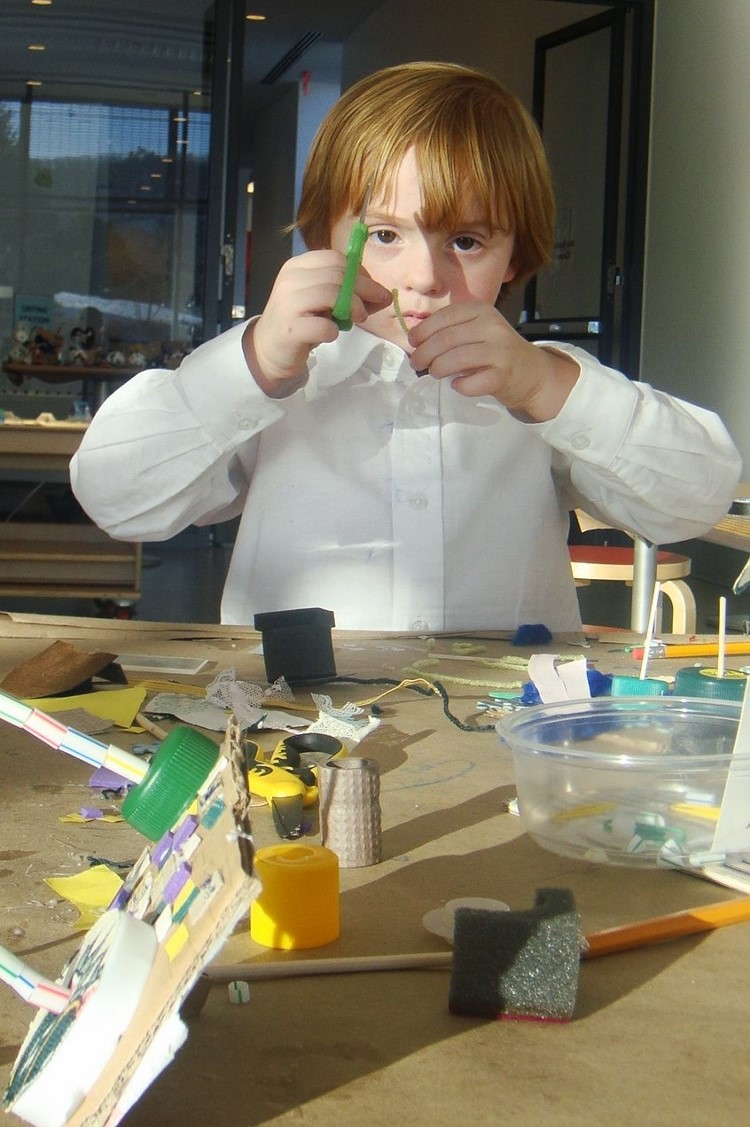
Something similar happens when I watch kids sit down at a table with an open-ended prompt, like “How can you project an image onto a screen?” They start by sifting through every available material, and they work until they’ve found two or four or ten solutions, often using every Lego in sight. And most of the answers they come up with make sense, because they intuitively understand that lenses and light, in some combination, will help them reach their target.


Meanwhile, their parents often turn to me within seconds of sitting down and ask, “What’s the right answer?”

I don’t fault grown-ups for thinking like this. It’s a combination of what our traditional education system has taught us to value and the many hats we wear when we take our kiddos out into the world: timekeeper, taskmaster, bathroom-runner, and above all, expert. Each of those roles is important at times, but for a museum experience that lasts in the minds of all family members, I wish parents could check most of their hats at the door when they walk in.

The best advice I can give to adults visiting any museum with children is to be 25 percent grown-up and 75 percent kid while you’re there.

Go ahead and use your advanced fluency skills and big vocabulary to make sense of the information given on plaques and signs, but then assume your role as a kid and just enjoy it.


On your day at the museum:

  • Ask questions with the assumption that there are no right or wrong answers.
  • Talk about connections between what you’re seeing and anything (literally, anything) it reminds you of.
  • Don’t feel obligated to see every single thing in every exhibit. Let your and your kids’ natural interests tell you where to linger, which exhibits to race through, and which to avoid.
  • When you discover something new or are confused, stop and pay attention to those feelings. Discuss them with your kids. In other words, model the fact that learning is a lifelong process.

I see our youngest visitors do most of these things naturally, and it enhances their learning and overall experience when they see their grown-ups behaving this way too.

As museum professionals, we have theories upon theories about how to engage your children, but in the end, you spend every day with them and have so much more influence over their experiences than we ever can. We do our best to facilitate experiences that will be meaningful to kids and stick with them. But when parents let go and learn to walk through the museum like their kids do—with boundless imagination, curiosity, and amazement—that’s when the truly lasting impressions happen.

That’s also when parents and kids have the most fun!


Abigail Kutlas

 

Math and happiness

Lacie Taylor is founder and owner of Math For Keeps, a math ed business in Austin, Texas. She teaches her students how to practice math (much like you’d practice piano or basketball). With this approach, as she explains in the guest post below, her students develop a fluency in math as a language that changes the whole game for them.

Learn more about the Math For Keeps practice-to-mastery method here.


One of the magical things about one-on-one teaching is that it’s easy to keep a student in what educational theorists call their Zone of Proximal Development. I call it your Sweet Spot! If you’re bored, optimal learning is not happening. On the other hand, if you’re stretched so far that you’re freaking out, shutting down, with tears and much stress, optimal learning is also not happening. Here’s the fun, happy news: when you’re feeling your best while learning something, when you’re stretched enough that you’re engaged and inspired but not so much that you’re giving up, it FEELS good, AND that’s when optimal learning is happening. How lucky is that?

So how do we keep a student in that sweet spot? Let’s use one of the most famous subjects for knocking students out of their happy learning place—math—for outlining how.

First, a more formal definition of the Zone of Proximal Development: it is the gap between what a student can do independently (what they have mastered) and what they cannot yet do independently. Skills that are in the gap might have been introduced, and perhaps the student can do them with assistance, but they don’t yet have them mastered. Another way to put it: You’ve got your Actual Development, and your Potential Development, and your Zone of Proximal Development is where skills live when they’re in transition from one to the other.

So this space of learning—after you’ve been shown something, but before you’ve got it in the bag—that’s a fun happy space! The brain loves to be in this space, and loves to see skills move through this space into mastery. So why does learning sometimes stop feeling so fun? One culprit is our expectation that students work on things outside this zone. We’re expecting them to work on things they either already have in the bag (boring) or things that are unfair to expect them to do on their own just yet (defeating). The antidote, then, the guidelines for keeping students in their sweet spot, are pretty simple:
 

GUIDELINES FOR KEEPING A STUDENT IN THEIR SWEET SPOT
1. Don’t teach past what they’re ready for.
2. Don’t give busy work.
(TO NOTE: Do not get mad at your child’s classroom teacher if they aren’t doing this for your child. Doing this in a classroom of 25+ kids, all at different levels, when the paradigm is set up for its opposite, is a formidable challenge. But it’s one that alternative education is up to, and that’s one reason we’re all here on this blog.)


Number One Guideline: Don’t teach past what they’re ready for.

 If you as a student have truly been set up for success, each new level of math should feel completely do-able and accessible. The fact that it doesn’t, for most math students, sooner or later, simply means that the last level didn’t get mastered. At every new level of math, there is a new layer of skills that you’ll be figuring out. You won’t be able to do them independently; you’ll need help. The previous layers will have felt like that too at some point, but by now, if they have been practiced effectively all the way to mastery, then they will feel intuitive. You will be DONE with those skills. You won’t have to figure them out anymore. They are there to support the new skills you’re being expected to learn. When math starts feeling impossible, as it does for so many of us, it’s because we’re still getting that last layer down. We’re not ready for the new layer yet. Don’t give it to us before we’re ready, or our brains will reject it. We will hate math, feel discouraged by it, think we can’t do it, and start asking why the heck we have to learn it. Vicious downward spiral. Yuk.
 

Number Two Guideline: Don’t give busy work.

This is a tricky one because it is true that the more practice you have at a given type of problem, the better you become at it. The more automatic it feels, the more your brain energy gets freed up for the next level of skills. But it is also true that practice can quickly become tedious and mind-numbing once you’ve made it past that first-problem moment. In a perfect world, the student will have perfectly prescribed practices that are just right for their level. Your brain loves to witness progress. Nailing something that just recently seemed difficult is rarely boring. In fact, the most common student response to this scenario is “these are fun!”
 

Alt Ed for Curing Math Woes

In public education, currently, it seems students have two options: they learn at the school’s pace, or they end up having a less than happy, thriving experience in math. Sadly, most fall into the latter camp, because the school’s pace really doesn’t work for that many students (at least not without a different approach for practicing skills to mastery).

Students learn at different paces. If practice methods were introduced earlier, we could probably equalize better, but as it is, the further along you get in age, the more likely you will be in a class full of 15+ other kids all at dramatically different levels.

In the work I do, if I get a student early enough, I can make sure they’re ready for each class as it happens. The more likely scenario, however, is that parents have no idea just how behind their students are until after the student is multiple grade levels behind. The pain point gets loud enough long after the “ideal” time to fix it.

This doesn’t mean it’s not fixable. For many students, remediation can still happen in time for them to get on grade level. Then there are students who, even though entirely capable of learning math, at their own pace, will not catch up with the school’s pace. In this scenario, for students in public school, it is so easy for everyone involved to feel defeated. Parents, students, teachers alike are all operating under the assumption that because the student is not learning math at the school’s whirlwind pace, which has been pushing them along before they are ready for years, the student is condemned to struggle and to be perpetually behind and to probably not really learn math at all. And this is all with students (those using my practice method anyway) who are absolutely learning math.

What if “behind” didn’t even have to be a notion? Already, some students don’t go as far in math as others, and that’s fine, but what if those who didn’t go as far still learned math, and still loved it? Of course, this is totally possible in public education, with a bit of overhauling. Meanwhile, let’s explore it via all the amazing alternative education options in Austin.
 

Summary

Happy is most important! My whole method was developed on the premise that most of us (both “math-minded” and not) will end up frustrated by math trying to learn it with the minimal practice that is offered in the classroom. And not just the kind of healthy frustration that comes as a natural part of learning, but a very defeating kind that makes us feel inept. This is not fair. EVERYONE deserves to have a rewarding experience learning math. I aim with my practice method to give that to my students, regardless of what they’re getting in the classroom. So while it may feel discouraging—for those of you for whom your brain’s timeline is different than your school’s timeline—-I hope that overall the message I am sending is encouraging. The people I work with are fantastic students. They work hard, they’re enthusiastic, they show up ready to learn, they will get this stuff, on the timeline that is perfect for their brains. My job, with the help of parents—we all work as a team—is to make sure that when this timeline is different from the school’s, as it sometimes is, they don’t feel defeated, that if their enthusiasm for learning takes a hit, they know the reason and bounce back.


Lacie Taylor
 

Does your child’s school support mental health and well-being?

Returning guest contributor Michael Strong is co-founder of the Kọ School + Incubator. He joins us on the blog today to discuss an important but often overlooked factor in adolescent well-being: school connectedness.


I’ve spent most of my life developing small, personalized schools that provide supportive environments for teens. For decades it has been obvious to me that a teen’s connection to a school is one of the most important factors in adolescent well-being. The research community is finally beginning to recognize this.

The Centers for Disease Control (CDC) reported in 2009 on the National Longitudinal Study of Adolescent Health:

School connectedness was found to be the strongest protective factor for both boys and girls to decrease substance use, school absenteeism, early sexual initiation, violence, and risk of unintentional injury (e.g., drinking and driving, not wearing seat belts). In this same study, school connectedness was second in importance, after family connectedness, as a protective factor against emotional distress, disordered eating, and suicidal ideation and attempts.

Families are certainly important. But note that school connectedness is even more important than family connectedness with respect to a teen’s propensity to engage in multiple dangerous behaviors (substance abuse, violence, drinking, and driving). Moreover, school connectedness is the second most important factor, after family, to guard against clinical depression, eating disorders, and suicide.

What is “school connectedness”? Teens were asked:

How strongly do you agree or disagree with each of the following statements:
  • I feel close to people at this school.
  • I am happy to be at this school.
  • I feel like I am part of this school.
  • The teachers at this school treat students fairly.
  • I feel safe in my school.

A 2003 analysis of the responses of 36,000 teens discovered remarkable correlations between “school connectedness” and well-being. Summarized as “Improving the Odds: The Untapped Power of Schools to Improve the Health of Teens,” this research led to the CDC’s public position on the importance of school connection and adolescent well-being.

Researchers are only now discovering just how deeply these connections go. For instance, a 2007 article in the Journal of Adolescent Health discovered a direct connection between early teen experiences and mental health. They surveyed a cohort of almost 3,000 teens at grade 8, grade 10, and one year after graduation:

Overall, young people’s experiences of early secondary school and their relationships at school continue to predict their moods, their substance use in later years, and their likelihood of completing secondary school. Students with good school and good social connectedness are less likely to experience subsequent mental health issues and be involved in health risk behaviors, and are more likely to have good educational outcomes.

In a world in which an estimated one third of teens are on prescription medication, and almost half of those are on psychoactive substances (medications addressing depression and hyperactivity), it is important for more parents to realize that school may be a causal factor with respect to their child’s depression.

Another cohort study of 2,000 teens states bluntly in its report title: “School Connectedness Is an Underemphasized Parameter in Adolescent Mental Health.” It explicitly suggests that a lack of school connectedness is a causal factor in mental health issues.

School connectedness also predicted depressive symptoms 1 year later for both boys and girls, anxiety symptoms for girls, and general functioning for boys, even after controlling for prior symptoms. . . . Results suggest a stronger than previously reported association with school connectedness and adolescent depressive symptoms in particular and a predictive link from school connectedness to future mental health problems.

Pharmaceutical companies invest significant marketing dollars into persuading parents and health care practitioners that depression is a biochemical disorder to be corrected by pharmaceuticals. But what if a significant portion of adolescent dysfunction and mental illness is actively caused by a child’s feeling of disconnection from the school community?

A recent dissertation on schools and depression summarizes the scale of the issue:

Depression is a debilitating condition that is increasingly recognized among youth, especially adolescents. Nearly a third of adolescents experience a depressive episode by age 19 and an increasing number of youth experience depressed mood, subsyndromal symptoms, and minor depression. The prevalence of depression is particularly high among female, racial minority and sexual minority youth. . . . major depression and subthreshold depressive symptoms often first appear during the adolescent years. Rates of depression steadily increase from ages 12 to 15. Based on retrospective studies of depressed adults and prospective studies of youth, major depression is most likely to emerge during the mid-adolescent years (ages 13–15). Prospective studies that follow the same children over time reveal a dramatic increase in the prevalence of major depressive episodes after age 11 and again after age 15, with a flattening of rates in young adulthood (Kim-Cohen et al., 2003).

Meanwhile, a Gallup poll finds that only 44 percent of high school students feel engaged at school.

As a lifelong educator who has seen literally hundreds of children improve their well-being by means of transferring to a school at which they felt more connected, these are not merely hypothetical speculations. I believe we have a mental health catastrophe among our teens, and massive disconnection from schooling is a major causal factor in this catastrophe.


The CDC goes on to describe four factors that can improve school connectedness:

1. Adult support: “In the school setting, students feel supported and cared for when they see school staff dedicating their time, interest, attention, and emotional support to them. Students need to feel that adults care about them as individuals as well as about their academic achievement. Smaller schools may encourage more personal relationships among students and staff and allow for personalized learning.”

2. Belonging to a positive peer group: “Students’ health and educational outcomes are influenced by the characteristics of their peers, such as how socially competent peer group members are or whether the peer group supports pro-social behavior. Being part of a stable peer network protects students from being victimized or bullied.”

3. Commitment to education: “It is important that both students and adults are committed to learning and are involved in school activities. Students’ dedication to their own education is associated with the degree to which they perceive that their peers and important adults in their lives 1) believe school is important and 2) act on those beliefs. . . . School staff who are dedicated to the education of their students build school communities that allow students to develop emotionally, socially, and mentally, as well as academically. Committed adults engage students in learning, foster mutual respect and caring, and meet the personal learning needs of each student.”

4. School environment: “A positive school environment, often called school climate, is characterized by caring and supportive interpersonal relationships; opportunities to participate in school activities and decision-making; and shared positive norms, goals, and values. One study found that schools with a higher average sense-of-community score (i.e., composite of students’ perception of caring and supportive interpersonal relationships and their ability to be autonomous and have influence in the classroom) had significantly lower average student drug use and delinquency.”

Is your child experiencing healthy school-connectedness? All parents should take these issues very seriously, before their teens experience much more serious challenges.


Please share this article with your friends so we can begin a national debate on how we can help address our most pressing teen issues—including, according to the CDC, “ . . . substance use, school absenteeism, early sexual initiation, violence, and risk of unintentional injury (e.g., drinking and driving, not wearing seat belts) . . . emotional distress, disordered eating, and suicidal ideation and attempts”—through authentic human relationships rather than pharmaceuticals. It is wonderful that we are now much more attentive about the foods that we put into our children. Now we need to focus on the ways in which they may be supported by their school environments.

Michael Strong

Top 5 reasons why teens make great entrepreneurs

Sarah Hernholm, lead contributor of this guest post, is the founder/president of WIT—Whatever It Takes, the only six-unit college-credit social entrepreneur and leadership course in the country for high school teens. Based in San Diego, WIT has locations in St. Louis, New York, and now Austin. WIT is currently accepting applications for 2016–2017; visit www.doingwit.org to learn how. To view Sarah’s TEDx talks and read more of her thoughts on why teens rock, check out www.sarahhernholm.com. You can follow her on Twitter @miss_wit.

Also contributing to this piece were teen entrepreneurs Safi Jafri, founder of WhiteHat; Daniela Montes, president of Student 2 Student Art (S2S); and Andrew Castro, president of Choose You.


Rebellious.
Willful.
Out-of-the-box.

These are just a few words to describe two groups of people: teens and entrepreneurs. 

Over the last six years, through my company WIT—Whatever It Takes, I’ve spent my days working with teens and helping them become entrepreneurs and leaders in their communities. The work isn’t always easy (because of those words mentioned above), but it certainly is rewarding to see teens become more confident, empathetic, self-aware, and successful. 

And since I think most experiences are better with teens, when I was asked to write this Top 5 list, I went to teens and asked them to chime in with their reasons as to why they make great entrepreneurs. Check out some of their thoughts below.


1. Teens want to do something. I know the common societal narrative is that teens are apathetic and self-absorbed (although I think I know more adults than teens who fit that description!), what I see on a regular basis are teens who are frustrated by what is happening in their world and interested in figuring out how to make “it” better. What usually holds them back is the lack of programs/platforms available to them and those countless hours of ridiculous homework (but that’s a topic for another blog). Yet at WIT we see teens finding ways to launch a social enterprise despite their heavy school workloads. Why? Because they are passionate about doing work that actually matters to them.

2. Teens like proving you (adults) wrong.  If I wanted to apply reverse psychology on teens, I would just say, “I don’t think you can build a company,” and I know that would only fuel them to do it. But I don’t take that approach. I don’t have to. Society is already doing it. As teen Safi Jafri puts it, “. . . that teenage mind that people say can't ever be professional enough or smart enough or mature enough? Well that mind will do whatever it takes to get what they want, no matter how little you believe in their potential . . .” Just because they don’t want to do their homework doesn’t mean they don’t want to change the world.  Proving doubters wrong is a common motivation for successful entrepreneurs. As teen Andrew Castro says, “We love to prove people wrong and push the envelope.”

3. Teens aren’t carrying a lot of baggage.  As teen Pia Deshpande shared with me, “ . . . most teenagers haven't defined themselves as people yet. They never sit back and say, ‘That's not me’ like so many adults do . . . they're still exploring . . .” In other words, teens aren’t as cynical and hardened as most adults; they haven’t labeled themselves or put themselves in boxes like a lot of adults do. Also, the majority of teens don’t have a mortgage, lots of bills, debt, or dependents, so they are able to take on more risks—and being able to take risks is a great trait of an entrepreneur.

4. Teens want more “real world” experience. Most of a teen’s day is spent sitting and listening to someone tell them what they think is important. All of this is done in the hope of better preparing said teens for the “real world.” But last time I checked, I don’t spend my days sitting for 10 hours while someone talks at me. It doesn’t surprise me that teens experience burnout and want to ditch school. I would too (and did). Teens just want adults to acknowledge that the world they are living in is actually their “real world” and that they would prefer not to just talk about things in theory but instead apply the knowledge to their real world! This is why entrepreneurship is a great outlet: teens can apply math, reading, writing, public speaking, debate, etc., all while running their own business!

5. Teens want reasons to believe in themselves. Teen Daniela Montes shared with me: “At an age where insecurity is common, building entrepreneurial skills allows us to believe in ourselves and say, “Hey, I'm capable of making a difference,’ thus creating confidence, professionalism, and maturity.” Those teen years can be tough. It can be seven years of questioning your place, value, and worth and wondering if you measure up. But when you launch a business as a 16-year-old and see your efforts improve the lives of others and get recognized for your impact, you see proof that you matter and are changing lives. That tangible proof helps build confidence and self-worth, which all teens could use a little more of.


So to all those teens out there: I see you—your rebellious energy, willful determination, and desire to make a difference—and I applaud you for it!

And I want to invest in your enterprises . . . so hit me up.
 

Sarah Hernholm, with assistance from Safi Jafri, Daniela Montes, and Andrew Castro
 

Can your child learn more at a nontraditional school?

Michael Strong is co-founder of the Kọ School + Incubator, an Austin school serving students of middle and high school age. He is also author of the book The Habit of Thought: From Socratic Seminars to Socratic Practice, a frequent speaker on TEDx stages, founder or co-founder of several successful schools, and an advocate for nurturing the entrepreneurial spirit as a force for social good. In this follow-up to an earlier guest post, Michael addresses, in an interesting new way, a question I hear often in consultation sessions with parents considering alternative forms of schooling for their kids: Will they be prepared to do well on the SAT and other college entrance requirements?


Two years ago, I wrote an article for Alt Ed Austin titled “Preparing for the SAT by Means of Alternative Education.” In that article, I explained how I had gotten high SAT scores that helped to get me into several Ivy League universities (Harvard, Yale, and Dartmouth) by means of extensive reading and chess playing. At the time, Khotso Khabele and I were just launching the Khabele Strong Incubator, which is now known as the Kọ School + Incubator (KSI).

It has long been my belief that if students engage in serious intellectual work that they love, it is possible for them to develop high SAT scores while also enjoying school. Because traditional schools often force academics on students in ways that are disempowering, many traditionally educated adults find it hard to imagine teens enjoying learning while also developing high SAT scores.

Because of my belief that our program develops SAT scores, we have administered the SAT several times per year at the high school. Although we don’t have data for all KSI students, for those for whom we do have comparable data, the results are remarkable.

  • Average SAT gains for KSI high school students for 2015–2016: 140 points (80 points verbal, 60 points math)
  • Average SAT gains for KSI high school students who have been with us for two full academic years, 2014–2016: 313 points (173 verbal, 140 math)

We only have two-year data for students who were with us for grades 9 and 10 and who were present at SAT administrations for both September 2014 and May 2016.

For comparison purposes, analysis of three large-scale evaluations of SAT coaching concludes that the average student enrolled in an SAT prep course gains 30 points (5–10 points verbal, 10–20 points math).

Students who have attended KSI for two years are averaging gains more than 10 times those of students enrolled in the average SAT prep course.

Yet KSI students do very little explicit SAT prep. Instead, we have a daily Socratic discussion in which students discuss complex texts while relating them to their personal lives along with weekly math problem-solving sessions that are often like brain teasers. How can such a program outperform SAT prep courses by such a large margin?
 

1. The College Board has always maintained that “SAT measures reasoning abilities that are developed gradually over the years of primary and secondary schooling that precede college.” That is, insofar as the SAT measures reasoning abilities that take years to develop, it is not surprising that two years of a cognitively demanding program would outperform short SAT prep courses.
 

2. Very little in conventional education is designed to develop reasoning abilities. KSI Socratic discussions and math problem-solving activities are far more cognitively demanding than is a conventional curriculum.

With respect to reading, the texts studied in Socratic are almost all college-level prose, whereas all conventional high school textbooks are necessarily written at grade level or below. Many students at conventional schools are never exposed to the sophisticated prose that is the essence of the SAT critical reading section. Moreover, the “new SAT” is even more focused on high-level reading than was the earlier version.

Our math problem-solving sessions, developed by Jeff Wood, our lead STEM guide, are a critical element that goes beyond the linear math curriculum that is standard at most schools. It is designed to train students to think mathematically rather than simply moving through the traditional sequence of topics in math. SAT math requires that students think mathematically.
 

3. There is a large literature on the activity of practice proving the age-old maxim “Practice makes perfect.” When human beings deliberately attempt to improve their skills by means of practice, they improve. Our students don’t merely practice the SAT test itself; they practice thinking verbally and mathematically.
 

4. There is a great deal of evidence that a lack of engagement is one of the most severe problems in secondary education. In essence, most students find the academic component of school boring and meaningless. Many students love the social life, and some may love extracurricular programs, but the substance of schooling is not interesting or relevant to them.

Gallup surveys show student engagement as high in elementary school, much lower in middle school, and even lower in high school. Not coincidentally, American students score fairly well on international exams in elementary school, worse in middle school, and most poorly in high school.

By contrast, most KSI students are intellectually engaged most of the time. Subjectively speaking, it does seem to me that on average those who are more consistently intellectually engaged showed larger gains than those who were less engaged. For me, our most successful classes are not those in which teachers are talking much. Our most successful classes are those in which the students are leading the conversations or problem-solving sessions, thinking, talking, questioning, joking, laughing, and being teens—all while actively engaging their minds.


Simply by focusing seriously on developing students’ abilities to think verbally and mathematically, day in, day out, while engaging them successfully, we can achieve extraordinary results—in most cases with very little homework.

From a scientific perspective, because of our small numbers, these results should be regarded as suggestive rather than conclusive evidence of the power of our program to improve cognitive performance and increase SAT scores.

That said, as we live in a world with so many teens disengaged from learning, with so many teens suffering emotionally and socially, with so many families frustrated with traditional homework loads, it is valuable to be reminded that when a school creates a healthy, engaging intellectual culture, high-level learning takes place spontaneously. The suffering and frustration of traditional schooling is entirely unnecessary to produce extraordinary results. For some students, breaking free from the structure of traditional schooling itself may be the most important step in achieving what they were meant to achieve.

Michael Strong
 

A way outside of the box


Zach Hurdle is director of math education at Skybridge Academy in Dripping Springs and a PhD candidate in mathematics education at Texas State University. He joins us on the blog to share some of his own journey as a learner and educator, as well as his thoughts on how students really feel about math and learn it best. He also invites Austin-area teens and tweens to a unique summer camp he’s co-leading with Skybridge social studies director Tyler Merwin.


I grew up in a traditional public school system in north Dallas. I was thrown into a competitive blender full of students I sometimes knew, but mostly didn’t, and was one of hundreds in what would end up being a graduating class of 1,167. I didn’t have relationships with most of my teachers. Sometimes I wasn’t even sure if they remembered my first name. But then, that’s just what school is for everyone, correct?

Clearly not.

I didn’t know there were places in education like Skybridge Academy. Sure, alternative education is alive and thriving in Austin, but it wasn’t until I got an opportunity to teach mathematics at this private school that I realized we could make a place for those kids who think outside of the box and want learning to be an experience rather than a chore. That’s part of how I have created my teaching strategy: it’s formed as a direct result of the job. I’ve learned as my students have learned.

We focus on relationships in the classroom. Relationships among students, relationships between myself and the students, relationships with mathematics. Strangely enough, math doesn’t have to be some terrible ordeal, created solely to make kids’ lives harder. Once the pressure to understand everything the teacher is telling them is lifted, students realize that they can achieve goals greater than themselves. At Skybridge, we don’t put the pressure of grades on kids. How can they value the process of learning cohesively if there is an underlying need to outscore each other on tests?

What really makes school hard for thinkers is not just that teachers say so much that doesn't make sense, but that they say it in exactly the way they say things that are sensible, so that the child comes to feel—as he is intended to—that when he doesn't understand it is his fault.
—John Holt

Part of what makes the math experience at Skybridge different from others is that students make their way through the curriculum at their own pace. Of course some ideas may be more difficult than others; this is only natural. That’s how life works, and it’s how mathematics works as well. Why should a student struggling with a problem set have to be pushed forward despite minimal understanding for the sake of moving the class forward? Why should students who are excelling at a topic have to pause their process for others to catch up before continuing? Students will learn, as teachers should highly expect, but they will learn from internalizing, self-actualization, confidence, and practice.


Allied to imagination is the notion of engagement. Exercising imagination is inherently engaging, so a classroom in which students use their imaginations to study content, play with ideas, and imagine new possibilities should be an engaging one.
—Alison James & Stephen Brookfield

With this kind of education comes freedom. I don’t experience this freedom alone in lesson planning; the students feel less pressure, too, and can leap to meet high expectations. While we cover material that students throughout the country are expected to learn, we do it in engaging ways: building polyhedrons, evaluating percentages on field trips to stores or restaurants, evaluating the importance of ratios in actual cooking scenarios, to name a few. But at the same time, students also recognize the value in repetition and exercise. They don’t typically hate math, they just hate the system that comes with math. Students hate not knowing how to do something and being expected to grasp it immediately. Wouldn’t you?
 

Math, Cooking, Reading, Playing: A Summer Camp

I have teamed up with Tyler Merwin, head of social studies at Skybridge, to offer a summer camp because we’ve found that our students miss school over the break! Further, we feel that students outside of the Skybridge community could benefit from taking a glimpse into the culture we share at this school, to test the waters of a different way of learning, so we have opened this camp up to the public as well. The idea started as a math camp, but gradually morphed. It will include group dialogues about social issues, mathematics exercises and activities, and time set aside for reading, cooking practice, outdoor play, video games, and general socialization.

If you (or a young person you know) would like to join in for academic and social rejuvenation over the summer, here are the details:

Dates: July 11–July 15, 2016 (8:30am–4pm)
Ages: 11–18 (middle and high school)
Location: Skybridge Academy, 26450 Ranch Rd 12, Dripping Springs, TX
Cost: $450 (includes lunches)
What to bring: A laptop, snacks, water bottle, reading book
How to sign up: Contact Tyler Merwin, 608-751-2947, tyler@skybridgeatx.com or Zach Hurdle, 469-556-9617, zach@skybridgeatx.com


Zach Hurdle