“The gentle art”: Brazilian Jiu Jitsu and self-defense for kids


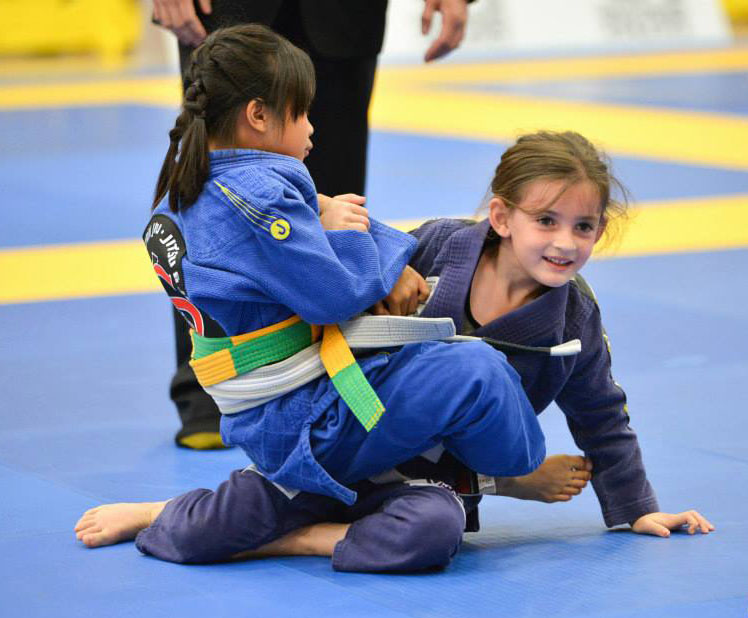
Chris Wilson, a student at Integração Jiu Jitsu here in Austin, joins us on the blog to explain the benefits of this Brazilian form of self-defense and how it differs from some of the better-known martial arts. IJJ is offering a free self-defense workshop designed for homeschooled kids this Thursday, Nov. 3, from 10:30am to noon.


What does it say about our society that many, if not most, parents don’t place self-defense skills very high on their list of important things to teach their children?

Perhaps we should see it as a good thing, an indication that today’s world is safer and less threatening, so spending time on self-defense seems unnecessary. I can see that perspective, certainly here in Austin. An article in Texas Monthly last year placed Austin as number 21 of the 24 most dangerous cities in Texas. That’s fairly good news, but it doesn’t mean self-defense isn’t important as a life skill.

The fact is that kids need to learn self-defense not so much to protect themselves from crime as to protect themselves from other kids. We all know the damage that bullying does to a person. I certainly do. I was bullied for several years growing up. The thing is that I was only attacked physically two or three times. But I was intimidated daily. I was afraid of other kids, even kids my own age, who were just bigger and meaner than I was. How I wish I had been taught to defend myself when I was growing up!

But I’m really not sure that it would have helped. In my day, if you wanted to learn to defend yourself, you took Karate or Tae Kwon Do. So, that’s what I did with my kids. I put them in Karate by the ages of 8 and 6. Sitting on the bench in the dojo one day, after both boys had been at it for over a year, it hit me. They had learned nothing. They punched and kicked at the air. They blocked imaginary attacks with gusto. But they had no actual skills that would protect them from someone who wished them harm.

Sure, they had the confidence that came from breaking boards and getting a new belt every 9 weeks, but they would not survive their first real fight. Why? Because most fights end up on the ground, where Karate and Tae Kwon Do have nothing to offer. Moreover, kicks and punches prolong fights and make them more dangerous—exactly the opposite of what I wanted for my children. I struggled with this realization and eventually concluded that I had to find something else to prepare them for the bullies and jerks of the world.

Then I discovered Brazilian Jiu Jitsu. The words mean “the gentle art” in Portuguese. Ironically, while it professes to be gentle and almost entirely defensive, Jiu Jitsu is, hands-down, the most effective approach to fighting and self-defense that exists on the planet. Don’t take my word for it. The Ultimate Fighting Championship was started in 1993 to showcase the superiority of Brazilian Jiu Jitsu over all other fighting styles.

The UFC in its early days was brutal. No gloves. No holds barred. Anything goes. It was bloody and often hard to watch. We saw giant men in overalls (street brawlers) face enormous chiseled wrestlers and black belts of all types, representing everything from Kung Fu to Boxing to Karate. And who won? The little Brazilian guy using his Jiu Jitsu. He won again and again. Even today, Jiu Jitsu skills are essential to success in mixed martial arts on any level. It’s just that effective.

But this is not about what it takes to become a top-level mixed martial artist. This is about what kids need to protect themselves from other kids. It turns out that the gentle art is superior for this, too. Here’s why:

  • The focus is on defense and on de-escalating conflict. To punch is to attack. To kick is to attack. Even if you’re counter-punching, you’re counter-attacking. That is not de-escalation. Kids who practice Jiu Jitsu do not spend time punching and kicking the air. They spend time learning how to stop or redirect punches and kicks as they gain control over an attacker. They spend time learning how to get the other person to simply walk away.
  • The objective in Jiu Jitsu is to get the aggressor to stop attacking. If a bully knows he cannot win, he will stop. Or, if she knows she will suffer injury if she doesn’t quit, she will stop. This is the fundamental premise of Jiu Jitsu.
  • Training in Jiu Jitsu is real. Students spar against one another in every class. A kid who trains in Jiu Jitsu knows what to do when a fight breaks out, and he or she knows what to do when it goes to the ground (which it almost always does). The mental preparedness that comes from regular sparring is a very big part of the self-defense equation. Being mentally prepared for a fight causes a kid to exude enough confidence to stop it before it starts.
  • Jiu Jitsu equalizes size and gender. This is because Jiu Jitsu relies upon leverage-based control holds to neutralize threats without violence. Students learn to use their opponents’ size and strength against them. These days, when a smaller kid stands up to a larger, meaner one, the big kid should be worried. There’s a good chance the smaller kid knows Jiu Jitsu.
  • Jiu Jitsu is intellectually stimulating. When kids realize the principles of applying leverage using their bodies, a world of possibilities opens for them. They start to recognize that every sparring scenario is different and what they can do is limited only by their creativity and experience. Practitioners of Jiu Jitsu often refer to it as “human chess.”
  • Jiu Jitsu is FUN! While there is certainly some structure to a Jiu Jitsu class, there is also a great deal of room for play. Kids can get great exercise while rolling around on the mats, competing with one another in a peaceful and friendly way. They often don’t even realize how much they’re learning.

All in all, Jiu Jitsu has been transformational for me and for my two sons. I only lasted about two months on the bench watching before I signed up and started training myself. That was four years ago, and now I have the privilege of owning a Jiu Jitsu school with a world-class Brazilian Jiu Jitsu black belt. It is such a pleasure to watch my kids and the other kids at the school grow through Jiu Jitsu.

It has given them all the confidence they need to stand up to anyone who wishes to push them around or intimidate them. It has given them the skills to not only look after themselves, but to defend those around them when no else can or will. Most importantly, it has taught them how to turn a potential conflict into nothing, which is the ultimate in self-defense. If you haven’t considered Jiu Jitsu as a self-defense/fun activity for your kids, I highly recommend it. Just google Jiu Jitsu in Austin. There are schools all over town. If you want to visit ours, just check out our site at www.ijjatx.com for class times.

Stay safe, Austin!


Chris Wilson

Middle School: The Worst Years of My Life (movie review)


Looking for a movie to see with your teen or tween this weekend? Our guest contributor, Antonio Buehler, says this film is worth your while. Antonio is the founder of Abrome, a K–12 school just west of Austin that offers a program of “Emancipated Learning” for students age 5 to 18.
 

Middle School: The Worst Years of My Life (PG) revolves around a young man named Rafe who has a wild imagination that flows through the drawings he keeps in a special notebook. He also has not had the best experiences at school, seemingly due to behavioral issues, and is on his third school since his younger brother died from leukemia. He understands that this is his last shot at public school, and the threat of being sent away to a military school looms on the horizon if he does not make it work at Hills Village Middle School (HVMS). 

His first day of school does not get off to a great start. After staying up all night drawing cartoons in his notebook, he is stopped by the principal as he is approaching the front doors of the school. Principal Dwight informs Rafe that the clothes he is wearing violates one of many school rules. While he is droning on, telling Rafe to get to know all of the rules in his rule book, Rafe’s friend Leo shows up behind the principal and mocks his every gesture. Rafe is thrilled to see Leo, who says that he was pushed out of his old school, too.

In class, the first thing Rafe experiences is laughter from his classmates when they find out what his last name is, and then a student tells him, “Welcome to hell.” Bullying is baked into the environment at HVMS through the common structures of schooling, which include age-based segregation, competitive testing and grades, and the oppression of restrictive rules and abusive adults (e.g., Principal Dwight). The social conditions within the school and society also contribute to a bullying culture. While giving a pitch for his student council campaign at a school assembly, a male student encourages people to vote for him because “my dad is super rich and my mom is smoking hot.”

While bullying contributes to the misery of schooling, so does standardized testing. At the aforementioned assembly, Principal Dwight attempts to rally the students to focus on the upcoming B.L.A.A.R. (Baseline Assessment of Academic Readiness) test. Unfortunately for Rafe, a fellow student grabs his notebook while he is drawing up a sketch that mocked Principal Dwight’s focus on the B.L.A.A.R., and this brings the assembly to a tense halt. In retaliation, Principal Dwight destroys Rafe’s notebook.

Distraught, Rafe holes himself up in his room at home. Fortunately, Leo comes to the emotional rescue and encourages Rafe to seek revenge by engaging in a campaign to undermine Principal Dwight’s oppressive rule. Leo convinces Rafe to figuratively destroy Principal Dwight’s rule book. With eight weeks left until the B.L.A.A.R., Rafe and Leo begin to plan and execute elaborate pranks that systematically violate each of Principal Dwight’s beloved rules.

As Rafe and Leo carry out prank after prank, with the outcome always seen by an amused audience of students, many older viewers will be brought back to their middle school years, wishing that they could have done something about the needless limits imposed on their freedoms, while younger viewers may find themselves imagining taking on The Man in their schools in their own ways.

Just beyond the pranks, the B.L.A.A.R. is a constant, brewing threat. Not just for the students in terms of a stressful waste of time, but even more so for Principal Dwight and Vice Principal Stricker, who are judged based on the scores of their students. Rafe recognizes how pointless the B.L.A.A.R. is and comments at one point, “I’m learning more by breaking the rules than by preparing for some dumb test.” Principal Dwight, on the other hand, is willing to expel students in an effort to boost the test scores for the school, much like many public schools have been documented pushing out poorly performing students or those with disciplinary issues.

In the course of breaking all the rules at school, Rafe falls for a social justice oriented classmate named Jeanne while trying to navigate around a bully named Miller. At home, Rafe and his little sister Georgia have a complicated relationship, likely complicated by the passing of their brother, while they both suffer through socially painful interactions with their mom’s obnoxious boyfriend, Carl. The acting is not as moving as the story, although I doubt many people can get through it without shedding some tears, particularly during a moving plot twist toward the end of the movie.

All in all, the movie does a fine job of highlighting some of the problems inherent in conventional schooling. Rafe’s homeroom teacher asks at one point, “What is this obsession with testing and categorizing kids?”—which, hopefully, plants a seed in the mind of every student and parent who sees the movie. Unfortunately, the movie does not take this question to its logical conclusion, given the reality that traditional schools will continue to test and categorize young people for the foreseeable future. Fortunately, for those who are willing to pursue an answer, there are many alternatives to conventional schooling, including progressive alternative schools, homeschooling, and unschooling.

I encourage people to go see this movie, preferably as a family, and then discuss the themes it raises.


Antonio Buehler


Home-brewed education at AHB

Nicole Lessin is an Austin-based writer whose work has appeared in the San Antonio Express-News, Edible Austin, and the Hundreds of Heads Survival Guides. She has recently returned from a two-year adventure living in Denmark with her husband and two daughters, both of whom are thriving at AHB Community School. We invited Nicole to the blog to write about the school and its unusual fundraising and community-building tradition.
 

For the past eight years, Austin Home Base Community School (AHB), a small, progressive elementary and middle school in Hyde Park, has been hosting the Austin Home Brew Festival, an annual fundraiser that celebrates Central Texas’s finest home-brewed beers, meads, ciders, and kombuchas.

Though the brewfest began as a small backyard gathering of parents swapping their homebrews and tossing cash into the kitty, the event has in more recent years emerged as a player in the city’s iconic festival landscape, offering participants a unique, DIY Austin experience.

“People say the beers at our festival taste professional, but they are not mass marketed,” says AHB parent and longtime festival volunteer Wendy Salome. “They are unique and individual and they exist in that moment.”

Indeed, this year’s uncommon flavors—all preselected by a panel of certified beer judges and not otherwise available for sale in any stores—will include Sweet Coffee Stout, Summer Cider, and some great traditionals like Helles Lager.


While small-batch beer and progressive education may seem at first glance to be unlikely bedfellows, festival organizers say the slow-food spirit of home brewing is a perfect match for AHB’s creative and collaborative approach to education.

“We talk about AHB a lot as a hybrid, taking the best of different things and creating something even better out of it, and I think that’s what homebrewers do as well,” Salome says. “It’s kind of taking the things that you like about your different beers and making the beer that works best for you. That’s what families and administration have done all along at AHB.”

To be sure, in an era of increasingly standardized education, testing, and grades, the emphasis at AHB is on authentic, project-based learning, critical thinking, and community participation. Instead of standard grade levels, kids work in mixed-age classrooms. And instead of mandatory attendance five days a week, the students’ school week ranges from three to five days—depending on age and interests. 


“When I first discovered the school and came into the classrooms, the thing that hit me the most was the confidence and the importance of the narrative voice of the child to be heard, to be understood, to be supported, and that follows along in everything we do in our integrated curriculum,” says AHB Director Mary Williams. “The teachers set the agenda, but then it’s up to the children to help drive the curriculum and to complete the process and the products and the projects.”

Parents say the result is a unique blend of creative freedom with rigorous academics, often at the level of or even exceeding international standards.

“We wanted to find a place where kids could grow and be free and be creative, but also have structure, so we knew that there was accountability for their learning,” says festival volunteer and AHB parent Valerie Sand. “I wanted someone who knew what they were doing to say, this is what’s going to happen now. Let’s make it fun. Let’s give you ownership of it. And I really believe in that, and that makes it easy to get involved.”


The 8th Annual Austin Home Brew Festival will be held from 6:00 to 9:00 p.m. on Friday, November 4, 2016, at Saengerrunde Hall. For more information, go to facebook.com/AustinHomebrewFestival or ahbfestival.org.
 

Nicole Lessin


3 reasons personal development is essential to 21st-century education

Guest contributor Letsie Khabele is co-founder and CEO of KọSchool, a unique high school in south-central Austin. He joins us on the blog today to share some of his expertise on personal development, one of the pillars of a KọSchool education.
 

Many high-performing athletes, entrepreneurs, and leaders stress the value of personal development. While there are variations on approaches, there is a lot of consensus on the goals: How does a person increase their performance in any area by becoming more responsible, more compassionate, creative, and present? Oddly enough, an emphasis on personal development is either missing or marginalized in traditional schools as it’s typically considered silly and unnecessary. However, rather than minimizing its role, 21st-century education requires personal development as the foundation for student growth and success.
 

1. Being an Effective Learner

Hard work and studying matter. But they’re no longer sufficient. To deal with the abundant and ubiquitous data and information of our times, learners increasingly require presence, focus, and an optimal mindset. Consider the different results when a student spends two hours on pre-algebra with the mental model “I’m horrible at math” versus the same amount of time on the exact same subject with the mental model “Math is a puzzle that’s fun to figure out.” A core practice in personal development is becoming aware of one’s attitude and mindset around a particular activity, taking full responsibility for it, and then embodying an attitude that’s more effective. Unless students are in control of their mindsets, they’re often resigned to drudgery and struggle to “just get through the classes,” which can color their educational and learning experiences for life.
 

2. Having Purpose

Getting through secondary school and graduating from college can be challenging. Without purpose, it’s often daunting, meaningless, and uninspiring. Students who have purpose, who have passion, who have a context for their experiences, are more likely to make the most of their time in any school. Developing an authentic purpose necessitates a level of personal responsibility, self-confidence, and self-awareness. When schools neglect to provide students opportunities to develop these characteristics, like anyone else, they are less likely to overcome challenges or connect with their inner fire of motivation. Worse, once structures of accountability disappear upon graduation, many young people are left rudderless, without a developed connection with their inner compass. On the other hand, when educational systems invest in teaching personal development practices, purpose and meaning naturally emerge. Students become increasingly likely to succeed on their educational path and even enjoy the process.
 

3. Embracing Change

There’s a saying that the only thing that is constant is change. I’d argue that even change is changing. What I mean is that the speed of change is accelerating. Driven by technology and demographics, there will be more disruption and change in 2017 than there was between 2000 and 2005. Successfully navigating change requires years of personal development work. Without ongoing practice, the vast majority of people automatically fear change, with many being prone to intense anxiety. With practice, not only can students learn how to stay centered and proactive during times of rapid change; they can also learn how to embrace it. While most are feeling overwhelmed and reactive, people who have been practicing personal development will create new ways of providing value, will discover new solutions, and will find ways to make a difference in the world.


At KọSchool, all members of the community engage in a sustained personal development practice. For our students we use group exercises, socratic inquiry, and personal coaching to expand their capacities of mindfulness, integrity, and self-awareness. Our mission is to develop “FutureAuthors”—students who continuously improve, can teach themselves anything, and are driven to make the world a better place. If you’re interested in learning more, please join us for a tour or our upcoming open house.


Letsie Khabele

How to have a great day at a museum? Step into your kid’s (lunar-powered) shoes.


This post was written by Abigail Kutlas, who studies Learning Sciences at Northwestern University. This summer, Abigail is a museum intern and researcher in Washington, DC. Her research focuses on family engagement and accessibility for children with intellectual disabilities.


What would you invent to help someone see differently? Ask an eight-year-old and a thirty-eight-year-old and you’ll get very different answers.

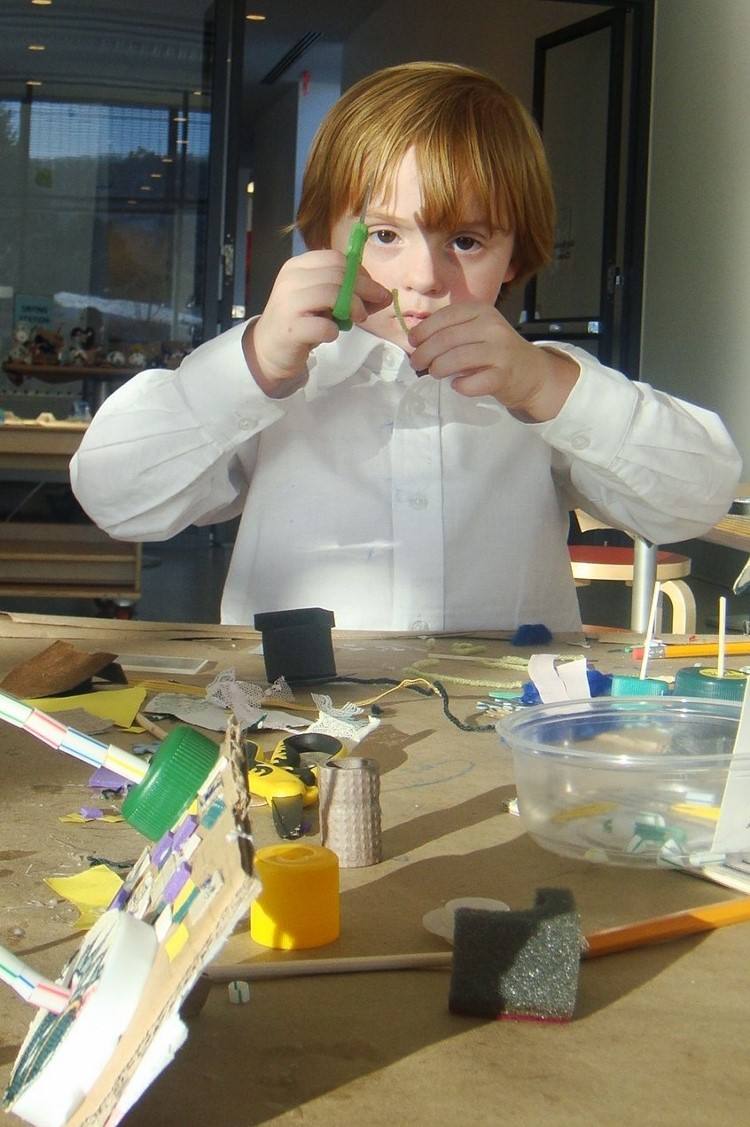
When we posed this question to our visitors at the hands-on, maker-space-esque exhibit I work in, the youngest patrons were fountains of innovative ideas. They drew elaborate lunar-powered shirts, shorts, and shoes so soccer players could practice at night. They wanted to make a virtual reality headset so you could see information about your favorite constellations just by looking at them. One jokester even sketched carrots.

The answer I got nearly every time from grown-ups? Glasses. Nothing special or new, just glasses, like the ones perched on my own nose.  

Something similar happens when I watch kids sit down at a table with an open-ended prompt, like “How can you project an image onto a screen?” They start by sifting through every available material, and they work until they’ve found two or four or ten solutions, often using every Lego in sight. And most of the answers they come up with make sense, because they intuitively understand that lenses and light, in some combination, will help them reach their target.


Meanwhile, their parents often turn to me within seconds of sitting down and ask, “What’s the right answer?”

I don’t fault grown-ups for thinking like this. It’s a combination of what our traditional education system has taught us to value and the many hats we wear when we take our kiddos out into the world: timekeeper, taskmaster, bathroom-runner, and above all, expert. Each of those roles is important at times, but for a museum experience that lasts in the minds of all family members, I wish parents could check most of their hats at the door when they walk in.

The best advice I can give to adults visiting any museum with children is to be 25 percent grown-up and 75 percent kid while you’re there.

Go ahead and use your advanced fluency skills and big vocabulary to make sense of the information given on plaques and signs, but then assume your role as a kid and just enjoy it.


On your day at the museum:

  • Ask questions with the assumption that there are no right or wrong answers.
  • Talk about connections between what you’re seeing and anything (literally, anything) it reminds you of.
  • Don’t feel obligated to see every single thing in every exhibit. Let your and your kids’ natural interests tell you where to linger, which exhibits to race through, and which to avoid.
  • When you discover something new or are confused, stop and pay attention to those feelings. Discuss them with your kids. In other words, model the fact that learning is a lifelong process.

I see our youngest visitors do most of these things naturally, and it enhances their learning and overall experience when they see their grown-ups behaving this way too.

As museum professionals, we have theories upon theories about how to engage your children, but in the end, you spend every day with them and have so much more influence over their experiences than we ever can. We do our best to facilitate experiences that will be meaningful to kids and stick with them. But when parents let go and learn to walk through the museum like their kids do—with boundless imagination, curiosity, and amazement—that’s when the truly lasting impressions happen.

That’s also when parents and kids have the most fun!


Abigail Kutlas


Math and happiness

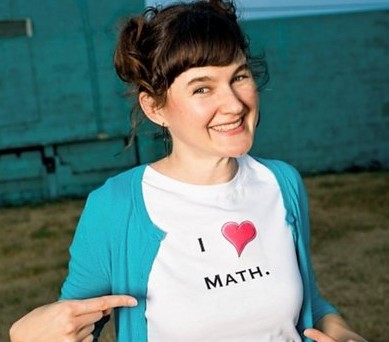
Lacie Taylor is founder and owner of Math For Keeps, a math ed business in Austin, Texas. She teaches her students how to practice math (much like you’d practice piano or basketball). With this approach, as she explains in the guest post below, her students develop a fluency in math as a language that changes the whole game for them.

Learn more about the Math For Keeps practice-to-mastery method here.


One of the magical things about one-on-one teaching is that it’s easy to keep a student in what educational theorists call their Zone of Proximal Development. I call it your Sweet Spot! If you’re bored, optimal learning is not happening. On the other hand, if you’re stretched so far that you’re freaking out, shutting down, with tears and much stress, optimal learning is also not happening. Here’s the fun, happy news: when you’re feeling your best while learning something, when you’re stretched enough that you’re engaged and inspired but not so much that you’re giving up, it FEELS good, AND that’s when optimal learning is happening. How lucky is that?

So how do we keep a student in that sweet spot? Let’s use one of the most famous subjects for knocking students out of their happy learning place—math—for outlining how.

First, a more formal definition of the Zone of Proximal Development: it is the gap between what a student can do independently (what they have mastered) and what they cannot yet do independently. Skills that are in the gap might have been introduced, and perhaps the student can do them with assistance, but they don’t yet have them mastered. Another way to put it: You’ve got your Actual Development, and your Potential Development, and your Zone of Proximal Development is where skills live when they’re in transition from one to the other.

So this space of learning—after you’ve been shown something, but before you’ve got it in the bag—that’s a fun happy space! The brain loves to be in this space, and loves to see skills move through this space into mastery. So why does learning sometimes stop feeling so fun? One culprit is our expectation that students work on things outside this zone. We’re expecting them to work on things they either already have in the bag (boring) or things that are unfair to expect them to do on their own just yet (defeating). The antidote, then, the guidelines for keeping students in their sweet spot, are pretty simple:
 

GUIDELINES FOR KEEPING A STUDENT IN THEIR SWEET SPOT
1. Don’t teach past what they’re ready for.
2. Don’t give busy work.
(TO NOTE: Do not get mad at your child’s classroom teacher if they aren’t doing this for your child. Doing this in a classroom of 25+ kids, all at different levels, when the paradigm is set up for its opposite, is a formidable challenge. But it’s one that alternative education is up to, and that’s one reason we’re all here on this blog.)


Number One Guideline: Don’t teach past what they’re ready for.

 If you as a student have truly been set up for success, each new level of math should feel completely do-able and accessible. The fact that it doesn’t, for most math students, sooner or later, simply means that the last level didn’t get mastered. At every new level of math, there is a new layer of skills that you’ll be figuring out. You won’t be able to do them independently; you’ll need help. The previous layers will have felt like that too at some point, but by now, if they have been practiced effectively all the way to mastery, then they will feel intuitive. You will be DONE with those skills. You won’t have to figure them out anymore. They are there to support the new skills you’re being expected to learn. When math starts feeling impossible, as it does for so many of us, it’s because we’re still getting that last layer down. We’re not ready for the new layer yet. Don’t give it to us before we’re ready, or our brains will reject it. We will hate math, feel discouraged by it, think we can’t do it, and start asking why the heck we have to learn it. Vicious downward spiral. Yuk.
 

Number Two Guideline: Don’t give busy work.

This is a tricky one because it is true that the more practice you have at a given type of problem, the better you become at it. The more automatic it feels, the more your brain energy gets freed up for the next level of skills. But it is also true that practice can quickly become tedious and mind-numbing once you’ve made it past that first-problem moment. In a perfect world, the student will have perfectly prescribed practices that are just right for their level. Your brain loves to witness progress. Nailing something that just recently seemed difficult is rarely boring. In fact, the most common student response to this scenario is “these are fun!”
 

Alt Ed for Curing Math Woes

In public education, currently, it seems students have two options: they learn at the school’s pace, or they end up having a less than happy, thriving experience in math. Sadly, most fall into the latter camp, because the school’s pace really doesn’t work for that many students (at least not without a different approach for practicing skills to mastery).

Students learn at different paces. If practice methods were introduced earlier, we could probably equalize better, but as it is, the further along you get in age, the more likely you will be in a class full of 15+ other kids all at dramatically different levels.

In the work I do, if I get a student early enough, I can make sure they’re ready for each class as it happens. The more likely scenario, however, is that parents have no idea just how behind their students are until after the student is multiple grade levels behind. The pain point gets loud enough long after the “ideal” time to fix it.

This doesn’t mean it’s not fixable. For many students, remediation can still happen in time for them to get on grade level. Then there are students who, even though entirely capable of learning math, at their own pace, will not catch up with the school’s pace. In this scenario, for students in public school, it is so easy for everyone involved to feel defeated. Parents, students, teachers alike are all operating under the assumption that because the student is not learning math at the school’s whirlwind pace, which has been pushing them along before they are ready for years, the student is condemned to struggle and to be perpetually behind and to probably not really learn math at all. And this is all with students (those using my practice method anyway) who are absolutely learning math.

What if “behind” didn’t even have to be a notion? Already, some students don’t go as far in math as others, and that’s fine, but what if those who didn’t go as far still learned math, and still loved it? Of course, this is totally possible in public education, with a bit of overhauling. Meanwhile, let’s explore it via all the amazing alternative education options in Austin.
 

Summary

Happy is most important! My whole method was developed on the premise that most of us (both “math-minded” and not) will end up frustrated by math trying to learn it with the minimal practice that is offered in the classroom. And not just the kind of healthy frustration that comes as a natural part of learning, but a very defeating kind that makes us feel inept. This is not fair. EVERYONE deserves to have a rewarding experience learning math. I aim with my practice method to give that to my students, regardless of what they’re getting in the classroom. So while it may feel discouraging—for those of you for whom your brain’s timeline is different than your school’s timeline—-I hope that overall the message I am sending is encouraging. The people I work with are fantastic students. They work hard, they’re enthusiastic, they show up ready to learn, they will get this stuff, on the timeline that is perfect for their brains. My job, with the help of parents—we all work as a team—is to make sure that when this timeline is different from the school’s, as it sometimes is, they don’t feel defeated, that if their enthusiasm for learning takes a hit, they know the reason and bounce back.


Lacie Taylor