On proficiency

Kami Wilt has been thinking a lot about proficiency lately. She shares her thoughts on the topic in this guest post, her third for Alt Ed Austin. Kami runs—quite proficiently, I might add—the Austin Tinkering School, which now has a second location, on North Lamar.
Proficiency: A high degree of competence or skill; expertise. Synonyms: skill, expertise, experience, accomplishment, competence, mastery, prowess, deftness, dexterity, finesse

I’ve had a sewing machine for several years now—longer than I’d care to admit, because I continue to have a contentious relationship with my machine. I didn’t grow up sewing, and although I took a few sewing classes awhile back, my experiences sewing at home are peppered with frustration and troubleshooting. I can hack it through a small project, but the thought of using it kind of stresses me out. I don't feel like, “Oh, I’ll just sit down and whip that out,” but instead brace myself for the inevitable snarls and hiccups that accompany my sewing experiences. 

I don’t know what happened, or what shifted, because I hadn’t even used the machine recently, but this week I had an idea for something I wanted to make, and I just sat down and MADE it. My off-and-on usage over the years had somehow reached the tipping point, and I achieved proficiency. The machine didn’t give me trouble. My project came together more or less the way I had wanted it to. I’m no expert, so maybe saying that I suddenly became proficient on the sewing machine is overstating it a tad, but the feeling that I could use the machine with ease opened me up to all sorts of projects that seemed way out of my range before, and my synapses were firing all over the place.

Of course, I've had this experience with other tools, too. I can remember the mental “click” that happened when using the chop saw changed from anxiety-producing to no big deal, and the possibilities that suddenly opened up when I could make those quick cuts easily. I took a screen printing class a few years ago, yet the screens I made weren’t seeing any action; I still felt like it was something I couldn’t really do on my own. But this summer I wanted the kids in my summer camps to get an Austin Tinkering School t-shirt, and ordering a bunch of preprinted shirts just didn’t seem very tinkery. Now, 84 t-shirts later, I'm feeling pretty fly with that squeegee!

At least for me, a single class usually is not enough to help me break through my mental block with a new tool. It takes a lot of time and floundering and mess-ups, which can be very hard for us results-oriented and failure-averse adults. Kids are so much better at just being interested in the process and persevering as they learn to use a new tool, if we give them that space. At Tinkering School we often see kids sawing through a big, thick two-by-four with a handsaw or working to cut a piece of cord with a pair of scissors, completely absorbed for surprisingly long periods. Sometimes it’s hard to not just step in and do it for them. But we don’t rescue them, because we want them to have that chance to hone their skills—and to be opened up to the multitude of possibilities that mastery of a new tool affords.

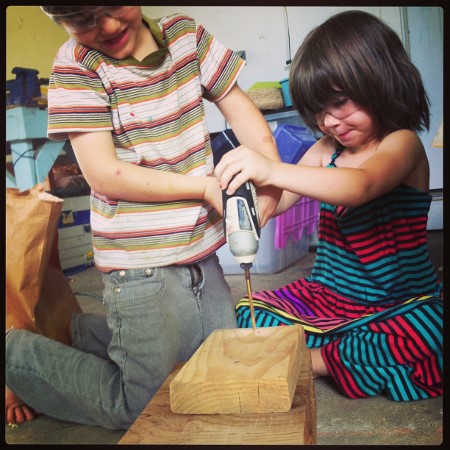
When I see a kid suddenly driving in screws by herself, where before she was fumbling and nervous and needed help, I am so psyched that she was able to make the leap from “I can use a drill, but only at Tinkering School” to “I can use a drill. On my own. Any time I have access to one.” That’s a kid who’s more empowered.

Proficiency is key to feeling like we can have an effect on the world around us. We can fix things. We can make things. We move from passivity (“It broke, and now we have to throw it out” or “I have an idea but no idea how to build it, so I never will”) to action and participation. Not only does this society needs all the active participants it can get, but being a part of the Making and the Doing is also a lot more fun!

Kami Wilt

Adventures in learning

Guest contributor Paul T. Shafer is a self-proclaimed fun dad who enjoys going on educational adventures with his children. He writes about some of their exploits at shaferpower.com. In 2014, he’ll be launching IncrediBUS, a mobile learning extravaganza for children between the ages of 4 and 10. If you’d like to get a sense of the adventures Paul has in store (and a chance to win free passes on IncrediBUS) check out his weekly challenge, which can be found here.

Shortly after my son learned to speak, I hung a number chart on the wall and quizzed him using a laser pointer. In the event he would provide an incorrect answer, I would make him do push-ups totaling the number he had just missed. For some reason, he learned his numbers very fast. He also built some good strength along the way. (Kidding, of course—at least about the push-ups.) Anyway, it didn’t take me long to realize I needed to make some adjustments or this whole father-son teaching thing wasn’t going to last very long.

Fortunately, my wife witnessed the number chart episodes and gently intervened: “You might want to consider making it fun for him, or you’ll both end up pulling out your hair.” She was right: virtually every time I sat down with that laser pointer, my son or I ended up in tears. “There must be a better way,” I thought to myself.

Fast-forward several months and one deck of Uno playing cards . . .

The thing I noticed about playing Uno with Owen was the overwhelming joy we shared together. He was excited at all the numbers and colors, and I was elated because the cards were doing all the work. “What’s this one, Daddy?” and “Is this card a 9 or a 6?” We were both having fun and he was learning along the way. The experience left a profound impact on me—learning should be fun, right?

I decided to continue testing this theory of fun and adventurous learning for the next several years. For example, I always had an interest in entrepreneurialism, so I wondered if a fun entrepreneurial event might advance my kids’ interests on the topic. We forewent the traditional lemonade stand and sold Starbucks, chocolate milk, and donuts on a street near our house one Sunday morning. We sold our entire inventory and made some good tips to boot. The kids thought that was great. And we got to learn about creating flyers and counting money and saying “Thank you” to customers as part of the event.

We decided to take it a step further a few weeks later and sold breakfast in our neighborhood from my kids’ Radio Flyer wagon. We got the inspiration from a local food trailer called Torchy’s, and I arranged for them to meet the founder and ask him a few questions about how he started his business. He was incredibly kind to the kids, had a great amount of patience, and even donated a few tacos for their taco wagon event. Now we were really having fun!

Through all of these adventurous experiences (there are many others I’ve written about on my blog), I have noticed that kids are most engaged when they are exploring and having fun. Learning doesn’t have to be about worksheets and memorization and mundane repetitive tasks. It’s about experimenting and trying new things and getting lost in the experience. And to make things even better, I’ve found that if I’m joining in the experience and rolling up my sleeves with them, we all get to learn together and keep enjoying it for weeks to come.

Paul T. Shafer

Planting Roots of Empathy in Austin schools

Laura Smith, a postpartum doula with Austin Babymoon, is one of those rare individuals who seem to transform the world in positive ways with their every move. I am thrilled to bring Laura and her latest transformative project to you by way of today’s special guest post.

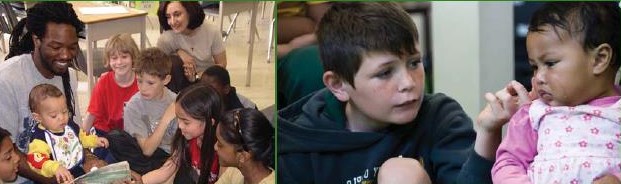
Roots of Empathy is a social-emotional learning program for elementary-aged schoolchildren that brings together everything most dear to me in the world: babies, children, and compassion and empathy. From the moment I first encountered the program, through an article in the New York Times in late 2010, I knew I wanted to bring it to Austin to share with our community.

At the heart of the program are babies, coming into K–5 classrooms every three weeks all year long as tiny teachers. As a postpartum doula and nanny (and mother) with over a decade of work with dozens of babies, I have long felt reverence for the simple wisdom and presence of babies. Babies’ lack of self-assertion and their guilelessness makes them universally appealing. Almost anyone can smile with a baby.

What Roots of Empathy has discovered since the program’s inception in Toronto in 1996 is that deliberate exposure to these infantile qualities can be profoundly transformative, bringing out the best in us all. The children connect to the baby's humanity on a deep emotional level. This connection becomes the lever for discovering their own feelings and the feelings of others.

Roots of Empathy takes place in classrooms with students and teachers, a parent & baby duo, and a trained, volunteer Roots of Empathy instructor. Through guided observations of the baby's development and feelings and of the loving parental relationship, children learn to identify and reflect on their own thoughts and feelings and those of others. The trained Roots of Empathy instructor prepares and reinforces teaching done during family visits using a specialized lesson plan each week.

Much research and independent evaluation back up what I could immediately intuitively understand: that the program significantly reduces bullying and aggression and increases social-emotional competence and prosocial behaviors such as sharing and cooperation. It also reduces bystanderism. When students who have been through the program later witness cruelty and injustice, even if they are not directly involved, they are moved to stand up for their beleaguered peers.

And of course, better academic performance is a natural outcome of children's lowered stress levels and sense of being more supported and safe in their classrooms.

The program has deeply affected many participants, like a troubled young man who had been in and out of foster care most of his life. He held “his” baby (a beautiful sense of ownership comes for the students as they connect to “their” baby throughout the year) in a Snuggli and took her to a corner of the classroom to spend a few quiet moments with her, while the mom, instructor, and teacher pretended not to look on. Afterwards, he said to the instructor, “Do you think that even if no one has ever loved you in your whole life, it is possible to love?”

The program is widespread in Canada, England, Isle of Man, Northern Ireland, Scotland, and New Zealand and is newly established in Germany, Seattle, San Francisco, and New York. It is so effective that the Scottish government has decided to implement it countrywide.

Roots of Empathy has been recognized by His Holiness, the Dalai Lama; Emotional Intelligence author Daniel Goleman, Dr. Dan Siegel, the award-winning psychiatrist, author, and educator; and the World Health Organization, among others. The organization works in partnership with indigenous people and minorities globally. Mary Gordon, the founder, has won numerous awards, and the program has also won an International Changemakers award from the Ashoka organization.

And now, this fall, as a result of more than two years of community development work, Roots of Empathy is coming to Austin!

There is nothing quite like seeing the program in action, so I suggest at this point watching this two-minute introductory video:

Here is a longer, ten-minute video with a lot more classroom footage. (I will admit it now: I can never keep from tearing up when I watch these videos!)

You might also want to listen to this Jian Ghomeshi interview with Mary Gordon that aired on NPR in May.

Interested in being involved? I would love that, and I need your input! Here are a few ways to participate.

  • I am looking for people who are interested in becoming volunteer Roots of Empathy instructors. Instructors deliver all aspects of the Roots of Empathy lessons in the classroom and work closely with the participating volunteer family. The instructors witness and guide the transformative effect of the baby’s presence in the group of children. It is an amazing experience!
  • We will also need volunteer families, once funding is secured. Babies should be between two and four months old at the beginning of the program, so born between early July and late August of this year. It is a transformative experience for participating families. Often, the parents are so moved by the experience that they become volunteer instructors the following year!
  • Perhaps you know of a school that would benefit from this program. This fall, it will be in 15 classrooms across the following four schools: The Khabele School, Austin Discovery School, Cedars International Academy, and Ridgetop Elementary. I have interest from schools in Pflugerville ISD and Eanes ISD as well and am already starting to prepare for the next school year (2014–2015), when it will be in 15 more classrooms.
  • Lastly, and at the moment most importantly, funds. Financial support. We are applying for several grants, but in order to conduct the training in October for this fall, we need immediate funds. Roots of Empathy is a 501c3 nonprofit organization. We are looking for private individual donors as well as corporate sponsors.

Thank you for your interest! For more information, check out the Roots of Empathy website. And please feel free to ask me any questions in the comments section below.

Laura Smith

Movers and shakers

Austin’s alt ed community has seen lots of movin’ and shakin’ this summer. Here’s a roundup, in no particular order, of some changes you should know about as you're looking for schooling options for your kiddos.

A new school serving ages 3 to 103 is forming in Central Austin, just south of the river: Integrity Academy at Casa de Luz, Center for Integral Studies. Led by executive director Ali Ronder, formerly of AHB Community School, and founder Eduardo “Wayo” Longoria, the school is currently enrolling (and hiring!) for the 2014–2015 school year. You can help shape the school’s future or just enjoy a stimulating discussion about how humans learn by attending one of Integrity’s weekly salons.

Taking over the helm at AHB is M. Scott Tatum, who brings a wealth of experience in arts education, administration, and integration. Meet Scott and learn what makes this part-time elementary school in Hyde Park special by watching its new series of short videos.

Bronze Doors Academy has a new campus and a new name. According to director and chief motivator Ariel Dochstader Miller, Skybridge Academy will continue the same liberal arts college–like program for junior high and high school students for which Bronze Doors was known, but with some additional STEAM (Science, Technology, Engineering, Art, and Math) opportunities made possible by its new location at the Stunt Ranch in Southwest Austin. As always, both full-time and à la carte options are available.

Accompanying Skybridge in the move to Oak Hill is its elementary school partner, the Soleil School. Cofounder and head of school Carly Borders says the new location on the Stunt Ranch will give her young students access to a ropes course, a pool, and more than 20 acres of beautiful land to explore.

Another unique school on the move this summer is Acton Academy. Construction on its permanent home on Alexander Avenue in East Austin is nearly complete. Laura Sandefer, Acton’s cofounder and head of school, invites you to check it out at the open house on October 24; meanwhile, take a peek at this architect’s rendering. It looks plenty big to house the academy’s current elementary and middle school students as well as the high school program slated to open in 2016.

The Olive Tree Learning Center, a Reggio Emilia–inspired preschool, recently opened its second campus, at 6609 Manchaca Road, near Garrison Park. Like the original Bouldin Creek campus, the new one is currently enrolling children between the ages of 18 months and 5 years. Director Michelle Mattalino says she is “very proud of the staff at both locations” and excited to fill the beautiful campuses with happy children.

Mariposa Montessori is also opening a second campus in South Austin. It will house this American Montessori Society full-member school’s new Lower Elementary program. Head of School Whitney Falcon recently reported that there were a few spots open for fall enrollment.

Progress School is expanding this fall to serve kindergarten through 5th grade. Located in Hyde Park, Progress offers “authentic education for natural learners,” with full- and part-time options as well as an after-school program. More exciting news from director Jennifer Hobbs: “We're getting chickens!”

Likewise, the Inside Outside School has expanded to serve kindergarten through 6th grade this fall, says executive director Deborah Hale. Its current enrollment of 24 will make up three classes—primary, intermediate, and upper elementary—on the school’s seven wooded acres in Pflugerville.

9th Street Schoolhouse is growing, too. The East Side home-based school will serve ages 5 through 9 this fall, with 8 students currently enrolled. 9th Street now has two mentors: founder Caitlin Macklin and Laura Ruiz.

Finally, the Whole Life Learning Center is rolling out a new nature-based one-day program called Mother Earth Mondays, which fosters a connection with the earth through gardening, wilderness survival skills, arts and crafts, games, and other fun activities with mentors Braden Delonay, Caroline Riley Carberry, and Leesalyn Koehler. In addition, director and founder Michael Carberry says he is excited to introduce the newest mentors for the Teen Mentorship Program, Kizzie, Etienne, and Adam, whose bios will soon be posted on the WLLC website alongside those of the school’s veteran staff.

Any questions or comments for these movers and shakers? Feel free to leave them below.

Teri

Start them now

I couldn’t be happier to welcome Virginia Woodruff to our roster of guest bloggers. Today she shares her family’s experiences with one of Austin’s best language immersion programs. Virginia founded the website Great Moments in Parenting, where moms and dads share the agony and ecstasy of life with kids. She invites you to share yours, too.

When I admit that my kids take Chinese, I immediately follow it with “But I swear I’m not a tiger mama!” I’m actually a rather laissez-faire mother, but my mother-in-law’s trip to China prompted me to start my kids in one of the world’s oldest, most spoken, and most challenging languages. (Note that I said “challenging,” rather than “difficult”—part of my attempt to reframe words around my kids, who have no idea that for an average American adult, learning Chinese is equivalent to having your hair plucked out strand by strand.)

My mother-in-law, a language maven, studied Chinese before her trip, just to have a “get along” ability. At the time my son was two. When my mother-in-law returned, she said, “If you can, start him in Chinese NOW!” Apparently it was difficult to “get along.”

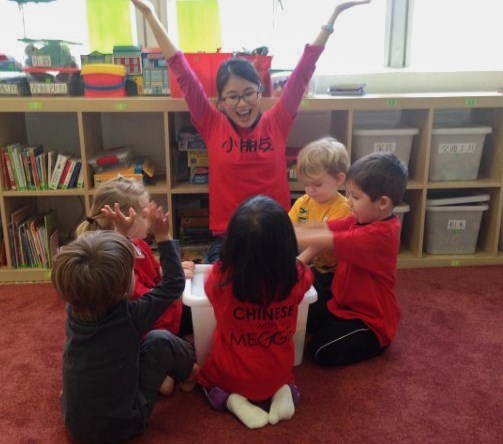
We had always hoped our children would be bilingual, so why not start them in this complex language? I set myself to researching and found Chinese with Meggie, an immersion program in central Austin. It was so quaint: Taiwan native Meggie Chou held classes in a toy-filled studio behind her home. Classes were limited to four kids and were all in Chinese. The children played as she slid in the learning by reading picture books in an animated tone, doing puzzles, and playing eating and drinking games with plastic toys. As my son got older it included a quick game of flashcards, identifying pictures of animals or family members.

The program became so popular that, just a few years later, Meggie moved it to the former Griffin School building in Hyde Park, took over five classrooms, and hired six Chinese teachers. Meggie trains all her instructors in her own child-friendly style. “Working with young children, you need a very special connection with them so they trust you and want to communicate with you,” Meggie explains.

Meggie says immersion learning works best for children under age six: “For kids at this age, their brains are working on building language skills in general. There is no concept of ‘first language’ or ‘second language.’” Young children don’t filter the information they receive. “Whatever information they get, they just try to sort out and save it as part of their cognition,” Meggie says.

Older kids usually begin with Chinese-as-a-second-language classes taught in English. “They start to filter information that cannot be recognized by their cognition,” says Meggie. “The total-immersion class might be difficult or ‘distanced’ for older kids.”

We’ve been going to Chinese with Meggie for four years now (my twin girls joined when they were about 18 months old). We’re committed, but it’s not always easy. It’s a long drive in traffic from their school, and I can’t say my kids skip into the classroom every week. But when they grumble, I remind them, “It’s pretty cool that you’re learning Chinese. Maybe one day you can go to China!”

My girls, who started so young, just think it’s par for the course to speak Chinese.  As Meggie explains, “When they start to speak, they copy whatever sound they hear. Mommy says, ‘apple’; Miss Meggie says, ‘pingqua.’”

We count ourselves lucky that we found this intimate atmosphere for learning a language. When I started looking, I swore, “I’m not doing this if it’s taught in some authoritarian style.” I pictured rows of students reciting memorized phrases. We were Montessorians, after all (“help me to help myself”), and I knew a traditional structure wouldn’t fly with my individualistic kids.

I appreciated the difference between Chinese with Meggie and traditional Chinese ways of teaching when we hosted a high school exchange student from China. I had hoped she would speak Chinese with our kids, but it was a nonstarter. The idea of slowing down and repeating words to children, engaging their natural curiosity, didn't make any sense to her. If they couldn't understand her immediately, she walked away. She was used to learning through tests and quizzing. The only part she did grasp was flashcard review.

Some parents bring their kids to Chinese class because they want them to be global citizens; some are bilingual themselves and see Chinese as the third logical language to add; some are—yes—tiger mamas; and some, like me, stumble upon it. But if you want your kids exposed to Chinese (or any other language) while their brains are still spongelike, take my mother-in-law’s advice: Start them now.

Virginia Woodruff

Is it ADHD or a kinesthetic learning style?

Continuing our summer mini-series on learning styles, I’m pleased to share this guest post and video from Madison McWilliams, who runs The Joule School. This unique program is now enrolling for Fall 2014.

LearningStyles for blog.jpg

At The Joule School, we serve students who are considered bodily-kinesthetic learners. These are children who learn best when they are allowed to engage their hands and feet as well as their minds. To some, there may appear to be an overlap between these children and those who have been diagnosed with ADHD, a neurological condition characterized in part by hyperactivity (the need to move often and difficulty in sitting still).  

Introductory material on learning styles is available here, here, and here. In short, a learning style is the method by which a student takes new information and converts it into knowledge. Learning styles influence the entire educational process, including which strategies children use when studying for tests and the types of subjects that they prefer. Many education experts recognize three primary learning styles: auditory, visual, and kinesthetic.

A kinesthetic learning style is characterized by an ability to retain (memorize) information best when it is related to movement.  When presented with new material at school, kinesthetic learners zero in on action that can be performed with the human body. They have an innate ability to copy movement and tend to excel in gross and fine motor activities such as dance, sports, art, or playing instruments. While telling a story, they will likely act out the scene or role-play while they speak.  Kinesthetic learners function best in a classroom where they can role-play, build, measure, jump, sing, and experiment because all of these actions help them process information into long-term memory.  

Kinesthetic kids have a long history of being unsuccessful and/or unhappy in traditional schools because their natural tendency toward movement is at odds with desk-and-lecture classroom structure. These children

  • tend to “zone out” when listening to a teacher for a long period of time and may daydream or doodle;
  • have difficulty concentrating on paper-and-pencil assignments;
  • get “the wiggles,” which may lead some students to fidget, kick, or get out of their seats;
  • may interrupt a student or teacher (likely with requests to show or demonstrate something);
  • may drop things on purpose, in order to have an excuse to get out of the seat to pick it up; and
  • walk to the pencil sharpener or bathroom an unnecessary number of times.

Misinformation has led many adults to automatically assume that behaviors like these (especially from boys) are the result of ADHD. Teachers of these students may respond with discipline or by contacting parents with a referral for ADHD testing. In fact, while the rate of ADHD in youth is approximately 8 percent of the total population, one recent study noted that when given a diagnostic checklist, schoolteachers rated 20–23 percent of the entire male population at their schools as having ADHD.*  This is not surprising, as the symptoms of ADHD in the classroom are almost identical to those of a kinesthetic learning style.  ADHD students often

  • blurt out answers to questions;
  • fidget in their seats, kicking the seat in front;
  • daydream;
  • have difficulty listening to a teacher for long periods of time;
  • may get out of their desks and wander around the classroom at an inappropriate time; and
  • interrupt the teacher or classmates.

Since the manifestations of ADHD and a kinesthetic learning style are so similar, it is prudent to address an ADHD referral by first screening a child for a kinesthetic learning style. This helps ensure that the child's behaviors are not simply evidence of a mismatch between his or her needs as a student and the learning environment. Two simple questions can help establish whether or not the student is challenged by ADHD or is simply a bodily-kinesthetic learner:

1. When provided with a bodily-kinesthetic lesson, do the “ADHD symptoms” disappear or appear to be dramatically reduced?

True kinesthetic learners will be able to stay engaged in a lesson that allows them to use their bodies. For example, a kinesthetic learner who is offered the opportunity to classify roots by movement and touch will probably be quite successful during the lesson and subsequent evaluation, because such an activity stimulates his or her mind. Students with ADHD, which is characterized by impulse control issues, may still find themselves distracted, fight the urge to disrupt or abandon the lesson, or have difficulty explaining what they are doing when prompted by a teacher to describe their learning.  

If a child is suspected of having ADHD because he or she struggles to sit still in class, stakeholders should try a kinesthetic lesson in a subject that the student ordinarily does not enjoy. (This is recommended because we all tend to concentrate better if we like the subject being taught.) If the student can remain focused during the lesson and retain the material taught, then it is likely that he or she simply has a mobile learning style. If the child completes the hands-on activities but shows little or no retention of the concepts covered, or seems far too stimulated by the hands-on environment to focus on the lesson, then an appropriate expert in ADHD should be consulted.

 2. Do appropriate ADHD accommodations help the child focus or achieve in school?

ADHD accomodations are designed for visual and auditory learners who need additional help to overcome their struggles with distractibility and hyperactivity. These children often retain material best if it is taught in a traditional format with traditional assignments, but they simply cannot focus on the lesson long enough for the material to sink in. There are dozens of research-based accommodations for these children. For visual learners, an appropriate ADHD accommodation might be a written checklist of tasks to help them organize and complete an assignment, which they can cross off as they progress through each task. Using audiobooks as a supplement to text-based materials can help hold the attention of an auditory student with ADHD. If appropriate accommodations are implemented and they facilitate gains in student learning, then the child may be a visual or auditory learner who simply needs assistance in focusing, and a specialist in ADHD can make recommendations for that student.

A Sample Lesson for Kinesthetic Learners

I will leave you with a brief video I made to demonstrate one example of a simple and effective math lesson geared to kinesthetic learners. Please feel free to leave questions or comments below; I’d love to continue the discussion.

Madison McWilliams

* Nolan et al. (2001), Teacher reports of DSM-IV ADHD, ODD, and CD symptoms in schoolchildren, Journal of the Academy of Child and Adolescent Psychiatry 40, 241—249.