Media Monday: Pearson pares down

timlewisnm | cc-licensed http://flic.kr/p/6sNk6c

timlewisnm | cc-licensed http://flic.kr/p/6sNk6c

For our January 2016 Media Monday, we want to take note of big news in the world of education publishing and courseware. Pearson, often cited as the world’s biggest education company, announced major layoffs amounting to 10 percent of its workforce of 40,000 last week. The company is based in the UK, but most of its business is in the United States, and it has approximately 20,000 U.S. employees, many of whom are Texas-based. In fact, after losing a lucrative Texas testing contract last year, the company laid off more than 200 workers in Austin.

Today, the Austin American-Statesman reported that the State Board of Education is meeting this week to discuss dropping Pearson as the supplier of state GED tests. The cost of the tests is $135, which many advocates argue is too high. In addition, failure rates for the Pearson GED are climbing, with only half of 20,000 people who took the 2014 exam receiving a passing grade. Texas ranked 50th in the nation in the percentage of adults who hold a high school diploma, according to a 2012 Census Department survey, and thousands take the high school equivalency exams each year.

Pearson controls an estimated half of the U.S. standardized test market. Education blogger and teacher Mercedes Schneider argues that committing heavily to Common Core testing, which has been under attack from parents, legislators, and educators lately, was one of the company’s big problems. “There are those who insist that Common Core is a success. Looks like Pearson reality prevents it from joining that brigade.”

The company says that it will now be putting more money into “adaptive, personalized, next-generation courseware,” focusing more on blended and virtual learning, and improving its English-language-learning programs.

Shelley Sperry
 

Teaching driving readiness to young teens

Missy Menzes, occupational therapist and founder of Extra Credit! LLC, is dedicated to helping school-aged kids and families dealing with “hidden disabilities” and learning differences. As program director of Driving Readiness for Teens (DRT) and a member of the Texas Teen Safe Driving Coalition (TTSDC), Missy is excited to be able to add a unique and valuable perspective to caregivers of potential drivers. She hopes to reach the central Texas community as part of her volunteer roles in the TTSDC’s Zero Teen Driving Fatality Initiative and others nationwide as a guest blogger for the Drive it Homeproject.
 

Community mobility is a necessary part of human independence and socialization. While most individuals can use public or private transportation, not everyone can or should drive. As a pediatric occupational therapist, one of the most important and unique roles that I have taken on is facilitating driving readiness potential for high-risk teens. Principles of my DRT therapy program and concepts of “driving fitness” are relevant to any parent raising a potential driver.

The first step of assessing readiness for driving is to notice how the child moves, sees, thinks, feels, and takes on general responsibilities. All of these attributes will, in some way, affect driving performance. Parents of middle school and even younger school-aged children should ask the question “Is my child coordinated, attentive, and adaptive?” Start addressing noted concerns in any ways you can on your own, and seek assistance for areas of need from qualified therapists or other professionals early on.

Pre-driving skills include coordinated use of extremities, quick/accurate visual & cognitive perceptual processing functions, and safe attention and reasoning abilities. A driver must be able to effectively filter and process incoming sensory stimulation while attending and responding to “most critical” information. One must also be knowledgeable about rules of the road, have good anticipation skills, and be capable of managing unexpected events as well as stressful situations.

My DRT therapy program activities vary among families to enhance the areas that we determine to be specifically problematic or at risk for their children. Students perform individualized home activities between sessions. These vary from simple postural and coordination exercises to more complex visual and cognitive processing games. I occasionally prescribe the use of cutting-edge technologies such as Drive Fit® or Interactive Metronome® at home. These modalities help build skills of noticing, prioritizing, and reacting to information both quickly and over time.

Once foundations for driving are well established, it’s time to proceed to pre-driving “passenger level” training activities. Most of my program recommendations at this stage are based on specialty training I received from Miriam Monahan of the Driver Rehabilitation Institute. If you have a child with unique needs, I highly recommend you work with an occupational therapist trained in American Occupational Therapy Association (AOTA) courses, if not a certified driving rehabilitation specialist.

For ideas to guide your own “backseat driver education” before permit time, my advice is to thoroughly check out driveithome.org from the National Safety Council. I have all my DRT participants reference Drive it Home™ because it offers free parent resources, including digital driving lessons, courses, programs, and videos. Parents can use this information as a way to initiate dialogue about teen driving risks and road safety, but much of it can also provide ways to approach aspects of driving earlier on with your children.

Every parent has the opportunity to help teens be better prepared for driving by addressing some readiness skills before permit time. You can ask them to put down their phone or tablet, stop thinking about what happened today and what’s to come, and stay focused on the road when a passenger. Teens could practice identifying cars in the blind spots with you, help navigate by providing directions, and notice general distractions or obstacles to avoid.

Of course, safety is always Priority Number One. If implementing this or any other type of parent-initiated readiness training is in any way distracting or emotional for you as a driver, don’t do it! There are other ways to practice pre-driving skills safely. From afar, one can safely observe traffic flow at a neighborhood intersection or community traffic signal. Individuals can also take note of driving behaviors while shopping somewhere busy. An important aspect of readiness is awareness that people break rules sometimes. A safe driving practice is to make sure the careless actions of others don’t cause you to have an accident.

Perhaps most importantly, caregivers should practice good habits for teens to follow. You know the big ones: buckle up, follow the road rules, always be a defensive driver, no texting or phone use (even over the speaker), only initiate use of navigational systems if necessary when the vehicle is in park, and keep your vehicle in good shape. There is really no good excuse to break these safety measures, but some habits can be difficult to curb.

Drivers should also avoid eating/drinking, listening to the radio/movies in the car, putting on/taking off things, reaching for objects, glancing at a phone or other device, or having distracting conversations/thoughts. These actions have led and can lead to serious accidents. It’s also important for drivers to keep emotions in check and practice time management. It’s never safe to drive under the negative influence of added stress or pressure.

I know that many of these tips can feel difficult if not impossible to follow at times. The important thing to remind yourself of is this cold, hard truth: driving is the number-one killer of teens. Teenagers cannot comprehend their levels of risk as inexperienced drivers and are more likely to engage in distracting behaviors. It is also much easier as a caregiver to set driving rules and say assertively to a teen, “You absolutely cannot _____ while in the car” if they can’t argue back to you, “But YOU do it, so why can’t I?!”

As seasoned drivers, we need to remind ourselves of how stressful the learning-to-drive process can be for everyone involved. As parents, we can start teaching kids early on, and they will (hopefully) listen to us, imitate us, and do as we say. More work ahead of time should mean less of it later on, and this will be especially useful when dealing with a teen who is hormonal, emotional, distracted, or stressed.

Thank you for reading, and I hope you have found this perspective and some of the suggested recommendations of value. It has been a pleasure acting as a guest blogger. Please use any of the tips I’ve provided here as loose guidelines. As a parent, you are ultimately the only one responsible for actions taken with your child. Driving is one of the most dangerous things that we regularly do, and this important privilege should never be taken lightly.

Drive safely!
“Ms. Missy,” OTR

P.S. To learn more about Extra Credit! LLC, visit www.extracreditaustin.com and like us on Facebook to receive informative postings. For more information about OT’s role in driving rehabilitation and community mobility, please check out AOTA and the Driver Rehab Institute.
 

Let’s donate before we celebrate

If you’re anything like millions of other Americans on December 31st, you’re trying to decide where to make some last-minute donations before finding just the right person to kiss at midnight. Let us make a few suggestions of admirable nonprofits here in the Austin area and farther afield, all aimed at helping kids and spreading knowledge. Any of these organizations would be worthy of your 2015 dollars. In alphabetical order:

Amala Foundation runs the Global Youth Peace Summit, Camp Indigo, and many other youth empowerment programs.

Austin Book Arts Center engages Austinites of all ages in creative, interpretive, and educational experiences related to the arts of the book.

Austin Bat Cave offers free writing workshops for kids to spark creativity and enhance literacy skills.

Children's Defense Fund provides a strong independent voice for all the children of America who cannot vote, lobby, or speak for themselves, with special attention on the needs of poor children.

EcoRise Youth Innovations inspires young leaders in Austin to design a sustainable future with its school-based programs teaching environmental literacy, social innovation, and design skills.

Education Transformation Alliance is a collective of alternative educators around Austin who organize the annual Alternative School Fair. The next fair will be held February 20, 2016.

Khan Academy seeks to provide a world-class education for anyone, anywhere through videos and exercises.

Wikipedia. You know it. You use it. And so do your kids. It’s not perfect, but it provides valuable information to millions every day and is designed to reach everyone in the world with free knowledge.

Happy New Year!

Shelley and Teri Sperry

Media Monday: Five education news stories that mattered in 2015

It’s that time of year: Time for everyone to put out lists of people, movies, music, photos, and books of the year, so we thought we’d get into the act. For our final Media Monday of 2015, we take note of  a few of the many education news stories that took center stage locally and nationally this year. Two troubling national crises found unique expression in Texas schools, and the results are still echoing: fear and suspicion of the Muslim community and the proliferation of guns.

  1. Ninth-grade tinkerer Ahmed Mohamed, of Irving, built a clock that school authorities believed resembled a bomb. Ahmed was arrested and became a Twitter sensation—with an invitation to the White House.
  2. Student and community protestors on both sides joined the controversy over legislators’ decision to allow “campus carry” ofguns on state university campuses.
  3. On the national stage, the much-criticized No Child Left Behind legislation passed under the George W. Bush administration died with a whimper. On December 10, 2015, the Every Student Succeeds Act (ESSA) replaced NCLB, expanding access to early childhood education but keeping the yearly testing regime mostly in place. Time will tell whether the new system will allow for more innovation and less “teaching to the test.”
  4. Gaps in educational opportunities based on race, ethnicity, and class were big news in 2015 and cause for more and more student protests, as in-depth reporting revealed funding inequities and persistent segregation in the South and throughout the nation.
  5. But a surge of grassroots activism brought hope for change and empowerment for students. The “opt-out” movement surged in Texas and nationwide as parents and students rallied against excessive testing and Common Core requirements. At the same time, activism against the growing student debt crisis has led presidential hopefuls to address the situation head-on.

Let us know your thoughts on how these trends affected you and your kids, or if there are other important stories you think ought to be added to this list.

Shelley Sperry
 

Media Monday: Appy holidays!

Have you started thinking about a new phone or tablet as a gift for your son or daughter for the holidays? I know that’s often the kind of gift many kids—including my own—are asking for. So I was pleased recently to see a couple of trustworthy media sites suggesting some excellent educational apps.

Take a look at the American Library Association’s “Best Apps for Teaching and Learning, 2015” and then read Joan Brasher’s “Education Experts Offer 18 Apps that Make Learning Fun.” Brasher also suggests ways of choosing apps that meet your child’s learning needs. Vanderbilt University’s Collen Russo suggests using Common Sense Media’s App Reviews.

Common Sense is always a great “before you watch” source of information. Its reviews help parents and kids assess the content of TV shows, movies, games, and books, but I didn’t realize until now that the group also rates apps.

Enjoy everything your new tech has to offer!

Shelley Sperry
 

Imagine new possibilities

We always jump at the chance to publish Marie Catrett's lovely Reggio Emilia–style documentation of her young students’ learning. Here’s the latest, a photo and video essay on the many uses the children have found for their classroom’s light table. Marie directs Tigerlily Preschool in South Austin.
 

Agency is the idea that when we act, and act strategically, we effect change upon our environment. Babies are agentive, reaching out into the world, building knowledge, ability, and strength from their own active experience without a negative internal voice suggesting otherwise. “I can’t” comes later when people tell children they are too small, what they want to do is too dangerous, or there’s not enough time to allow for all that pokey trying. But children need thoughtful adults to hold the space for them to explore with the trust and awareness of their own inner judgment. Do what feels right for you in your own body, I tell a child who’s thinking about whether to make the swing go higher. Hold tight with both hands (my rule!), but do what feels right to you.

In my teaching I observe children to understand them better and strive to be a supportive presence that honors the children’s agency.

When things get stuck, I might state what I see: Hmmm, I can’t let you push him, but tell me about what’s not working. This play isn’t working yet, but I know we can figure this out. Then I ask questions. What do you think? How else could you ______? Can you think of another way to _____? How could we find out? And my favorite question for a child who has just made something interesting happen is how did you do that? The response will be wonderfully agentive: Well, first I did this, and then I did that, and then . . . . Wow!

We want children to have a strong sense of agency and from that imagine new possibilities.

The key is curiosity, and it is curiosity, not answers, that we model. As we seek to know more about a child, we demonstrate the acts of observing, listening, questioning and wondering. When we are curious about a child’s words and our responses to those words, the child feels respected. The child is respected. ‘What are the ideas I have that are so interesting? I must be somebody with good ideas.’
—Vivian Paley

When thoughtfully providing children with a new experience to support their continued work, it seems to me that I have a responsibility to provide an introduction that expands rather than limits possibilities. Provide a child with quality materials and give her time to make her own discoveries—the delight of “Look what I just did!” I’ve thought about this idea quite a bit this semester as my children have gotten to know the new light table in our classroom.  

A piece of Reggio equipment that we see in each of their classrooms excited the imagination of North Americans. But the light table, after its purchase, is often misunderstood and underutilized. Think of the light table as a tool that will work independently to teach the children about translucency and opacity. They can do anything on the light table that they might do on any other table. Leave it to the children to figure out what the table is for! It’s safe for them to use either wet or dry media on the table—collage, paint, markers or to build with Legos—or anything. You can even eat there. Note the many uses the children invent. Left to their own exploration, they’ll come to discover what’s light permeable and what isn’t. Our strong Image of the Child and our commitment to children’s agency alert us to back off from providing familiar materials so that children can make their own discoveries.
Seeing Young Children with New Eyes: What We’ve Learned from Reggio Emilia about Children and Ourselves by Sydney Gurewitz Clemens and Leslie Gleim

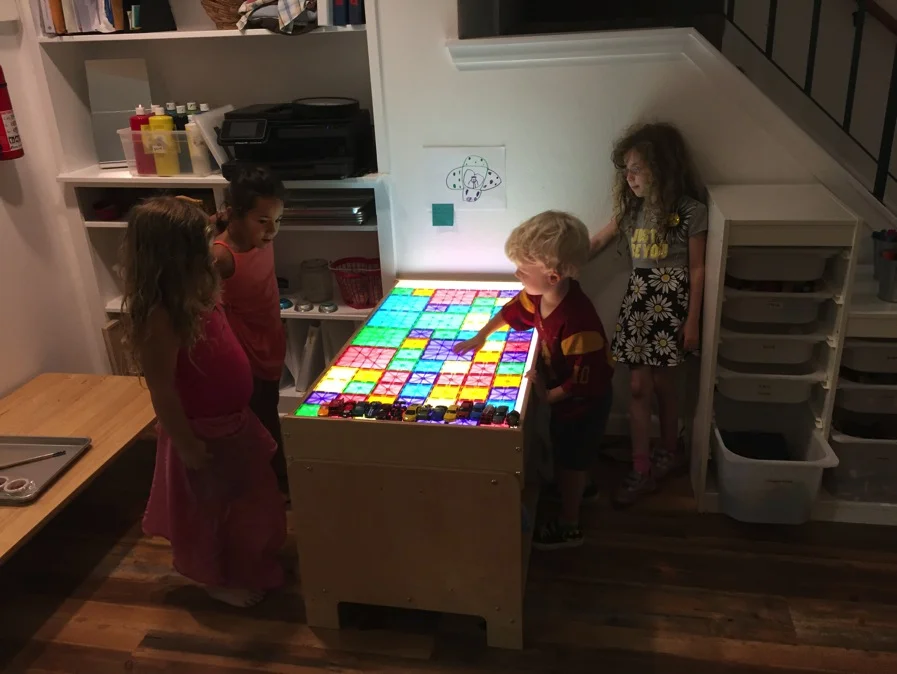
Here are some of the uses the children have discovered for their light table:
 

This afternoon the light table became a place to do clay. Viviana did some very fun flat faces, carving through the clay so the light illuminates the features. Stella, busy with flat-making for pizza, gets connected with a rolling pin to see if that tool helps her take clay where she wants it to go.
8/24/15
 

Shivani (proudly): Guys! Look at the table!
Macky (proudly): It’s a parking lot.
Stella (admiringly): Look at all these squares.
9/2/15
 

Imagine_3.jpg

Stella tells me she’s not happy with the way she’s making the letter S. I can give you something to help, I say, using a pencil to make a row of S's. She gets a marker and traces over her page of practice S’s. Actually she gets many markers and does each S in a different color. Writing “rainbow” has become a thing with the group.
Stella: That S is my best one.
9/10/15
 

Always looking to help the kids find more uses for their light table, this morning I left a basket of very pretty leaves out close by, hoping somebody might notice and combine the leaves with our fantastic light source. Kids did notice the leaves. Viviana decides she’ll draw them at the light table (hooray!) and she begins. Pretty soon somebody thinks that they wish there were flowers for drawing too. I get down the rest of the arrangement, a wonderful assortment of floral shapes and textures. I tell the children that if they see a flower they’d like to draw, they can each take one out of the vase at a time for looking at more closely. One child is pretty certain there’s only one way to draw a flower, making four small circles close together in what looks like a symbolic representation of flower. This is how you do it, she insists, I know because my babysitter taught me. The children consider this. Is there only one way to make a flower?
Marie (gently): I see that is one way to make one kind of flower. And you can do that. And you know what else, let’s look closely at the flowers kids wanted on the light table for drawing because . . . hmmm  . . . oh, I am seeing so many different shapes, I wonder about other ways to make flowers, too?
There is talk about making different kinds of flowers.
Shivani: Look at this flower!
Stella: I like this. I like this drawing flowers.
9/28/15
 

I am delighted with the latest kid-invented use for our light table. The back story is that in tidying my home I recently came across several spatulas and a big spoon, thought these kitchen items might appeal to the children in the dress-up/pretend-play collection, and added them in. About a week ago kids began making up a game where you push a whiffle ball across the room using the spatulas. This has been called "doing golf." Today the golf game had an entirely new setup on top of the light table, and I see much to admire in the children’s play: inventive use of the table, including making fine use of the on/off switch; "winning" is handled and made inclusive by the children; Viviana’s suggestion that they pause the game to make time to practice; their clear delight with themselves!
10/16/15
 

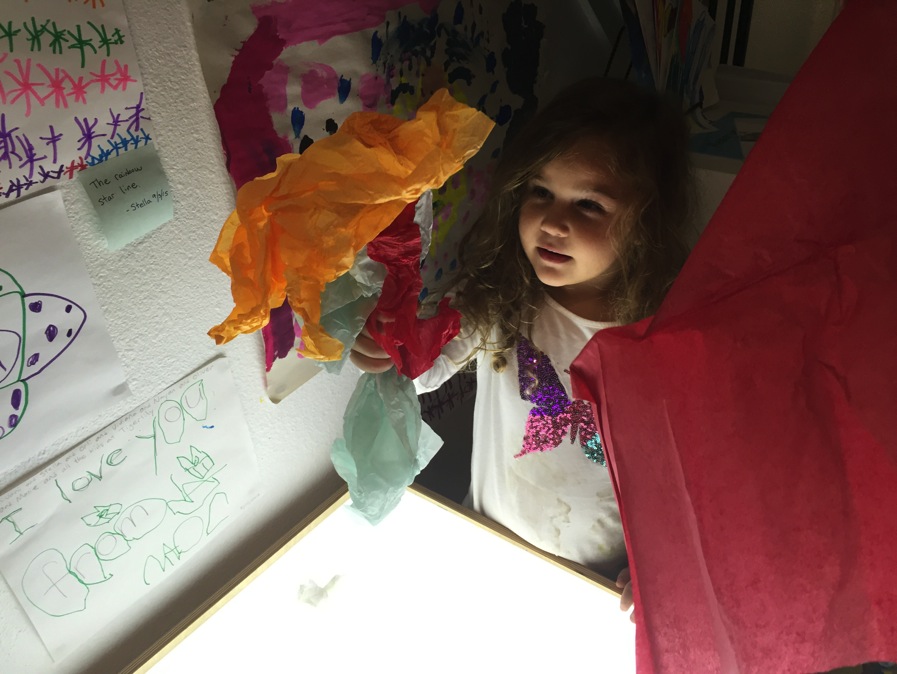
We’re continuing to take our time with paper and exploring collage making. I had put out a bin of tissue paper, hoping to encourage more discovery of what kids can do with tissue paper after one child noticed that the thin paper could be squeezed, rolled, and shaped much like our clay. Today kids could keep exploring tissue paper on top of the light table. We can crumple, fold, roll, and tear the paper so far. Viviana combined several pieces and announced she’d made a flower, see?
10/21/15
 

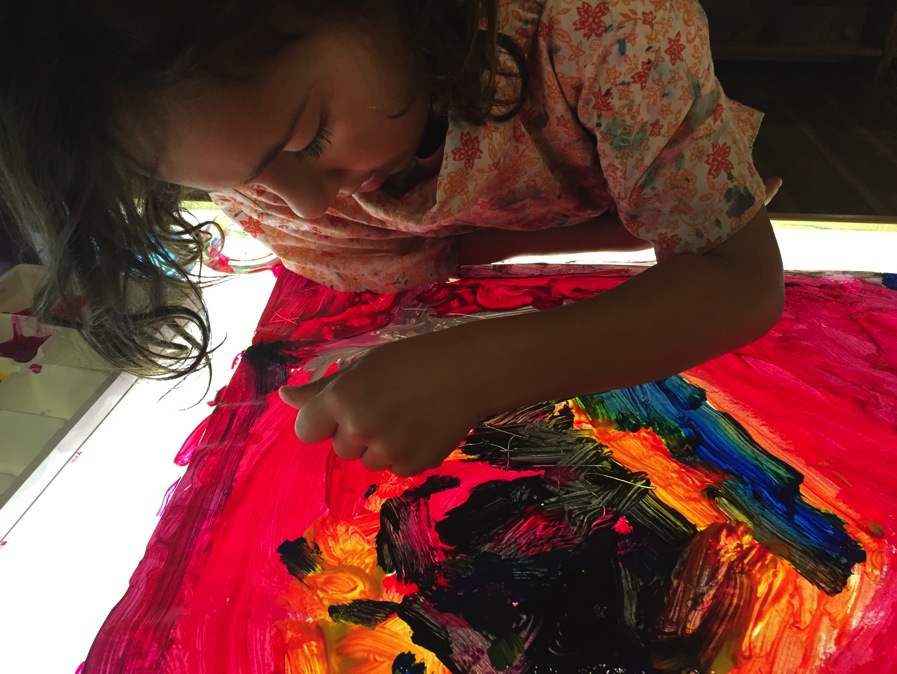
Stella (carefully covering every bit of the paper with paint, then using a toothpick to inscribe her name): I made the whole world.
10/26/15
 

Viviana (working with wire after her baby brother’s birth): Come look at the baby I made.
11/5/15
 

Marie Catrett