Looking back, looking ahead

Today is the first anniversary of Alt Ed Austin’s official launch, and with a memorable date like 12/12/12, it’s an auspicious start to another promising year of support for authentic education in all its forms. It’s also a good time to pause and reflect on what this growing community (both online and off-) has accomplished over the course of the past year, acknowledge our partners who’ve made it all possible, and look ahead to what’s in the works for our second year.

When I created this website and blog last fall, I had modest hopes that it would help connect the handful of small independent schools I happened to know about with local parents who were searching for different kinds of learning communities for their kids who, for a variety of reasons, were not thriving in public, charter, or traditional private schools. Since then, I’ve discovered that there are many more of these unusual schools and innovative educators in the Austin area—and many more parents looking for them—than I’d imagined. When it launched, the Alternative School Directory comprised eight programs serving K–12 students; it currently lists twenty-one. The Map of Alternative Schools now stretches from Leander and Round Rock in the north to Oak Hill and Dripping Springs in the south. Likewise, Alt Ed Austin’s readership has steadily increased, with more than ten thousand unique visitors and a growing and active Facebook community. Likewise, the Calendar has become a busy place, with open houses, information sessions, and workshops posted every month.

Almost immediately upon launch, I began receiving requests to add a directory of preschools that could be described as “alternative” in approach. That page has proven to be one of the most visited on the site. Soon I began hearing from both educators and parents who were looking for a way to get the word out about camps, after-school programs, and other, less easily classified educational programs; in response, I created the More Alt Ed Programs list, which is our most frequently updated page. Watch for the return of our popular directories of off-the-beaten-path summer camps in early 2013.

The most exciting and enjoyable aspect of managing Alt Ed Austin has been working with and providing a forum for the many brilliant educators who’ve contributed guest posts for the blog. They’ve generously shared their experiences, insights, struggles, and triumphs large and small. In twenty-one posts to date, they’ve written about both theory and practice in ways that are relevant and accessible to parents, education professionals, and anyone with an interest in alternative approaches to education. I’d like to thank all of them for not only helping provide a steady supply of excellent content for this blog but also adding their clear voices to the important ongoing community conversations about what education can be. I invite you to add your own voice by commenting on any blog post that interests, troubles, or inspires you.

I’m particularly pleased to report that these conversations are not limited to the blogosphere. Over the course of this year, I’ve become aware of and had the privilege of participating in a movement that has great potential for positive social change. Independent educators are coming together, exchanging ideas and best practices, collaborating and supporting one another, joining with esteemed colleagues working within the public school systems, creating ways to make these alternative models of learning accessible to all children, and changing the educational landscape in ways that I believe will ultimately benefit everyone. You can expect to hear a lot more about the Education Transformation Alliance in the coming year.

You’ll also hear about more public events like the independent school tours and fairs that Alt Ed Austin sponsored this year. In addition, we’re planning some brand-new ventures, including film screenings, panel discussions, and workshops on topics of concern to parents and educators. Stay tuned for details about the first of these, which will deal with a very timely subject: talking to kids about climate change. What other topics or types of events would you like to see Alt Ed Austin delve into? Please speak your mind! The comments section below is all yours.

Creating, maintaining, and promoting Alt Ed Austin truly has been a labor of love, but I haven’t done it alone. Many thanks go to my family, who have been unwaveringly enthusiastic about the project, even when it has meant long hours at the computer or away at meetings. I am also deeply grateful to those who stepped forward recently when I opened the sidebar for sponsorship to help offset the costs and time required to maintain the site: AHB Community School, Austin Creative Art Center, Edible Austin, Joyful Garden, Kairos Learning, Progress School, and Soleil School. Most of all, right from the beginning, it’s been the audience making this thing work. Without all of you reader-collaborators participating, supporting, and spreading the word, Alt Ed Austin could not have become the useful resource and thriving community it is today. Thank you!

I look forward to working together in the coming year to support diverse, wonderful ways of learning in Austin and beyond.

Teri
Teachers are like gardeners

Sir Ken Robinson is a hero to many of us in the alternative education community. His talk at the 2006 TED conference on how the standard school system undermines creativity has been viewed more than 8 million times, more than any other video on the popular TED site. His funny and inspiring 2010 follow-up TED talk, calling for a revolution to replace the industrial model of education with an agricultural one, has been emailed and shared on Facebook countless times and shows up on lists of recommended links nearly everywhere I look as I research child-centered schooling. It's hard not to love this guy.

I recently came across a brief video clip of a Sir Ken presentation in Florida that was new to me. In it he makes an analogy that builds upon his proposed agricultural paradigm: teachers as gardeners. It struck me as wonderful and apt not just because I'm a gardener myself (as are many of the teachers and students at schools featured on this site) but also because it shows so much respect for the inherent life in our children. Take a look and listen for a couple of minutes:

Another thing I like about this analogy is that it supports my own strong belief that there are many “correct” ways to educate children (or to pave the way for children to educate themselves). Just as gardeners can get superb, fully realized tomatoes through various methods (staked or unstaked, in containers or double-dug square-foot plots or raised beds—even hanging upside-down), you can see superb, fully realized human beings emerging from schools that employ various methods and models, so long as they nurture the distinct creative life of each child.

If you want to meet some terrific gardeners—both literal and metaphorical—visit the independent schools profiled in the Alt Ed Austin School Directory. You just might find a place where your kid will put down roots, blossom, and flourish.

Expert kids

What happens when you allow kids to follow their own passions at school, to delve deeply into matters that truly fascinate them? They become experts, in the best sense of the word. And they love to share their expertise.


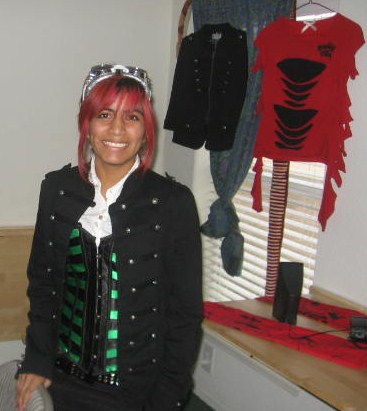
Punk fashion comes alive through independent study

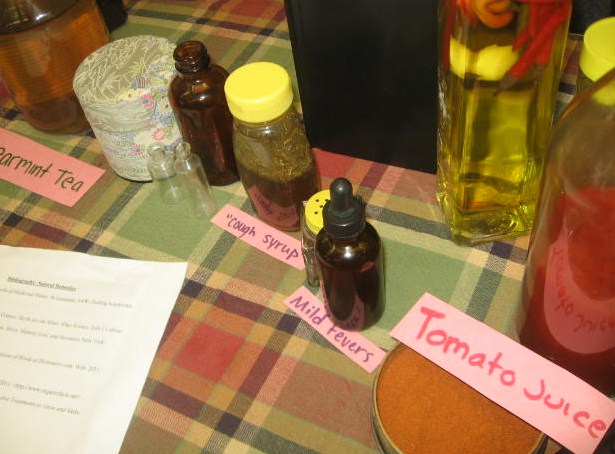
I met a bunch of young experts at the Inside Outside School’s Expo Day last month. Their areas of expertise were richly varied, ranging from the physics of electricity to the diversity of aquatic mammals, from the history of the Texas Rangers to the development of punk fashion, from the culture of Jordan to the uses of herbal remedies. The media they used to present their discoveries were equally varied, including music, a diorama, a Q&A session, a PowerPoint presentation, written reports, edible offerings, a map, a blog, and an original art portfolio.

Each student had been encouraged to choose a subject for independent study and had spent much of the semester immersed in it. I do not mean “choose” as it is euphemistically used in so many classrooms to mean, for example, “Pick a country in Europe and write a report about it.” I mean that at the beginning of the semester teacher/directors Deborah Hale and Kathy Cauley spent a great deal of time with individual students exploring their interests, ideas, dreams, talents, and goals, with their ears tuned to the limitless possibilities; then they helped them find a focus on what they were most excited to learn and how they wanted to go about doing it.

Throughout the semester Kathy and Deborah frequently checked in with students about their independent projects, offering guidance, support, provocative questions, and resource suggestions as needed. Students found ways to help each other get “unstuck” or re-inspired. Some found they needed a new angle after a few weeks of research. Some decided to do two or more projects rather than one. Others struggled to decide the best way(s) for presenting their discoveries, despite the school’s overall emphasis on process over product. In the end, they all seemed, to me and to other Expo Day visitors I interviewed, to be confident in their knowledge, eager to share it, and hungry for more.


Herbal remedies studied and shared at the IOS Expo Day

The Expo brought back memories of my fifth grade CLUE class, by far the best educational experience of my kindergarten through high school years. CLUE (short for Creative Learning in a Unique Environment) was an innovative program in the Memphis public schools that emphasized critical thinking skills, creativity, collaborative problem solving, interdisciplinary study, and independent projects. There, for a few hours each week, we escaped the confines of our regular classroom desks and were set free to pursue things we cared about. One CLUE kid I know spent most of her school year writing and illustrating a novel; another became uber-skilled in origami; another plotted the course of a certain star. For my independent project I chose to study the creation of the Panama Canal (it had captured my imagination the previous summer during a family trip to visit relatives in Panama). To this day, I feel a strong connection to this subject and remember it in more detail than anything I ever studied for a test—because it was mine.

A quick online search tells me that the CLUE program is still going strong in Memphis, although, naturally, it has evolved. Unfortunately, it is still restricted to a small percentage of the public school system’s students. I’ve always thought that kind of learning experience should be available to every child, everywhere. It is heartening to know that kids at the Inside Outside School (as well as some other alternative schools in the Austin area) get the encouragement, resources, and time to cultivate their curiosity, practice their passions, and share their expertise.

Small is beautiful

There is no right school size for everyone. Some children thrive in large groups with many diverse social opportunities such as those found in most public schools and typical private schools. But many children (and adults, for that matter) feel overwhelmed by crowds and find that they don’t function at their best when surrounded by too many people. They blossom in small groups and when nurtured with individual mentoring. That’s one reason Alt Ed Austin’s Alternative School Directory is focused on small programs. (You can find somewhat larger progressive schools in our carefully curated Other Recommended Schools directory.)

My son’s school during his upper elementary and early middle school years was what some in the education world refer to as a “microschool” and others like to call “small but mighty.”  It had about a dozen students and one main teacher (though students also learned from parent volunteers, neighbors, and guest speakers, as well as from artists, artisans, and other community experts the students visited in their workplaces). Now a teenager, my son is one of about 60 students enrolled in high school and middle school classes at another innovative school in Austin. These are just two of many intentionally small schools featured on this site, and the demand for this kind of intimate learning environment is growing. To be sure, some of the smallest schools in the directory are simply new; they plan to grow in student enrollment, staff size, and facilities—but not to exceed the size of a well-functioning community.

What is the upper limit of such a community? That’s a matter of opinion, and education researchers continue to debate the issue and to study the effects of “small learning communities” or “schools within schools” established in the last two decades in Boston, New York, and other large cities—even right here as part of AISD’s High School Redesign. The main idea behind the Human Scale Education Movement is that smaller classes and school communities lead to closer relationships between teachers and students and among fellow students, which in turn lead to higher levels of academic engagement, fewer dropouts, better test scores, higher rates of college admissions, etc. These programs generally try to cap learning communities at around 300 (so, for example, an urban high school of 1,200 students might encompass 4 separate or semiseparate learning communities that stick together with the same teachers and advisers for several years).

These smaller learning communities within large urban public schools are a good step in the right direction, but 300 is still too many for some kids, perhaps most. For my purposes at Alt Ed Austin, I’ve chosen to embrace Dunbar’s Number, a theoretical cognitive limit to the number of people with whom a human being can maintain stable relationships, which works out to approximately 150. First proposed by the British anthropologist Robin Dunbar and popularized by Malcolm Gladwell in The Tipping Point, Dunbar’s Number has come to be seen as a useful guideline in organizing groups in business, industry, law enforcement, some European government agencies, and even online social networks. Why not education?

Here’s a brief video primer on Dunbar’s Number, by Robin Dunbar himself:

Complete video at: http://fora.tv/2010/02/18/Robin_Dunbar_How_Many_Friends_Does_One_Person_Need Evolutionary anthropologist Robin Dunbar expands on "Dunbar's number," his theory that the maximum number of stable relationships a person can maintain is approximately 150. Time to delete a few hundred Facebook friends?

What’s your upper size limit for a school or other created community? Do you have a lower limit? Does it depend on the age of the students or other factors? Does size matter?

[2018 update: My son, mentioned above, is now in college, studying at a terrific small liberal arts college.]

Teri

What would Wendell say?

I recently had the pleasure of attending “An Evening with Wendell Berry and Wes Jackson,” one of the highlights of Edible Austin’s Eat Drink Local Week. It was a fascinating, wide-ranging dialogue between two of the world’s most interesting and important thinkers about food, agriculture, sustainability, and—yes, indeed— education.

Berry’s remarks that evening led me to revisit some of his writings (which are many and varied, including poetry, essays, and fiction) as well as his always enlightening interviews. In one such interview, published back in 1993 by Jordan Fisher-Smith, he articulated what for me are the most valuable characteristics of the schools here at Alt Ed Austin:

My approach to education would be like my approach to everything else. I’d change the standard. I would make the standard that of community health rather than the career of the student. You see, if you make the standard the health of the community, that would change everything. Once you begin to ask . . . what’s the best thing that we can do here for our community, you can’t rule out any kind of knowledge. You need to know everything you possibly can know. So, . . .  all the departmental walls fall down, because you can no longer feel that it’s safe not to know something. And then you begin to see that these supposedly discrete and separate disciplines, these “specializations,” aren’t separate at all, but are connected. And of course our mistakes, over and over again, show us what the connections are, or show us that connections exist.

The people I’ve met and observed at these little schools share a deep sense of community and an understanding that real education is about seeing and making connections. I believe Wendell would approve.
 

Big words


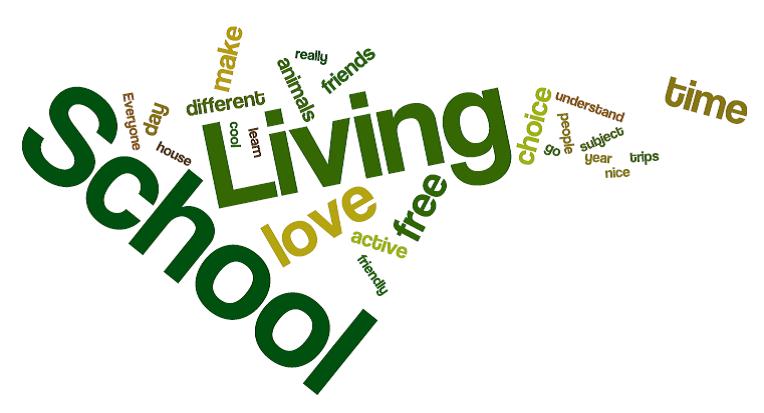
Paula Estes has a tradition of surprising her students at the annual Living School holiday potluck with gifts they’ve designed themselves without knowing it. This year was no exception.

Last week she invited the kids to write a few sentences on what they like about their school, leading them to believe it was for some other purpose. Then she stealthily loaded their responses into the “word cloud” generator at Wordle (where words that appear more frequently in the source text are given more prominence), and voilà! The new school t-shirt design was born. The shirts were a hit at the holiday party, and families report that they were inspired to try some interesting things with Wordle at home.

I am struck by the amount of love in this cloud (and this school community). Which words would rise to prominence in a word cloud about your school?