Texas should tell parents about course choice.

Guest contributor Heather Staker, a senior research fellow at the Clayton Christensen Institute, a nonprofit, nonpartisan think tank that works to transform education through disruptive innovation, writes frequently on blended learning and other education topics. This post is adapted from one that previously appeared on the institute’s blog. Three of Heather’s children attend Acton Academy, an independent school in Austin that regularly makes use of online learning resources.

The author with students at Acton Academy

The author with students at Acton Academy

Do you know what the TxVSN is? If not, you’re not alone. I asked 25 neighbors in Austin with children in grades K–12 what the acronym stands for, and not even one person knew. That’s unfortunate because last year the Texas legislature passed HB1926, which requires districts to pay for high school students to take up to three year-long online courses per school year through the TxVSN—the Texas Virtual School Network.

Despite that opportunity, 24 out of the 25 parents in my informal survey said they were not aware that tax dollars will pay for students to take online courses. When I asked how well schools communicate online course options to parents, 88 percent of the parents said “not at all” or “poorly.”

This suggests that thousands of students who need an alternative to a face-to-face course are likely to miss out simply because of lack of communication. Do students in Amarillo know that they can take online Chinese? Do busy athletes in Dallas and San Antonio know that they can take online world history, sociology, and psychology if those courses don’t fit in their normal schedules? What about students who want a course about information technology—do they know that the TxVSN offers an option for those whose districts have none?

The fine print of HB1926 says that school districts must provide parents with a written notification of TxVSN policies every year. But districts are likely to downplay that requirement; after all, they have little incentive to pay for students to pursue anything outside their geographic boundaries. Although I am sympathetic to the challenge of breaking down time-honored boundaries and staffing structures, limiting Texas students to the learning opportunities within their local vicinities no longer makes sense when countless lessons and resources are now available online and worldwide. Districts will need some pressure from parents and the state to do a really good job of publicizing options to students, but with some respectful encouragement, I’m confident they will choose to give their students every possible opportunity rather than keep them in the dark.

The legislature has acted to extend course choice to students. Let’s leverage that opportunity.

That’s my cheerleading for HB1926. Now for my criticism. Although HB1926 broadens course choice, Texas is nowhere near where it should be in terms of bringing digital opportunities to our children. For one thing, the TxVSN is pretty weak. Check out the site—it ought to look like the Amazon.com of learning opportunities, all listed in one clean, simple, user interface. Instead it’s a clutter of bureaucratic paragraphs and government FAQs. Dig a little deeper, and the range of courses is limited and uninspiring. I hope that the Texas Education Agency (TEA) will take a clue from Silicon Valley about how to build a consumer-facing portal. As Steve Jobs said, “Simple can be harder than complex: You have to work hard to get your thinking clean and make it simple.”

One essential feature of the site should be information about which courses are any good. Do students find them engaging? Do they learn anything? Was it even worth it? Let’s have some transparency, openness, and student input about what this site is peddling.

Furthermore, I don’t see why state portals such as the TxVSN are even limited by state. Shouldn’t a Texas student be able to take a great Florida Virtual School or Michigan Virtual School course? In fact, Texas should grant credit to students who can ace the state’s end-of-course exams even if they learned the content from an outside site such as Khan Academy or the edX platform created by Harvard and MIT. Our interest is in helping Texas students reach mastery, not in overly controlling or limiting the pathway to get there.

These are primarily TEA issues. But the legislature has some work to do, too, to fix HB1926 next session. The law has all kinds of loopholes to limit course choice. Districts can deny choice, for example, if they think they offer a “substantially similar course.” The state won’t pay for more than three a year. And the maximum price for a TxVSN course is capped at $400, which means that the state bars students from certain premium courses purely because it set an arbitrary fixed price. Better to let the state commissioner of education negotiate prices.

Online learning is a classic disruptive innovation that’s changing the way the world learns. It’s shocking to me that so many shun the one innovation that arguably has more potential to broaden education access than any other since the dawn of the printing press. Texas should stop trying to limit and duck, but instead lead the way nationally in channeling online learning to its highest quality and broadest potential.

Let’s make learning options for our children as big and bold as Texas is. Our state has always been a leader, and it’s a shame to be laggards in bringing next-generation learning formats to our youth.

Heather Staker
Resolve to find the right fit for your kid.

January is my favorite month. When the new year arrives, it brings a sense of possibility that I find utterly exhilarating. I love making resolutions, both personal and professional, and sometimes I even manage to keep them. That January buzz is in the air here at Alt Ed Austin right now as more and more parents resolve to find the right fit for their kids—and take the necessary steps to do it.

As enrollment deadlines for the next school year approach, our community calendar is filling up with school tours, visiting days, and information sessions. Likewise, my private consultation appointments are filling quickly, so I've resolved to expand my office hours this month to accommodate parents who are available only on evenings or weekends. Just contact me with your scheduling needs, and I’ll do my best to find a time to meet with you for an in-depth discussion of your unique child’s best schooling options.

We’re also offering a small-group workshop on January 19 for parents who are looking for general information about choosing schools. We’ll address different types of educational approaches, things to look for and ask when you visit schools, and common fears about taking your kid off the beaten parth. In addition, we’ll do some exercises to help clarify your own educational attitudes, values, and priorities, with ample time for Q&A. If you attend the workshop and then decide that you’d like to talk with me privately and in more detail about your child’s individual needs, you’ll get $20 off the regular consultation rate.

And don’t forget that we have all kinds of free information available right here on the website. Take some time to explore the directories of alternative schools, preschools, specialty schools, and other alt ed programs. (We’ll also be updating our summer camp directory for 2014 soon.) You can hear directly from wonderful local educators about their own approaches and techniques in the many guest posts that have appeared here on the blog over the past two years.

Make sure you get the latest alt ed news, commentary, inspiration, and special offers by signing up for our monthly newsletter. For more frequent updates, please follow us on Facebook or Twitter. Got a question, comment, complaint, or idea? Our suggeston box is always open.

Happy New Year, everyone!

Teri

Something beautiful: A solstice story

To celebrate the winter solstice, Marie Catrett has generously shared with Alt Ed Austin’s readers the gift of this moving story, adapted from a letter she sent yesterday to the parents of her students at Tigerlily Preschool. (It turns out to be a story within a story within a letter within a blog post!) Enjoy—and may your long winter nights be filled with light.


December 20, 2013

I’m still moving through all the layers of the story I’m sharing here today. It touches many different parts of me and my work here. You might already know that Reggio thinking, which I admire so much, began with a school started in Italy built literally from the rubble of World War II. Such a respectful, empowered view of learning arose from terrible circumstances. Of the many stories I'm learning in my own teaching journey, you could say Reggio thinking hooked me from the start as I'm a sucker for a good phoenix tale. . . .

Word had it that at Villa Cella, the people had gotten together to put up a school for the young children; they had pulled out the bricks from the bombed-out houses and had used them to build the walls of the school. Only a few days has passed since the Liberation and everything was still violently topsy-turvy . . .
     I felt hesitant, frightened. My logical capabilities, those of a young elementary school teacher overwhelmed by the events, led me to conclude that, if it were true (and how I hoped it were!), more than anomalous or improbable, it was out of this world . . . maybe someone from Cella would show up. No one did.
     That is why I got on my bicycle and rode out to Villa Cella. I got confirmation from a farmer just outside the village; he pointed out the place, a long way ahead. There were two piles of sand and bricks, a wheelbarrow full of hammers, shovels and hoes. Behind a curtain made of rugs to shield them from the sun, two women were hammering the old mortar off the bricks.
     The news was true, and the truth was there, for all to see on this sunny spring day, in the uneven but stubborn hammering of these two women. One of them looked up at me and waited; I was a stranger, someone from the city, maybe they could tell from the part in my hair or my low-cut brown shoes. “We’re not crazy! If you really want to see, come on Saturday or Sunday, when we’re all here. Al fom da boun l’asilo (we’re really going to make this school)!” . . .
     I had the honor of experiencing the rest of the story . . . and it remained an uninterrupted lesson given by men and women whose ideas were still intact, who had understood long before I had that history can be changed, and is changed by taking possession if it, starting with the destiny of the children.

. . . a new educational experience can emerge from the least expected circumstances . . .

—excerpts from “History, Ideas, and Basic Principles:
An Interview with Loris Malaguzzi,” in
The Hundred Languages of Children: The Reggio Emilia Experience in Transformation


Willa: (Upon arriving, handing me a small gift to unwrap; she and I are holding something wrapped in tissue) Look, can you see a little bit of golden peeking out?

Marie: I can, I can. (We unwrap further.)

Willa: It makes me think of a bird. (Gesturing to the folded paper that is with it) Read the words that tell you about it!

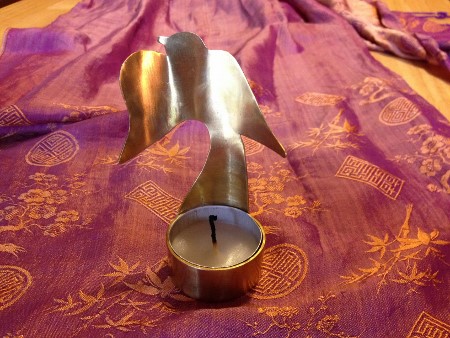
I read the paper to myself.  Here is some of what the paper says: “This candleholder spreads peaceful light from the remains of a brass bomb shell. Handcrafted by artisans of Cambodia’s Rajana Association. . . . ‘When we make jewelry [like this] then we know our country has peace,’ said one young silversmith.”

Willa gives me a hug and skips off to play. I watch the children, holding the candlestick for a while, until I call the children in for circle.


Marie: I want to tell a story that takes place in a far-away place called Cambodia. The people there were a having a big terrible problem where some people thought one thing and some people thought something else. And the people didn’t do talking about it. They got mad, mad, mad, mad and had a war.

Daphne: What’s a war?

Willa: It’s when you get so angry you’re like (waving arms like sword play) and set off bombs.

Marie: Big big fighting, mmmhmm.

Emerson: Yeah, and sometimes wars have those truck things that shoot out bullets. And bombs, they explode.

Willa: [In Cambodia] there were some bombs that didn’t explode, right?

Nayan: And there’s some places far away that didn’t have problems.

Kids name some far-away places.


Marie: This story is about the place called Cambodia.

Nayan: And there was bullet world.

Marie: The people there were having the terrible problems with each other. But then the people thought it was too much fighting and wanted it to stop. The people that thought one thing and the people that thought a different thing started talking to each other. And about how to fix the problems. Like how kids say, “I’ll be nice to you if you’ll be nice to me.” Finally the people did that. They said, “I’ll be nice to you if you’ll be nice to me,” and it stopped the fighting. But, because of all the fighting they’d had, there were still some bombs where they lived. So some people had the job to go find the bombs and put them away so they couldn’t hurt anybody.

Emerson: Spray them with water to try to kill the fire in them!

Marie: Yeah, they have ways to make them not dangerous anymore and had workers to do it. And, the people also wanted to make stuff. So when they had made the pieces of the bomb not dangerous anymore people thought and they thought and they thought. And they thought: hmmm, we had these big problems . . . and now things are better . . .

Emerson: (Really excited) And! And I know! How ’bout they make something out of those bombs?! And fill them up with water so it’s safe!

Willa: Yeah! And the water can just squirt out if there is a fire, (with a button like) push push push!

Marie: They did just exactly that, they did decide to make something good out of the stuff that had been the bombs.

Willa: They made a candle holder! They made something beautiful. This is something that my mother got for Marie that’s really really delicate.

Daphne: Is it her Christmas present?

Willa: It is her Christmas present! I wrapped it.

Emerson: It was in a box, right?

Willa: Yeah, and I wrapped it with blue paper, and I used a yellow ribbon for her.

Marie: We can pass the candle holder around before we light it ’cause I would like to share it with everybody.

Kids pass the candle holder around the circle, quiet and focused.


Marie: Everyone take one little scoouch back so we can light it, all see it, and be safe about the candle flame. (Getting ready to light the candle) Oh, I’m feeling so many feelings! That this candle used to be a bomb for hurting. And then people started talking, and made things better. And then people decided to make something beautiful out of it.

Nayan: Should you light it now?

Willa: It might do burning?

Marie: Well, it can’t do any more hurting now, it’s a candle holder, now that the people have made it into something wonderful.

Willa: It might burn up the metal?

Daphne: Or it might go all over the house?

Marie: Now it can’t be anything but a beautiful candle for looking at. I’m sure it’s completely safe. (Being careful like we are about candles when we light one together, I would add, though in the conversation I am certain the kids are needing to know that the candle can’t be a bomb anymore). This candle has been on a very big journey. It was a bomb, it used to be able to do hurting, but then the hurting stopped and people made it into a new thing, a wonderful thing. And then a mama saw it and thought it would be a good present. To be a beautiful candle to be special at our school. And a kid put it in a pretty striped box and wrapped it up in blue paper and tied it with a yellow string and gave it to me. And I opened it up and learned the candle’s story, and now I’m telling the story of the candle to you children.

Emerson: I wish I had it.

Marie: We’ll enjoy it, all of us together, and that’s the best part now of this candle story. It’s a pretty wonderful thing.

I light the candle and we’re singing together:

This little light of mine, I’m gonna let it shine
I’m gonna let it shine
This little light of mine, I’m gonna let it shine
Let it shine, let it shine, let it shine

Won’t let anyone (whsssh!) it out, I’m gonna let it shine . . .
Hide it under a bushel? No! I’m gonna let it shine . . .
Take this light around the world, I’m gonna let it shine . . .


We sing “This Little Light of Mine” with one finger for a candle, the other hand spread behind it, “to shine the light.”

The Something Beautiful candle
Marie Catrett
 

Anniversary Week Giveaways: We have winners!

Many thanks to everyone who entered our two-year anniversary giveaways this week and helped spread the word. We've notified all our winning entrants by email. Great big heaps o’ gratitude to the wonderful businesses and organizations who made it possible by contributing all the items we're giving away.

The entry process and randomized drawing went ever so smoothly thanks to the free app known as Rafflecopter. And the winners are . . .

Friendly Chemistry curriculum:
Kristi C.
STEAM3 Interactive Playground passes:

Stacey L. and Andee K.
Toybrary Austin 6-visit Stay & Play punch card:

May T.
Austin Tinkering School set of 3 Tinkering Challenge Boxes:

Monica P.
Smudge Studios art workshop gift certificate:

Jan B.
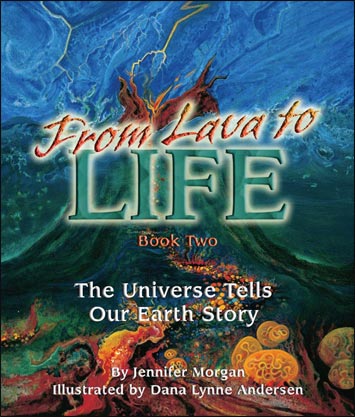
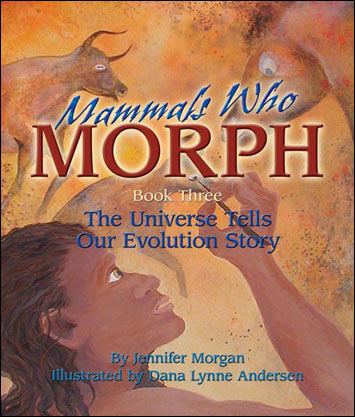
The Universe Trilogy children’s science books:

Jody H.

For those of you whose names were not drawn, here are two virtual hugs of consolation:

  • If you register for STEAM3 by Dec. 31 using the special code ALTEDATX, you’ll receive an extra $10 off the special earlybird price on the complete conference, interactive playground, and VIP party.
  • All entrants in the Friendly Chemistry giveaway are eligible for a 25% discount off the purchase of a student textbook. Just email Joey & Lisa at friendlychemistryinfo@gmail.com, tell them you came from Alt Ed Austin’s giveaway, and you’ll get a special code to use at checkout.

I look forward to sharing many more alternative learning resources and opportunities with you in the coming year!

Teri

Giveaway: The Universe Trilogy

Since I discovered them ten years ago, I’ve been seizing every opportunity to share my love for the three beautiful children’s books in The Universe Trilogy. What better excuse than Alt Ed Austin’s 2nd Anniversary Giveaway Week?


In this charming book, the “Universe” is your home, your host, and your storyteller. If it could talk, it would say exactly what Jennifer has scripted for it.
—Dr. Neil deGrasse Tyson, director, Hayden Planetarium, American Museum of Natural History


These books, all written by Jennifer Morgan, do an excellent job of explaining complex scientific concepts in ways that children can easily grasp without dumbing them down. Just as importantly, they do it in ways that inspire awe in readers of all ages. The books are narrated in first person—by the universe itself—and addressed directly to the reader. It’s an unusual strategy, and it works.


The story of life is, quite simply, the greatest story ever told . . . and here is the perfect first telling. —Bill McKibben, author, The End of Nature, the first-ever book about global warming; president and cofounder, 350.org


The illustrations, painted by Dana Lynne Anderson, are gorgeous and expansive. The Big Bang Theory, the formation of stars and planets, the origins and early development of life, and the evolution of humans will make lasting impressions on young readers’ minds in part because the facts are accompanied by such unforgettable images.


Mammals Who Morph . . . will engage and enchant, as well as educate. . . . It is a must for every school library—and I shall give it to my grandchildren and my sister’s grandchildren and my godchildren . . .
—Dr. Jane Goodall, founder, Jane Goodall Institute;
UN Messenger of Peace


If you are lucky enough to win this trilogy in our drawing, I predict that, like Jane Goodall, you’ll eventually want to get more to give away. If so (or, perish the thought, you don’t win), you can buy them directly from Dawn Publications, one of the best publishers of quality books on science and nature for families. In the meantime, be sure to get your entries in by midnight on Thursday, December 12! I’ll announce the winners of all of the week’s giveaways on Friday.


a Rafflecopter giveaway

Giveaway: Smudge Studios gift certificate

It’s Day 5 of our week of giveaways in honor of Alt Ed Austin’s second anniversary, and those notorious instigators of creativity over at Smudge Studios are helping us celebrate! They’ve offered up a $45 workshop gift certificate to one of our readers. They have lots of awesome art workshops for kids and adults to choose from, including some with winter holiday themes coming right up.

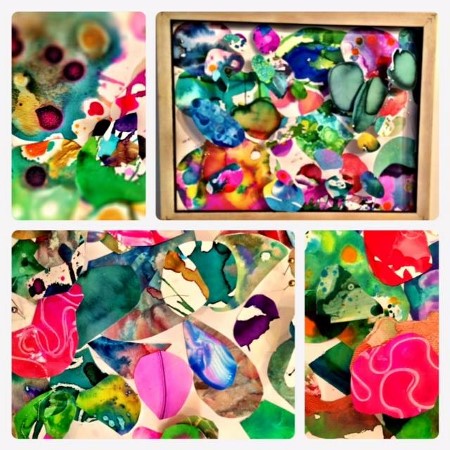
Smudge Studios after-school and homeschool students’ recent work with watercolors, salt, glue, wax, alcohol, and pushpins

Smudge founders Heather and Jaclyn both come from teaching backgrounds with an emphasis in art. They firmly believe that “everyone has a creative soul waiting to be unleashed”—and they are experts at that tricky unleashing part. In addition to workshops, they offer after-school and homeschool classes, weekend workshops, camps, adult studio time, parties, and other events for all ages.

Don’t miss the Smudge Studios Holiday Bazaar on Saturday, December 14, featuring handmade gifts from local artists. And if you need to get the kids out of the house on December 23 for some creative hands-on fun, sign them up for the Smudge Studios half-day winter camp for ages 4–13.

Back to the giveaway: You can enter the randomized drawing in various ways below. Be sure to do so by midnight on Thursday, December 12; we’ll announce the winners of all of the week’s special giveaways on Friday. Good luck!


a Rafflecopter giveaway